Software
Houzz Logo Print
sooz_gw123

What is this? Will it fall over?

7 years ago
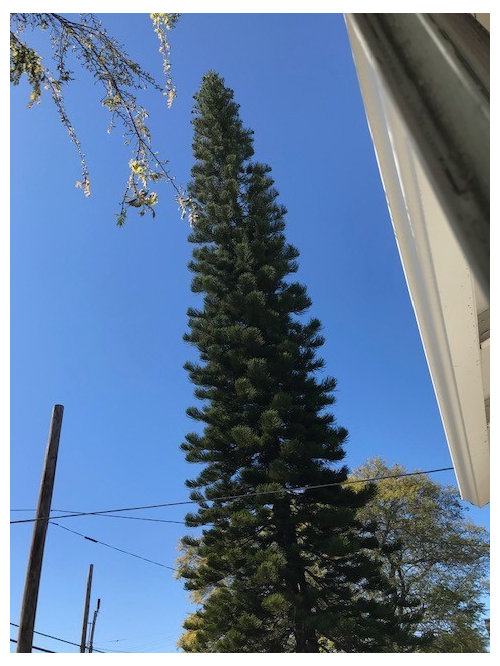
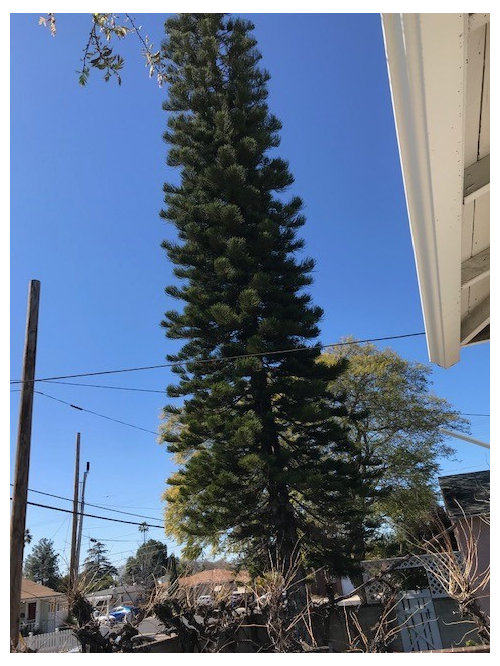
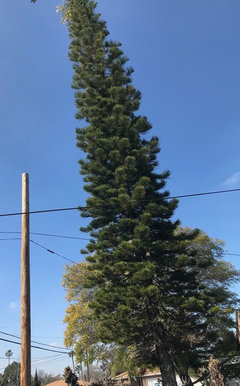
This very tall, pillar-like tree is next door. It's so tall that I couldn't fit it into one photo, but you can see in the bottom right corner of the second photo, a part of a capstone on the 5 ft tall cinder block wall.

The tree is leaning more and more, and getting taller, and every time we get a big wind storm, I wonder if it will topple over. Every time we get a lot of rain, I wonder if it will topple over. That's a jacaranda pictured behind it.

Unfortunately, this tall tree is leaning my way! I've spoken with the elderly owner and she's not interested in doing anything. It's leaning far more than the photos indicate.

What kind of a tree is it? Does it have a tendency to break and/or fall over??

Thanks!


Comments (17)

  • 7 years ago
    last modified: 7 years ago

    It looks like a Cook Pine (Araucaria columnaris).

    Hard to get a real idea of the lean (it looks like your photo might have unintentionally exaggerated it). Regardless, Cook Pine is known to lean towards the equator and is a identifying characteristic. So in the vast majority of cases, an leaning Cook Pine is natural and not prone to falling over.

    Leaning Cook Pine

    Sooz thanked Smivies (Ontario - 5b)
  • 7 years ago

    If (when) it falls, it looks like it’s going to take out some electric wires. I wonder if the utility company is keeping an eye on it?

    Sooz thanked littlebug zone 5 Missouri
  • 7 years ago

    You should back off quite a bit away, then take another pic w/your camera perfectly level to give us a better idea how much it's really leaning.

    Sooz thanked bengz6westmd
  • 7 years ago
    last modified: 7 years ago

    Hard to tell from your picture and if that's your house with the rain gutter to the upper right, it looks like if the tree would fall, it would be more towards the telephone pole to the left.

    It would be a good idea to get an ISA arborist over there, in person, to give you an idea of what you are dealing with.

    I've dropped thousands of trees in my day but when it mattered, I would view it from several different angles, judge the wind direction and strength and even then might put ropes on it or take it down in pieces.

    One or two pictures won't give people here what's needed to give you an accurate idea of what you are concerned about.

    Sooz thanked User
  • 7 years ago

    Agree 100% with Smivies' ID and assessment. It is the nature of this tree to lean and it is not about to fall any time soon, if ever!! In their natural habitat, these stand up to tropical typhoons much more powerful than anything one would experience in SoCal! And based on the height, it has been in place for decades as well.

    Although the lean or tilt can be disturbing visually, the tree itself poses NO threat.

    Sooz thanked gardengal48 (PNW Z8/9)
  • 7 years ago
    last modified: 7 years ago

    There may be more to it than what species of tree it is. And I can't tell from the picture but it looks like there may be a surrounding cinder block wall, even possibly a cement foundation that may be limiting the lateral direction and length of the roots. Causing the tree to have less than ideal anchoring at the root level. I can't understand how you people can be so smug as to think you can assure this person because you look at one incomplete picture!

    Again, a personal inspection by a qualified arborist is necessary to give an accurate assessment on this tree.

    Sooz thanked User
  • 7 years ago

    If it had less than ideal ancorage, it would not be 40-50 years old or 60'+ tall!! btw, these are very commonly planted in SoCal and they ALL look like this.

    Sooz thanked gardengal48 (PNW Z8/9)
  • 7 years ago

    " If it had less than ideal ancorage, it would not be 40-50 years old or 60'+ tall!! "

    maybe, maybe not.

    And the fact that they all tend to lean isn't saying anything about this particular tree.


    But it was just my suggestion, what do I know? :^)

    Sooz thanked User
  • 7 years ago
    last modified: 7 years ago

    Stand of Cook pines at the UC campus in Irvine, CA.

    btw, the farther the distance from the equator, the more pronounced the lean or tilt. SoCal is about as far away as one can get and still be within the tree's hardiness range.

    Sooz thanked gardengal48 (PNW Z8/9)
  • 7 years ago
    last modified: 7 years ago

    Thank you everyone for your help! A friend thought it was maybe an Atlas Pine as it doesn't have quite the lead of a Cook Pine (thanks for the links).

    Littlebug, the utility company only cares if branches are actually crossing or on top of the electrical wires & then they notify the homeowner.

    Bill, the cinder block wall is from the very late 1940s and the tree is outside of the wall--the tree was planted a little bit west of the wall in the neighbor's corner yard...and BTW, I didn't take anyone's post as being smug.

    Benz, I took another picture, with the pole in it for reference as to the lean of the tree (I may not have gotten the framing perfectly correct but the pole off to the left is perpendicular to the ground IRL)--you still cannot see the top of the tree, but you can see the lean better, I think.

    Thanks for removing the comment about my *incompetent* picture taking! Your kindness in doing that is appreciated! :O)

    Thank you everyone for ringing in here and giving me input and trying to help!

    Smiles,

    Sooz

  • 7 years ago
    last modified: 7 years ago

    Common in Hawaii, where one was measured 109 ft. tall in 1968. And the Leaning Tower of Pisa appearance is frequent also. They come through high wind episodes there as well - with examples on Kauai remaining standing through a 1983 hurricane that blew all of their branches off.

    https://gms.ctahr.hawaii.edu/gs/handler/getmedia.ashx?moid=6110&dt=3&g=12


    Sooz thanked Embothrium
  • 7 years ago

    Beautiful tree actually.

    Sooz thanked User
  • 7 years ago

    Yes GG I love that fact about these trees!

    Sooz thanked Sara Malone Zone 9b
  • 7 years ago

    Thanks again, everyone!!!

  • 7 years ago

    TIL


    Apparently they are common in San Diego. I'm sure that there must be one at Balboa Park. In my north county neighborhood there are several Norfolk pines, but I haven't noticed a Cook Island pine. I'm going to be looking for one now!

    Sooz thanked JXBrown (Sunset 24, N San Diego County)
  • 7 years ago
    last modified: 7 years ago

    In your original post, you say, "The tree is leaning more and more..." *IF* this is true, and you are certain that the angle of the trunk relative to the ground is shifting, then there is a HIGH likelihood that the tree will fail relatively soon. It may be the next time you get a good rain or it may be another ten years, but if it's shifting and my property was in the way, I would be highly concerned. Trees can grow with a lean (for a variety of reasons) and still strand strong, but, if they are unstable, they are likely to fall.

    If it were me, and I felt justifiably concerned about the danger, I would at least send a registered letter to the owner so that you would have a record of notice of risk and liability in case something happened. Getting an ISA-certified arborist's opinion would be very helpful, but the fact that the tee is on someone else's property may complicate that a little, especially if you are not on good terms with the owner of the property.

    As other's have indicated above, these tree frequently grow with a lean. So, I can't tell from your pictures whether there is a problem or not. But, after reading your post, it's not something that I would ignore and just assume to be normal.

    Sooz thanked brandon7 TN_zone7
  • 7 years ago

    I agree with brandon7, send a registered letter to the owner. It will help in the future if the tree does fall.

    A month ago in SD, a tree fell and killed a couple in the house next door. All the TV legal types were saying the owner of the house most likely would be liable.

    Sooz thanked Jason (Zone 10b, San Diego)