Software
Houzz Logo Print
robinlmorris

Planter depths and spacing for vertical planter design

7 years ago
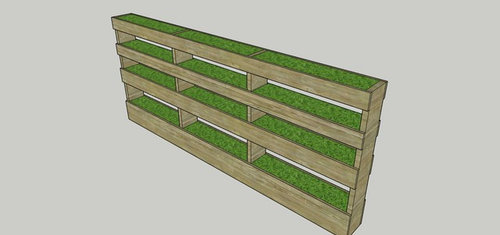
I do not have enough space to grow everything I want to grow, so I want to build a vertical planter along the side of my deck (in the same wood as the deck). I want it to be ~12' long, ~5' tall, and 1' wide with 4 tiers of plant. It will look something like this:


In it I want to plant all my herbs, salad greens, strawberries, chard, edible flowers, and maybe even a few hot peppers. What is the ideal depth for these plants? Right now I am thinking the bottom planter will have a depth of 9.75" (3 2"x4"s with a .75" bottom), the upper 3 planters will have a depth of 6.25" (3 2"x4"s with a .75" bottom), and I will leave 10" between the planters.

What do you all think? Should I change the ratios (really big on the bottom, even smaller up top?) or go down to 3 tiers? My goal is to maximize the amount of things I can grow.

I can get 2"x4"s which are really only 3.5" tall or 2"x6" which are 5.5" tall.


I am still working out how many vertical supports I will need and if I should support the planter bottoms with pocket screws, angle brackets, or both... I will probably post to some DIY forum for tips, but if anyone has built something similar, tips are welcome.

Comments (16)

  • 7 years ago
    last modified: 7 years ago

    Search the web for "vertical gardening" for lots more on this subject area. One thing I notice is that various plant wall designs all tend to have the plants all facing to one side, rather than in a bunk-bed-like arrangement.

  • 7 years ago

    Thanks lilyd74 (5b sw MI), I am glad you think it is sufficient. I could make the bottom one even deeper for the shard and peppers, I but I am worried about it being too tall. I could reduce the space between, but I'm already concerned 10" isn't enough.

    Yes, it will be a challenge to make the bottom sturdy, but there are a lot of raised planters that hold way more soil than this, so it is possible. The bottom planter will be the largest heaviest piece and it will be on the ground with a lot of heavy soil to prevent tipping.


    Embothrium, I assume you are trying to be helpful, but if someone posts here and drew up a picture, they most likely know how to use the internet.

    Many vertical planters are up against a wall, so that is why they are tilted/one-sided. There are pictures of other style planters if you search. The closest to what I am trying to do except not exact is: https://i.pinimg.com/originals/9e/fe/b2/9efeb2c404ce9a6bce22c457f8a9d59a.jpg

    or

    http://spydersx.info/wp-content/uploads/2018/12/vertical-garden-containers-amazing-living-wall-garden-container-the-b-e-t-d-i-y-vertical-for-small-space-project-create-a-do-it-vertical-vegetable-garden-containers.jpg


    It is really hard to find depth/vertical spacing requirements for plants, hence the post.


  • 7 years ago

    How many years do you plan to use it? If you are going to build it from pressure treated boards, it is not good for edible greens. If you are building it from oak or pine boards, they will rot by the end of growing season. May be you should try cedar boards.

  • 7 years ago

    You're welcome!

  • 7 years ago

    I want this to be a permanent fixture. I'm making it out of the same wood as the deck... which is Ipe (it is very expensive, and super hard, but the labor is free). I will likely use redwood for the bottoms since they can't be seen. Can't get cedar out here unfortunately...

  • 7 years ago
    last modified: 7 years ago

    If it is going to be sitting on the ground you may want to make the bottom out of a composite material as any wood will rot quickly when contacting soil. Even with a composite you may want it to set on a 6 inch layer of compacted traffic bond or similar so that the bottom planter drains properly. What size drainage holes are you putting in it?

    tj

    Robin Morris thanked tsugajunkie z5 SE WI ♱
  • 7 years ago

    For drainage and rot concerns, you could consider drilling drain holes, then line the whole interior with heavy duty plastic to protect the wood. You would also have to protect the interior of the drain holes.

    Robin Morris thanked lilyd74 (5b sw MI)
  • 7 years ago

    My experience is limited to window boxes, but here is what I have learned:

    - Plastic liners do help to slow down the rot as well as retain moisture. They will also provide a barrier between the roots and any chemicals in the treated wood (which retard fungle & plant growth in addition to edible concerns).


    -Angle brackets for supports are definitely recommended if you want it to last longer. Drainage is necessary of course. To reduce the bottom wood exposure to moisture drill a larger hole (1”) than the plastic liner. All wood rots eventually, even teak, so be prepared for periodically mending. I‘ve been toying with the idea of trying fiber cement composit boards (from remnants).


    - Soil: Potting mix or leaf fro will be much lighter than topsoil. If using top soil add some peat or composted wood chips to lighten and loosen the soil. Mixing in some Soil Moist granules will help a great deal in reducing the frequency you need to water and makes the plants very happy. I’ve heard that baby diapers do the same thing but have never tried it. i Would also add a slow release fertilizer to store bought top soil.


    The design looks beautiful and ambitious. I would love to have one on my patio. It would get the strawberries away from the slugs, mice, and chipmunks who eat all of mine. Enjoy!

    Robin Morris thanked Rebecca-(6b)MD
  • 7 years ago

    I love this idea and would like to do it too, but the strength and wood rot issues are holding me back. I agree it might not be big enough for roots of peppers and chard, but fine for many herbs, lettuce, arugula, and some flowers.

    Robin Morris thanked HighColdDesert
  • 7 years ago
    last modified: 7 years ago

    Thanks, everyone... sorry for the slow response. Decided I may build 2-3 smaller ones for flexibility instead of one large one incase I ever rearrange things.

    I am planning on leaving large gaps between the boards for drainage on the bottom and covering the bottoms with some heavy duty landscape fabric. If there is a composite material I should consider for the bottoms, please suggest. I hope that redwood+ landscape fabric will hold up.

    Will definitely use angle brackets and potting mix. Thanks!

    Don't think it will keeps the pests from the strawberries... if the squirrels and rats (my local critters) want them, they have no trouble climbing. I just have to grow enough stuff where everything doesn't get eaten.

  • 7 years ago

    Just wondering...will you add wide base supports or attach it to you handrail or wall? It seems like it could topple in a firm wind.

  • 7 years ago

    I do think having the large planter on the bottom filled with soil will make it stable. I guess if I get done with it and think it is unstable, I can add supports (no handrail on the deck).

  • 7 years ago

    Landscape fabric is permeable to water. It won't protect wood from moisture. Is that what you want?

  • 7 years ago

    Redwood and Ipe are both resistant to moisture/rot naturally... the fabric is so I can leave big gaps for drainage.

  • 7 years ago

    So you'll have drainage gaps/holes in the wood and have landscape fabric over the holes to stop the medium falling through? Have I understood that right? If so I'm not convinced it would work. Landscape fabric is permeable but tightly woven and not quick draining. Something like small gauge wire netting or some kind of mesh would allow better water movement.

Sponsored
CHC & Family Developments
Average rating: 5 out of 5 stars5 Reviews
Industry Leading General Contractors in Franklin County, Ohio