Software
Houzz Logo Print
morton2002

What's eating my ficus?

7 years ago

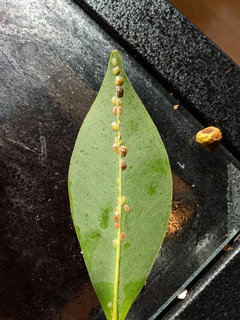
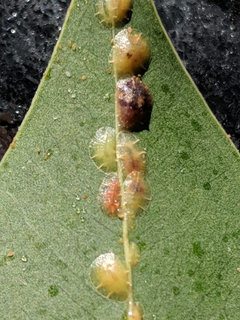
I have a healthy ficus that seems strong enough to nourish some kind of sustained infestation. There is sticky residue all over the leaves and the floor, and it appears there are thrips on some of the leaves. What are these strange gelatinous pods underneath the leaves?
(Not sure yet how to post pictures, I'll try in the comments)

Comments (15)

  • 7 years ago


  • 7 years ago

    You have scale :-( Those are the gelantinous globs. It looks like you have some immature ones (more translucent) as well as mature ones (darker color). They are sucking insects and the sticky stuff is honeydew or their excretions. They adhere to the leaf and stems very tightly and often have a hard, shell-like outer surface.

    This is not an insect that is easy to control. I'd first try wiping down the leaves (and stems) with something like a baby wipe....that should dislodge most of them. And you can also spray with neem, horticultural oil or insecticidal soap but that tends to work best on the juvenile crawler stage and has little impact on adult scale. Really, using a systemic insecticide registered for scale and appropriate for houseplant use would be best.

    Robert thanked gardengal48 (PNW Z8/9)
  • 7 years ago

    Thanks, gardengal. I scraped them off using my thumbnail and I applied neem oil to the tops and undersides of the leaves. Does neem oil typically need to be applied to the underside of the leaves in cases like this, or will it reach the scale if only the tops of the leaves get sprayed?

  • 7 years ago
    last modified: 7 years ago

    Thag looks like a severe infestation and might take a lot more than neem to knock down.


    The systemic would probsbly be best here.

  • 7 years ago

    I agree. If it's warm enough outdoors I'd spray 2 or 3 times at 2-week intervals with Bayer 3-in-1 Insect, Disease, and Mite control. It contains the systemic insecticide imidacloprid and is approved for use on houseplants (but you must do the spraying outdoors and wait until the plant is dry to bring it back in). It works best if you spray just as it's getting dark.

    Alternately, you can purchase a soil drench that contains 1.47% imidacloprid. Mix 1-2 tsp with a quart/liter of water and evenly drench the soil. Twice at 4-week intervals should eliminate the problem.

    Drench.

    Always follow directions on packaging

    Al

  • 7 years ago

    Robert, there's a way to do it without using systemics. Take outside and spray with Formula 409 or Windex. Let it soak for 10 minutes or so, then blast off the scale with a jet of water. Let the plant stay in the shade for a day, then put back in the sun.

  • 7 years ago
    last modified: 7 years ago

    I'd suggest that you not use ANY household cleaning products on your plants. Windex contains water, 2-hexoxyethanol, isopropanolamine, sodium dodecylbenzene sulfonate, lauramine oxide, ammonium hydroxide, fragrance, and Liquitint sky blue dye. All are phytotoxic except water.

    The known ingredients in Formula 409 are ethanolamine, alkyl dimethyl benzyl ammonium chlorides c12-16, alkyl dimethyl benzyl ammonium chloride, and propylene glycol propyl ether, all of which are phytotoxic. The pH of Windex is 10.7, and the pH of Formula 409 is 9-11.5, both of which are extremely caustic for use on live plants ....... just in case the phytotoxic ingredients aren't enough to give one pause.

    Al

  • 7 years ago
    last modified: 7 years ago

    Please do not take any advice from cactusmcharris unless you want to kill the plant instead of the scale.

    That might be the worst advice I’ve even seen given on this site.

    The Bayer 3 in 1 that Tapla mentioned has been the only thing that’s ever truly worked for me. Works as a drench and systemic all in one.

    It’s great, but only use outdoors.

  • 7 years ago

    I’m just curious, people often reccomend a solution with a tiny bit of bleach for infestations, and this one even appears on plant guides. Is that bad too?

  • 7 years ago
    last modified: 7 years ago

    Al,

    My suggestion always worked without harming the plants (cereoid and globular cactus), which I guess I should have noted in my post above.


    Dave,

    Any advice? The worst? Thanks for putting me at the top of the class. You are a man of impugning superlatives.


    It is odd how rigidly folks are attached to systemics when there are, in certain cases, a non-systemic method of pest control/elimination available.


    Rhamel, I've never used bleach in killing pests, only in washing pots.

  • 7 years ago

    While windex & 409 might work, A systemic is designed to safely kill bug infestations. It is cheap and widely available. IMHO, I don't think using cleaning products would be the best course of action.

  • 7 years ago

    My problem with using this systemic is that, IIRC, it poisons bees and hummingbirds (two forms of life that are known to visit cactus and succulent plants in flower). Is the recommended systemic now safe for insects and birds?

  • 7 years ago

    Since neither hummingbirds or bees are likely to visit a houseplant (which is also highly unlikely to ever bloom), that is a bit of moot point :-)

    Yes, imidacloprid and any other neonics are toxic to bees and other pollinators....much less so to any birds. If dealing with scale on plants that are growing outdoors and in flower or likely to, the application of some sort of horticultural oil and the correct timing is the recommended control with the least environmental impact.

  • 7 years ago

    Rahm - household bleach is extremely caustic. I wouldn't use it for any contact applications other than quick-dip sterilizing dormant woody cuttings, followed by a good rinse.

    CM - that the harm caused by using Windex & 409 might not be immediately conspicuous is not reason enough to judge it appropriate for use on plants; nor would it to be reasonable to suggest that it causes no harm because you haven't been able to identify it. Both destroy cuticular waxes, surface lipids, and root lipid membranes - on contact. Cuticular wax and surface lipids are part of a plant's dynamic defense system. They limit water loss, help with self-cleaning of the leaves, and help fend off biotic pathogens Everything either product is made from (save the water in Windex) is toxic to plants, which makes it sort of hard to pinpoint the beneficial active ingredient. My suggestion, for anyone who might have a moral issue with imidacloprid is, don't use it if it bothers you, but please don't suggest Windex or 409.

    Al