Software
Houzz Logo Print
steve_evans9

36 inch range hood 6 vs. 7 vs. 8 inch duct?

7 years ago

I have read many of the range hood threads out here but still have some questions.


Background:

  • I am getting a 30 inch Bluestar Platinum Range
  • Generally we do a lot of frying but not super intense heat, I would like to use the grill on the platinum and do some more wok cooking --
  • My contractor says that there is only room for a 7 inch duct to the outside
  • So the exhaust path would be up a few feet to the ceiling, 90 degree turn, about 15 feet to vent outside (there may be another 90 degree turn to vent outside as well not sure

What I am looking for:

  • I am looking for a 36 inch wide range hood in the range of 600 CFM
  • This would be a wall mount (not chimney) 18 inch high hood (but would consider 9 inch high.
  • I like the Vent-a-hood models (large capture area, seem efficient) but they have an 8-inch duct
  • Many other brands in this range also have an 8 inch duct


Question/Recommendations:

  • Do I go with an 8 inch duct hood but reduce it to 7 inches?
  • Do I look for a hood with a 7 inch duct so there is no reductions (there do not seem to be that many out there)
  • Do I go with a hood with a 6 inch duct (more choices)?
  • Any recommendations?


It seems a bit odd to me that an out-of-the box 6 inch ducted hood would perform better than an 8-reduced-to-7 inch ducted range hood like a Ventahood.


At the end of the day I just want good performance while keeping noise manageable and not going to crazzy on high CFMs that I likley will not need 95% of the time.


Comments (16)

  • 7 years ago

    If you have a grill, are wok cooking and frying I would want more than a 600cfm hood..

  • 7 years ago

    Vent-a-Hood uses a squirrel-cage type of blower to move air and sling grease. Their published data suggest these are more sensitive to pressure loss (back pressure) than the more common blower styles. Hence the plausible "It seems a bit odd to me that an out-of-the box 6 inch ducted hood would perform better than an 8-reduced-to-7 inch ducted range hood like a Ventahood." On the other hand, claims of performance almost never address the hood operating in place with restrictions on its output and input.

    The duct air velocity should not be higher than 2000 ft/min using the actual achieved air flow (not the blower rated air flow, which won't be achieved). This sets a lower limit on duct diameter. 1000 ft/min sets the upper diameter limit.

    There was a recent thread on duct effective size vs. squishing a larger duct into a space above some cabinets. I don't have time to look for it now but it should have been within the last month. Search on "kaseki" and "elliptical."

    While some pressure loss occurs in every transition, an 8 to 7 should not dominate the pressure loss calculation. Dominant pressure losses usually occur in the hood filter (except VaH which do not have a filter) and in imperfect make-up air supply.

    Review hood threads here on noise. Quiet generally requires a blower separated from the hood with a silencer in between.

  • 7 years ago

    You have a super-high-BTU gas range, and at 36" it's bigger than normal. 600 CFM per minute is nowhere close enough. You'll need a hood that is at least 42" wide, and that preferably extends as far to the front as possible. It probably needs at least twice as much power to be effective at all. Check in the archives for kaseki's posts that explain how to compute the required power.


    You also almost certainly need a make-up-air system. Your hood simply won't work without make-up-air. It would be an utter waste of money. By the same token, without a 10" duct, your hood is simply going to be a decorative noise maker. There is no way sufficient amounts of air could move through a 6" duct.


    Alternatively, get a much smaller range and/or switch to induction

  • 7 years ago

    Thanks for the feedback everyone and a special thanks to Kaseki for the many comments you have contributed to this topic. Just a few notes/observations:

    • I am getting a 30 inch Bluestar not a 36 inch (74,000 BTU total)
    • We will have a make-up air system (required by code) and also have a very "leaky" house
    • After reading many of the range hood threads out here, I understand that CFM is only one factor you should consider, some of the others being size of capture area. Here I am going with a hood that is 6 inches wider than the range; ideally one that comes out 24 inches
    • I am also conscious of not trying to solve for the 1 or 2 days a month where we might produce more smoke than a 600 CFM can handle
    • Having visited three major appliance stores in the area, I am surprised at the general lack of knowledge about range hoods, no one thinks I need a 36 inch hood for a 30 inch range; no one has mentioned the duct size issue without me bringing up first; and almost no one has referenced the make-up air issue
    • I do have a hard time following the more technical discussions around pressure and velocity


    So where am I? I need to decide between:

    • Vent-a-hood (8 inch downsized to 7 inch duct) but comes out 24 inches from wall and generally has a larger capture area than other hoods that use baffles
    • Victory range hood (7 inch duct); 900 CFM but only comes out 22 inches (also would need to order without seeing it)
    • One of the many 6 inch ducted range hoods (e.g., Kobe)

    There may be others but that is what I have found to date.


    Thoughts/recommendations?


    Thank you!


  • 7 years ago
    last modified: 7 years ago

    Your candidate list might also include hoods with 8-inch duct interfaces that, like the VaH, could be transitioned into a 7-inch duct.

    Sorry for pressure-flow glibness. I think it is an consequence of endless repetition. As with voltage-current in electricity, imagining what happens when extending or twisting a water hose may help. Air is also a fluid, but one that can be compressed.

    "Having visited three major appliance stores in the area, I am surprised at the general lack of knowledge about range hoods, no one thinks I need a 36 inch hood for a 30 inch range; no one has mentioned the duct size issue without me bringing up first; and almost no one has referenced the make-up air issue." When I had to investigate kitchen ventilation starting back in 2007 in the run-up to my reno, I embraced the research due to not just my exposure to appliance store ignorance, but in my then view, appliance store active disinformation. I couldn't understand how people responsible for selling things to customers they might want to keep would not themselves learn about how the devices were supposed to work.

    And most off-putting to me at the time were the "magic lung" claims of VaH. The easiest way to troll someone whose education is downstream of the Middle Ages is to drag "magic" across his path. (No slight intended to magical girl animation.) I saw this as an attempt to pander to the ignorant with the potential for them to end up with a noisy, insufficiently effective hood.

    VaH make a set of hood assemblies that meet the key requirements of cooking plume capture and containment within the usual limitations, fire blocking, and collection of the larger end of the grease particle spectrum to keep grease from collecting in the duct. Their configuration differs from the "standard" hood models, and has its own resulting flow rate vs. pressure drop limitations, which should influence when and where their configurations are used. Like many hood manufacturers, technical information is typically sparse, but there is no magic there.

    In case you haven't seen it mentioned in other threads, background information using commercial insights may be obtained by reading the first dozen pages or so of the Greenheck Guide available at: http://www.greenheck.com/media/pdf/otherinfo/KVSApplDesign_catalog.pdf

  • PRO
    7 years ago

    What is your objection to the required vent size for the Vent-a-Hood? One does not typically choose a hood based on vent size.

  • 7 years ago
    Ventahood requires an 8 inch duct, my contractor says there is only room for 7 inches so my issue is whether to look for a hood with a 6/7 inch duct size or go with ventahood (or another 8 inch ducted hood) and reduce it to 7 which I know is not ideal.
  • 7 years ago

    Ventahood isn't somehow subject to laws of physics that are magically different from what other manufacturers deal with. If you connect a Ventahood to a 7" duct, then as a first approximation it'll perform just a well or as poorly as any other manufacturer's hood that only needs a 7" duct.


    There is a small caveat, as different venting systems have different fan curves and thus different response to back pressure. But that's probably more complicated than what you need to look at at this early stage of your decision making process.


    If you want good performance, you need a bigger diameter. There really isn't any way around that. The math suggests that you should be looking at a 1000+ CFM hood for the type of range that you are buying. You're not going to squeeze that through 7". In fact, even for just 600 CFM, most manufacturers set a minimum of 6", but strongly recommend 8", if you actually expect to get anywhere close to the rated performance.


    IMHO, your best bet is going back to your contractor and asking him to find a solution to upsize the duct somehow. That most likely means installing an elliptical or even a square duct. That's not ideal, but it's still better than an undersized duct.

  • 7 years ago

    I actually increased the size of duct from the Vent-a-Hood 8" to 10" for the rest of the ductwork so that there wouldn't be a problem with the couple of bends required. Going to 7" is much less than ideal. I'd find a way to keep it at 8" or larger--even if that means building a box around the ductwork. In this case, the ductwork goes through the wall rather than out the ceiling. The 600 CFM works just find for the induction cooktop. I wouldn't think it would be sufficient for a gas stove of any kind.


  • 7 years ago

    Yeah, we went with a 10” duct for 900 CFMs. We got our HVAC final approved.

  • 7 years ago

    Our Vent-a-Hood is 1200 cfm and uses a 12 inch duct.

  • 7 years ago

    Note all that even an infinite diameter hood duct does not eliminate ventilation system loop pressure loss, even for a baffleless VaH, as the make-up air pressure loss has to be included. Even an open window will develop a pressure loss across the screen proportional to the flow rate per square foot. So besides meeting MUA safety requirements for house negative pressure, don't expect that over-design of the outgoing ducting will eliminate loop pressure loss because the pressure loss of the incoming (MUA) ducting adds to it linearly.

  • 7 years ago

    I'm not sure if you were referencing me kaeski. Just to clarify the 12 inch duct was what was specified in the installation instructions for our Vent-a-Hood. We did not over design.

  • 7 years ago

    Sever...I didn’t read all the above responses but wanted to give you my experience. I have a 36 inch Monogram with grill. My 600cfm Ventahood which they said was equivalent to a 900 cfm is fine with the grill.


    I grill all the time and don’t have any issues with my vent being overwhelmed. My only recommendation is to increase your depth for better capture. My VAH is 22.5 inches deep. I should have gone with the 24 inch deep insert.


    Also, I had surprise copper pipes in my duct run so I squished my duct to 7 inches to fit around them. I don’t think I lost any diameter since it just became more oval shaped near the obstruction. I think I remember reading about areas of circles vs ellipses back in the day and concluDing that there would be minimal interference from squishing my duct.

  • 7 years ago
    last modified: 7 years ago

    vinmarks

    No, in your case I was tempted to write that the VaH can make use of that size duct. I think VaH may be negligent if they don't point out that that duct size needs to be matched on the MUA side. As pointed out earlier, few in the kitchen hood sales chain want to raise the issue of make-up air and the horror it can be to retrofit into a renovation.*

    But lest others think that they need 12-inch duct for 1200 CFM with conventional blowers in lieu of using 10-inch for typical lengths, I wanted to point out that that would be only a modest improvement relative to getting the MUA in with low pressure loss. Pressure loss is counted from the cooktop to outside and then from outside to inside back to the cooktop.

    -------

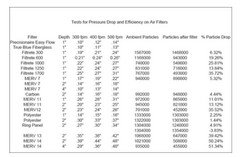
    *An example MERV7 high flow 4-inch deep pleated filter, 2 ft x 2 ft in area used to catch the big particles and bugs that the MUA air could pass into the house, used at 1200 CFM (300 ft/min) would have a pressure loss of 0.1 inches w.c. (See table from https://www.texairfilters.com/comparative-tests-on-pressure-drop-of-hvac-filters/ If one looks into VaH data, for example see below, 0.1 inches w.c. drops the flow rate of a dual blower (1200 CFM) hood to 1060 CFM. At 1060 CFM, the filter pressure loss is a bit less, so one really needs to plot filter loss vs flow rate against the fan curve implied by the data below to obtain the expected flow rates (excluding ducts, MUA register, and exhaust duct cap pressure losses which also need to be counted)


    .


    And for comparison, using an equation I found on the Internet at the HVAC engineering forum referencing the 2003 ASHRAE Handbook at Page 52.5 (confirmed in my copy) and adapting it with some trepidation to screening as was done at the forum, and assuming a screen of 70% openness across a 12-inch duct at 1200 CFM, the pressure loss is even higher than the pleated filter, reaching 0.7 inches, w.c. With a 15-inch screened duct, 0.1 inches w.c. at 1000 CFM could be achieved. The moral is, use a lot of screen area, or low loss filtering, or let the sparrows in.