

Crop rotation and vermiculture for containers
I'm planning to grow three crops in three containers, to be rotated with each other after each harvest. I want it to be as self sustaining as possible. What do you think of this model:
Crops will be:
dwarf corn in one container (20 inch whisky barrel)
Potatoes in the second
Organic soybean in the third.
After the first harvest of these, vermicompost each rootball and remaining plant material in separate containers. Then take the composted material and grow the next rotated crop in it.
What insights do you guys have into this method? I appreciate your help!
Comments (56)
 7 years ago
"Where does the waterlogged mess come from?"
From the composted material. Because container gardening is essentially a closed system - the only free exchange of both air and water is either from the top of the pot or very few drain openings - porosity/aeration and fast drainage are key. And compost offers none of these qualities. It is never fully finished and as it continues to degrade, it collapses, compresses and breaks down into smaller and smaller particles. It is excessively water retentive and contributes to a higher PWT, as does all very absorbent and finely textured materials you might include in the mix.
The most efficient container soils contain no real soil (ie, 'dirt) and very little easily degradable organic matter. Rather, they are made up of pretty durable and textural components - bark fines, coir or peat, perlite or pumice, often grit or calcined clay. Potting mixes are intended to provide fast drainage yet moderate moisture retention and plenty of air pockets to let plant roots develop as freely as possible, They are not intended to provide the ready nutrient sources that a decent garden soil would do. That is the function of the gardener via fertilization.
Successful container gardening was never intended to be sustainable. Pretty much everything about it requires outside input. I applaude your interest and intent but I think you are going to find it very difficult achieve sustainability with containers. One cannot even be 100% organic when gardening in containers and expect the same level of success as they would with a similar inground planting. The two situations are not at all comparable and require very different approaches and methodology.

busstead
Original Author7 years agolast modified: 7 years agoWow, gardengal, thank you so much for that reply. I read every word carefully. What I learned is that composting my rootball, et. al will slowly use up the light fluffy material that allows breathing and drainage until none of that is left except dense, albeit rich, water retaining fertilizer. I see the problem.
But if companies can make potting mixes, I'd think I should be able to, also. I'm trying to think out of the box. What if I got some natural sponges and tore them into small pieces, but large enough to fish out after each harvest? That would provide drainage, breathing and root development space.
Related Professionals
Everett Landscape Architects & Landscape Designers · Sanford Landscape Architects & Landscape Designers · Charlotte Landscape Contractors · Bartlesville Landscape Contractors · Grand Rapids Landscape Contractors · Southaven Accessory Dwelling Units · Potsdam Accessory Dwelling Units · Anchorage Accessory Dwelling Units · Champaign Landscape Contractors · Beatrice Home Builders · Seattle Landscape Architects & Landscape Designers · Augusta Landscape Contractors · Flint Landscape Contractors · Marquette Landscape Contractors · Fort Wayne Stone, Pavers & Concrete- 7 years ago
Yes, you can make a potting mix! Many people do because even commercial bagged mixes tend not to be of very high quality and by making their own, container gardeners can tailor the mix to best suit their plants' needs and their gardening conditions. But you gotta use the right kind of ingredients :-) I have never heard of anyone using a natural sponge for this purpose and I am not at all sure how well that would work...........I'd guess they too would be excessively moisture retentive.
- 7 years agolast modified: 7 years ago
Regarding your choice of crops, I'd skip the corn and soy. You'd get next to no production from a twenty inch whisky barrel. Maybe four or five corn plants and they'd have a hard time getting pollinated. You'd do better to grow higher value, higher yielding crops which are best used very fresh, like tomatoes, herbs and cut and come again salads, if you have restricted growing space. I'd only grow new potatoes since main crop are cheap and easy to purchase.
busstead
Original Author7 years agolast modified: 7 years agoThanks, floral. I already have a good "cut and grow" salad system going! Glad you like it as well as I.
I looked into container corn growing and people say to plant four in a 12 inch pot. A 20 inch pot has practically 3 times the surface area, so I'm going to try planting 8. There are many short varieties, including the Tom Thumb, which doesn't grow past two feet. I'm going to start with a three foot plant called Blue Jade. It produces 3 or more ears per stalk, about half the size of store bought. That's a minimum harvest of 24 ears.
I only use soy for making fermented natto, so I don't need much of it. Each harvest I get should be plenty. The organic variety I'm getting is only 12-15 inches high.
:-)
- 7 years ago
It is not the surface area that is of concern but soil volume in the container. It needs to be large enough to comfortably accommodate the root systems of all the plants. And because a plant is low growing or a dwarf cutivar does not necessary mean that its root system will be substantially smaller than a full sized plant.
 7 years ago
As far as sustainable potting soil, leaf mold is a very good base. You could pick it up as you travel and store it in bags. It will eventually decompose into usable crumbles. Also coconut coir lasts for years (and perlite/vermiculite almostbindefinitely), so it would not create a need for constant resupply. Personally I don’t see the need to replace every year. If you replace nutrients, and sterilize the soil if you are growing tomatoes or something that cares about sterile soil, you could recycle multiple times as long as the structure holds up.
And for sustainable fertilizer, look into fertilizing with urine if you can get past the yuck factor.
there have been a few posts on Houzz of using it in container growing, and seems to yield good results. And it’s as sustainable as you can get. :)
busstead
Original Author7 years agoTrue, but even the volume is three times as much because the depth is close to the same. I'm planning on growing only twice as much in a container that has three times the volume. Sounds doable, but we'll see what the final outcome is.
- 7 years ago
Dillybeansown, read previous comments about including a lot of organic matter in containers. It will hamper fast drainage and proper aeration, which is the key to success with any container gardening. And you may not see the need to replace annually but the plants certainly will!! Unless one is using very durable ingredients in the potting mix, the structure will break down and that will result in the same impaired drainage, lack of aeration and increased PWT.
Urine is an excellent source of nitrogen but many of the other necessary plant nutrients are lacking or in insufficient quanitites to be useful. And it has to be diluted before application or else it will burn sensitive feeder roots.
busstead
Original Author7 years agoGreat idea, dillybean! I can definitely search for coir when I'm in southerly latitudes. And leaf bunches should be easy to find anywhere! I don't mind pouring pee in my plants, but I'm keeping a vermicomposter in the bus, so urine may not be needed. (???)
The two reasons I thought changing each year would be helpful is,
1) The rotation of these particular plants benefit each of the other when planted in a particular succession. They do different things to the soil and help mitigate certain diseases. It's a great organic way to help the soil and plants.
2) Corn, in particular, and I've seen it with sweet potatoes, too, creates a dense rootball that fills the container. I just don't see how you could grow crops in it without composting first (is there?).busstead
Original Author7 years agoAlso, perlite and vermiculite are so tiny! I'm not sure how I could fish them out of the soil for reuse before composting. I assume they'd be broken down in the worm bin?
- 7 years ago
I read the thread. :) I understand the necessity of not overloading on organic matter. That is why I mentioned perlite and vermiculite, as a key to aeration. Lightened in a proper mixture, leaf mold certainly can supply a good base for putting soil.
Also, I said that you could “recycle multiple times as long as the structure holds up.” :) I don’t think that we disagree on the basics of what is necessary; just some of the practical application.
Urine would obviously have to be used at the proper dilution, as with any fertilizer. And it does contain potassium and phosphorus in small amounts (somewhere of a 20 to 1 ratio of N to P and K). If allowed to age for 1 to 6 months, as far as I understand it the nitrogen breaks down so that in the end it is something of a 1:1:1 ratio. I have no doubt that you could utilize both fresh and aged to get the proper supply main nutrients for the plant. Undoubtedly nowhere near as perfect a result as you were using a chemical fertilizer, but nevertheless a very usable sustainable fertilizer.
Trace minerals would probably have to come from an outside source, unless he wanted to experiment with rock dust or compost tea or some such.
busstead
Original Author7 years ago(I'm a "she",BTW) :-)
Too much nitrogen in potatoes directs lots of energy to leaf growth, away from roots and tubers. Great for foliage, not so good for nummies. Highest quantity in potassium is best for potatoes.busstead
Original Author7 years agoCheck this out... I had an idea.
Take a chunk of sponge and put a smaller chunk of charcoal inside of it (activated? Garden? Regular? I'm not sure). From what I understand, the charcoal absorbs water and is commonly used to prevent over watering. If the charcoal absorbs the water from the sponge, then the sponge can be used for aeration and fluffiness!
Million dollar idea, no?- 7 years ago
Vermiculite will absolutely, absolutely not hold up "indefinitely". It has a very short lifespan, as far as usable structure goes (it turns to mush).
- 7 years agolast modified: 7 years ago
HU, sorry about that!! :) “she” it is.
illstep, uh-oh. thanks for the info!! I guess I was equating it in that respect with perlite, which I have used more. Good to know that they are not alike!
- 7 years ago
Once again HU, you are applying inground growing theories and practices to container gardening and the two do not mesh at all. Feel free to do whatever you want but you are not going to get the results you hope for by using the volume of OM you intend, reusing the soil or rotating the plantings. It simply doesn't work that way.
 7 years ago
No matter how good an idea sounds, It has to work within the bounds of physics and chemistry. We can take some of the subjective nature out of the degree of comparison we assign to a medium (poor, middling, good, better, best) if we can agree a soil must at least be able to be watered to beyond the point of saturation without a tax being levied on your plants' vitality by that action. If you can't water them correctly, the level of frustration goes up and the results either go down or are much more difficult to achieve.
The idea that charcoal as an amendment can somehow prevent over-watering is unfounded. You can use screened charcoal as part of other coarse ingredients (or on its own) to make a medium that doesn't hold perched water, but that's a function of particle size as opposed to the composition of the material.
Don't depend on perlite or vermiculite to improve air porosity. Vermiculite won't, and the job of perlite is to take up space that might otherwise be filled with water-retentive medium. Perlite is not internally porous; so, if you have a gallon of water-retentive medium with 5 units of aeration, and you add a half gallon of screened perlite to the medium, you now have (almost) 1.5 gallons of medium with the same 5 units of aeration. Adding perlite effectively REDUCES aeration in media until you reach a threshold level that occurs at the point where there is a large enough fraction of perlite (and other coarse materials) in the medium to render the volume of fine material insufficient to fill all spaces between the coarse particles. Aeration decreases up to that point, then starts to increase. If you want to take advantage of the superior aeration of mixes containing coarse material, you must start with a large fraction 75-90% of coarse material. You would be better served to use a mix that would be marginal when used conventionally, and use a judicious measure of ballast to reduce the planting's ability to hold excess water than to add the perlite. Perlite reduces water retention by roughly the volume of the fraction of perlite added, but it doesn't increase aeration proportionately. You're simply trading root space for water retention, which isn't much different than using a smaller pot.
Forget the urine, unless you are strongly adhering to a self-limiting ideology, in which case you should be ready to sacrifice efficacy on the altar of that ideology. You have no idea whet's in the urine, it's high in dissolved solids, which meshes poorly with water-retentive media that don't lend themselves to regular flushing as you water.
Finally, please don't think that coir and CHCs can simply be substituted for peat and pine bark respectively w/o having some work-arounds in place to allow for the varying chemistry. Coir has less loft, too, which won't fit well with a medium we already feel will be excessively water-retentive from the jump.
Best luck.
Al- 7 years ago
Like some of your ideas, but if you're living in a bus, are your plants going to receive enough direct sunlight to flourish? I know that doesn't help with your potting questions it's just some thing that occurred to me when reading your posts.
Good luck.
 7 years agolast modified: 7 years ago
The point of crop rotation is to remove the host of a pathogen so that it dies out. By composting everything together you are just innoculating all the pots with all the pathogens each season. So there would be no point to rotation.
busstead
Original Author7 years agoTapla, thank you for the bountiful information! I think I still need to read it again few more times to get full benefit from it. I think you'd be a pro research paper writer!
Harry, that's a good thought! And one that I've mostly solved. These containers are going to be extremely heavy, so bringing them in and out is not practical. But this is a shuttle bus, which means it has huge windows, where the plants will line. Additionally, I have just the right sized grow lights and solar generators to take over when the sun still doesn't reach. I expect I'll use the lights frequently.
Nil13, another great consideration that I'm trying to solve. At first I was just thinking I'd have 3 separate bins, but the more I logisticize (that's a word, right?) the more I'm concerned about finding the space.
I have a spot for one main composter. I might be able to fit a smaller one next to it. Maybe if I rotate, not only soil, but the timing of each crop, I can get by with only 2? Do you have any idea how long it would take worms to go through a 20 inch rootball? (as much soil removed from it as possible).busstead
Original Author7 years agoDo you also think it's possible that the worms digestion processes, in fact any composting process, already corrects the pathogen problem? Maybe it's a non issue and only one composter is sufficient.
- 7 years ago
Have you considered using coarse sand as the potting soil? It’s not moisture retentive, unlike the other materials suggested above, so waterlogging wont be a problem. It doesn’t decompose, so it won’t naturally shrink and get compacted over time. It’s also very cheap, and sometimes free.
busstead thanked Seun  7 years ago
I realize this post is about soil, but, after your comment about all being inside the bus, I'm wondering about pollination. At the least, soy beans need bees and the corn a very localized breeze.
As to soil: I grow all in pots and find that by adding some new soil and giving all a very good work-over, My garden does fine; but.... I do buy fresh organic soil to add in.
Also, wasn't there an earlier thread that suggested adding hunks of bark to help keep the soil looser? Even small stones?busstead
Original Author7 years agoMore good thoughts! Pollination can be done by hand using a small paint brush. Also, the windows are emergency exits and the entire thing swings open leaving ample space for bugs to come and go in the day. I may not always use that option depending on the local bugs (mosquitoes? Nu-uh).
The corn plants will be very close together. When I see they're ripe for pollinating, I can put a very thin plastic drop cloth over them and shake them all at the base. Remember, these corn plants are only 3 feet tall!- 7 years ago
Just out of curiosity but have you ever tried this before? If so, what kind of success did you have?
I just see way too many pitfalls in your methodology to be any more than just marginally successful. In addition to the very dubious soil mix, the biggest issue is that these plants are essentially being grown indoors. Even with very large windows, there is no remote resemblance of the plants being grown out in the open in full sun.....not even close!
And what happens when you water? Is it just allowed to flood the bus?
- 7 years ago
Can you confirm that you are indeed intending to keep your containers inside the bus? Maybe you have a double decker with an open top?
busstead
Original Author7 years agoI generally use containers that have trays under them. The trays are designed to catch excess water so it doesn't spill onto your floor. I think most indoor plants use them. If the plants are watered properly, there shouldn't be a river flowing out the bottom and the drainage should be manageable.
Grow lights are designed to give plants the light spectrum they need. They are a suitable replacement for sunlight and used in conditions much darker than my bus, which is already quite bright inside from windows everywhere.
No, I've never done this before, which is why I've reached out to the community. Time, experience and the will to succeed are amazing catalysts to success. They may be all I get for this project.
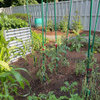
Here's a picture of what I have so far. All three containers will ultimately be the size of the middle one, which is my 20 inch. I'm working on it!- 7 years ago
Proper watering of containers does require the water to run freely out of them....more so than any saucer could accomodate. And you cannot leave the saucer of water sitting just sitting under the pot....it needs to be emptied.
And I hate to tell you but grow lights do not come anywhere close to providing the intensity or range of light that sunlight does. Even the strongest grow light will fall dismally short. About the only thing that will come remotely close to full, direct sunlight - which is what all these plant need - is metal halide.
busstead
Original Author7 years agoThanks for your supportive words, garden gal. I'm glad you've got the whole world figured out. Too bad I insist on being inquisitive and creative with my life, otherwise I'd heed your pessimism.
All I know is something called evaporation and a plethora of growers that have success with grow lights. But you did your best, and I appreciate that you at least tried.- 7 years ago
I'm sorry if you do not find me supportive.....I am only trying to be realistic. I may not have the whole word figured out (far from it!!) but I do have a degree in horticulture, have worked in the nursery industry, including greenhouse growing, and have been growing plants in containers for many, many years. So I fully understand the science and methodology of growing plants in containers. And I have absolutely nothing against creativity but there is a limit on how creative one can be and still have success doing what you plan to do.
Grow lights can work reasonably well for indoor houseplants or seed starting but you are attempting to grow temperate climate, full sun outdoor plants inside and that is not a situation in which they will thrive or even be moderately happy in.
busstead
Original Author7 years agoIf I don't try, it's as good as having failed, anyway. And if failing is imminent, I'd rather fail trying.
Brainstorming solutions is more helpful than merely claiming failure. This project is very important to me but if I can't make it work, it's not meant to be. I'm just experimenting, learning, tweaking, retrying and hopefully putting food in my belly. Life is great!
Now if I could just figure out how to get that photo up...- 7 years agolast modified: 7 years ago
If you're going to be rude to people voluntarily trying to help you, at least give us the satisfaction of posting updates from start to finish so that we can watch the predictable results as you disregard their advice.
And no, I don't think you're "learning" if you are asking questions and disregarding the answers because you don't like them.
Common mistake to make though, it seems..
PS Gardengal: LED is slowly catching up to HID, as far as sole-source indoor grow lighting is concerned. So metal halide isn't the only option (but it's definitely the cheaper option). But I agree that a grow light is unlikely to be a solution here. Any grow light that can produce light intensities that mimic full sun would not be a light I would want to share a small space with! Not to mention the cost to purchase, and the absurdity of trying to power at least 500-1000 watts of light for 12-16 hours a day while living in a bus..
busstead
Original Author7 years agoTelling someone they will fail is hardly what I would call advice. Garden gal and I are capable of handling our own relationship, but you're welcome to chip in your own slice of negativity.
A 1000 watt led light only has a 150 watt draw. Technology these days. Amazing, no?
12-16 hours? That's a bit excessive. The sun might be out that long in the summer, but many of those hours are not prime sunlight hours because of the variance of the sun's rays throughout the day. The best hours for sunlight are between 10am and 4pm. Grow lights don't have this variability problem. 8 hours under a non varying light should be plenty. I've watched a ton of growing in container videos and they all agree 8 hours of direct sunlight is sufficient.- 7 years ago
" they all agree 8 hours of direct sunlight is sufficient."
But if indoors under artificial light, they are NOT getting direct sunlight :-) No artificial light yet made can replicate direct sunlight! And there is a big difference in intensity, which is a defining factor for plant growth. Light intensity is the single most important factor in photosynthesis. Low light intensity may not kill a plant, but will result in leggy, weak growth and plants that don't flower or produce fruits. Outdoors on a sunny day, the light intensity measures approximately 10,000 foot-candles. A typical sunny living room may only have about 3,500 foot-candles and even the best/strongest LED will only provide a portion of that....about 7500 foot-candles.
busstead thanked gardengal48 (PNW Z8/9) - 7 years agolast modified: 7 years ago
Telling someone their plan will not work, and explaining why, is ABSOLUTELY advice. Just not advice you (or anyone) wants to hear.
A 150 watt draw LED is not even remotely close to what you need to grow any plant that wants full sun. To grow those under LED you will need the sort of lights that are either being sold to professional greenhouse growers as supplemental lighting, or being sold to marijuana growers. And these draw significantly more than 150 watts.
"Watching some videos" is probably one of the worst ways to use the internet to learn anything more complicated than how to change a tire. Text resources online from reliable sources (*.edu sources are an excellent place to start) will get you farther than some yahoo on YouTube.
If you are interested in going the grow light route (Powered by solar panels?? The power draw needed for the grow lights you would need is not trivial! For comparison: I use around 150 kilowatt hours per month for LED lighting that covers only 13 square feet of my propagation areas - and propagation requires just a fraction of the light intensity that you will need!), I suggest you look up the following things to help you learn about the light intensity grow lights provide vs. the light intensity plants need:
Photosynthetic proton flux density (PPFD)
Foot candles to PPFD conversion
Daily light integral (DLI)
DLI requirements for various greenhouse crops
Inverse square law of light
 7 years ago
busstead: A 1000 watt led light only has a 150 watt draw. Technology these days. Amazing, no?
Amazing, yes. Not technology but marketing is amazing. I do not know about you but I expect a 1000W device to draw 1000W otherwise it should be called 150W device.
Eg. Sun hits us with about 100W per square foot of radiation. Of that about 40W is visible light. There is no single technology yet that produces as much light per square foot while using only 40W. Best of the LEDs (not the marketing crap that most sell on ebay and amazon) can do about half of that> Metal halides can do less than a third of that. Once indoors the same Sunlight is about half as effective and that too within a foot or two next to the windows.
I would suggest you heed what gardengal and illstep have to say. There is a reason why they do not agree with your observations derived from online articles and videos. Because bulk of them are marketing and hearsay.
I commend your enthusiasm. But learning by failing is not really a good way of do it when most of the causes of failure could be eliminated with the correct knowledge.
- 7 years agolast modified: 7 years ago
The marketing involving LED wattages isn't entirely ill intentioned. It arose out of the need to help customers understand what wattage bulb they needed to replace the old incandescent bulbs as they were being phased out (well, it actually went incandescent - fluorescent - LED). Since the new technology is more efficient at creating light than the old, you need progressively smaller wattages to generate the same amount of light, and customers needed a way to quickly understand that they only needed a 20 watt LED (or whatever) to replace their old 100 watt incandescent.
This led to the "100 watt equivalent" label, and others like it, on LED and fluorescent bulbs - the new bulb generates the equivalent amount of light as an old 100 watt incandescent bulb.
This is important to understand, because it means your "1000 watt equivalent LED light" that uses only 150 watts is equivalent to 1000 watts of INCANDESCENT light bulbs, which despite sounding like a lot, really isn't very powerful.
It is important to understand PPFD, the daily light integral, and the conversion rates to other light measurements like the foot candle because they give you the tools to understand how bright your plants think a light source is. 1000 watts of incandescent light bulbs would sure look bright to me, but to a plant, that's moderate shade (not what you want for a full sun plant!)
busstead
Original Author7 years agoSeun, your post didn't come to my attention until just this morning! I'm stepping away from this thread now but wanted to acknowledge and thank you for that good idea before I did. I'm glad I saw it and look forward to trying it.
busstead
Original Author7 years agoWould we tell someone that loved painting to give it up because we thought they had no talent? Some of you might, but you really shouldn't. Personal happiness and freedom have more value than some of you realize. It's their life let them have it.
In words sung by Whitney Houston in her song, The Greatest Love of All.
"Let the children's laughter remind us how we used to be.""If I fail, if I succeed, at least I lived as I believed".
I look forward to failure on my road of happiness and I wish happiness for you all.- 7 years ago
illstep I am not referring to marketing of household lights. They are usually OK. But grow lights are marketed differently. If they use 100 3W leds to build their light then they market it as 300W which is pretty meaningless.
busstead: I do not remember anyone asking you to give up. Most here are trying to provide some knowledge so that you can make an informed decision. The intention on our part is for you to succeed - the rest is up to you.
- 7 years agolast modified: 7 years ago
Oh, good point. Yes, most of those numbers are flat out junk. My mistake!
That being said, most of those lights don't advertise their actual power draw, which makes me wonder what the OP is using to have arrived at the "1000 watt light using only 150 watts". Since a 100 watt equivalent LED light bulb uses 14 watts (close to the 15 that would explain the numbers she presented), I am curious if she is planning to use those!
- 7 years ago
LOL!! You can't compare painting and gardening!! Painting is perhaps 5% science (mixing paint, understandng perspective, etc ) and the rest art, whereas successful gardening is maybe 5% art and 95% science. Disregard the science, which you are apparently eager to do, and your chances of a successful outcome decline dramatically.
- 7 years agolast modified: 7 years ago
Just finished reading the entire thread. My thinking, someone is trying to bend light. And this made me wondering. I don't have a degree in anything and that's why I'm asking the following question as I have seen and read this set up in the adenium section several years ago.
Is it possible to surround the plants with foil (in addition to using lights/lamps) to increase the light and help with the lighting issue? The adenium poster used those survival sheets looking like aluminum foil.
- 7 years ago
It's possible, but aluminum is phytotoxic when it's soluble. If it reacts with fertilizer salts (and it does) and makes its way into the soil solution, I can't see it being marked on the positive side of things. I very often see white grit used to top-dress the container media and reflect light to the underside of leaves. See white stuff (Gran-I-Grit in grower size - starter size also acceptable) on the right.

Al
- 7 years ago
The guts of the worms will not significantly reduce plant pathogen loads in the compost.



User