Software
Houzz Logo Print
dekal35

SPC Flooring - Clicking/Hollow

7 years ago
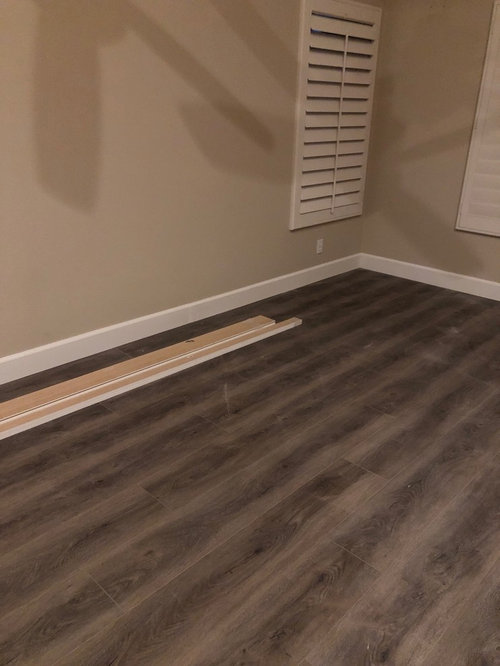
Hello,

Recent remodel project includes flooring throughout the downstairs. Visually, everything looks great. However, certain areas have a hollow/springy feel. The original material was carpet and we have replaced it with Republic Flooring SPC. After bringing it up with the GC, he indicated this was normal and to be expected with floating flooring.

A brief google search seems this is an issue that comes up frequently. Having said that, I can’t help but feel a bit disappointed given the price tag of the overall project. Is this truly, par for the course or should pre-emptive steps been taken to ensure a level subfloor? The topic wasn’t even brought up before install.

Is it too late to make changes? Will time/items being placed on the floor help balance this out?

Given the GC’s tendency to brush this off as “normal”, I’m curious to know what experience or suggestions others have in this situation..

Thanks in advance!

Comments (4)

  • 7 years ago
    I would also like to know the answer to your question. Also, can you tell me the color of your Republic floor.
  • 7 years ago
    I have a couple of areas of “hollowness” with my floating floor. It is normal, you have padding under there, and even with good prep work, it is almost impossible to have perfectly level sub floor underneath. Even with a new build. Don’t let it bother you now, and after a while it won’t be an issue.
  • 7 years ago

    A well installed floating floor can and will feel 'solid'. Ahem...well installed. There are SOOOO many ways a floating floor can BECOME 'bouncy'...it is hard to determine with a single photo.


    Here are some of the links I have found for your flooring (you didn't say WHICH SPC so I'm including ALL links): https://www.republicfloor.com/copy-of-laminate-installation-instr

    https://www.republicfloor.com/copy-of-spc-installation-instruc


    Here are my thoughts with the quick description of your project (I used to sell floating cork flooring and it could have the same 'bounce' when the subfloor prep wasn't done).


    Carpet....sigh. Dearest carpet. How thee hidethe the worst of the worst. I'm not kidding. Carpets HIDE some of the WORST subfloors on the planet. That's why builders LOVE to use carpet. They hide every thing 'wrong' with a build. If this is over concrete, then carpet will hide dips, lumps, bumps, hollows, massive cracks, crumbling concrete, etc.


    If this is over 'wood joist' system then the carpet will hide height variations between underlayment sheets (yes...we've seen builders 'fudge' underlayment thickness because they ran out of one thickness so they throw down another and do a light sand on the edge to cover it up). Carpets hide slopes. They hide wavy subfloors (or subfloors that are too thin for the joist distance = warping of the subfloor). Carpets hide EVERYTHING.


    Once the carpets are gone, the CONTRACTOR must FIX everything. Must. Fix. Everything. All the humps, bumps, hollows, hieght variations, etc MUST be fixed before rigid floors are installed. For that reason, your contractor's QUOTE would have included subfloor prep. And it would look like a range of money: $1-$4/sf for subfloor preparation based on conditions found upon carpet removal. Please check your quote. If it ins't mentioned, it MAY NOT exist.


    If the subfloor prep was NOT done...then we have our FIRST suspect. Yep. First of MANY. Second thing that throws up red flags for me: the installation instructions do NOT mention "underpad" of any sort. That means it is NOT allowed. Please check to see if your installer used 'underpad' (like the stuff found underneath laminate flooring). An example of this is the 'laminate' floor installation instructions SPECIFICALLY MENTION the use of underpad...but the SPC/vinyl does NOT.


    Now we get onto the EXPANSION gap (the thing hidden behind the baseboards). It needs to be a minimum of 10mm thick (7/16" or so). It must be MORE if the long run is MORE than 20 ft.


    Now for the door areas. Do you have t-molding through EACH and EVERY DOOR? A photo will confirm that. And the MAXIMUM RUN (ie. down a hallway, into the living room, around a corner into the dining room and out the laundry room) is 40 ft. Do you have a maximum run that is MORE than 40ft? If you do, is there a t-molding SOMEWHERE in that run? If not, then the installation is wrong.


    The Uniclic system (the click edge system) is very good but it has limitations as to how much it can handle if the floor has long runs. The numbers I've shown above are NORMAL for Uniclic.


    Uniclic MUST HAVE t-moldings in doorways. The expansion gap MUST be observed. The 'flatness' rating of the floor MUST be observed (it cannot be wavy, lumpy or bumpy). If you have runs that are more than 40ft long, you must have 'in-field expansion gaps' inserted to REDUCE the length of a continuous run.


    These things can cause movement or bouncing of a floor. Which is why you need to have a look at the preparation (should have cost you $2-$4/sf depending on how BAD the subfloor was underneath the carpet). You then have to look whether or not an underpad was used under the floor. And then you have to look to see if the expansion gaps (at the walls) were maintained as well as t-moldings through doorways.


    My guess: the subfloor prep was skipped. But you still have to check all of the above. Because if things were missed, you have no warranty due to 'installer error'.

  • 6 years ago

    Hi!


    has the sound get better?

    did you do something to fix it?


    we installed last week Republic flooring SPC and having same problem!

    i'm trying to find a solution before freak out.


    thank you!