Software
Houzz Logo Print

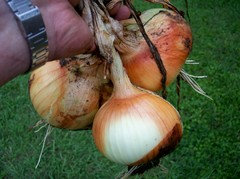
Down here, we put in onions in the fall, and they mature over the winter. I have oodles of big purple onions now. Tops are now down. Planted too many. The question is, how can I store them? How long can I safely leave them in the ground? I do not have a cold place to store them, as you might have over the winter up north. Best I can do is 72F RH50%. Can I dry and store under those conditions? Are we talking weeks or months?

Comments (20)

  • 7 years ago

    What does your rain situation look like this time of year? To cure onions, they need a few dry days in the sun with their tops flopped down, followed by a few dry days out of the dirt in the sun, followed by a few dry weeks in the shade or in a dry basement or shed, spread out. Then they can be trimmed up and stored for quite a while in the conditions you describe - weeks or potentially months depending on the variety. There is a lot of good information about curing them online too, I am not the best expert out there on it. I do know that moisture is just as important, if not more so, than temperature.

  • 7 years ago

    This is the rainy time of year. But I can harvest and lay them out in the sun, and take them in when it rains. Moisture in important - how? As in not getting too much of it, or keeping enough of it? The outside air is pretty humid.

  • 7 years ago

    I do short day grano and granex types in 8a Georgia. Harvest is beginning. I let the tops die before pulling for storage, I then hang them in clusters of 6 from the rafters of a storage shed. Granos will begin sprouting aboud Christmas. Granex in November. Short day onions are not noted for storage. 4-6 months is the best I can do.


  • 7 years ago

    Thank you. I'm also using short day, and I have warm humid conditions like you do. I have heard before that short-day store less well than long-day. I also set out starters in November/December. Survival for several months months hanging in a warm storage shed would be fantastic. My tops are mostly horizontal, but still mostly green. Should I let them brown completely before pulling the onions, or should I pull now, and dry the tops along with the onions?

  • 7 years ago

    My key is when the roots began to let go. I don't dig onions I pull them, so my criteria is mostly brown tops on onions that pull from the ground with minimum effort.


  • 7 years ago

    Great. Now I have a plan! I'm just pulling them now, but it takes a little force to do so. Maybe when the tops start to brown they will release more easily.

  • 7 years ago

    A lot of good information given so far. We try to dry them as much as possible and then chop and freeze them for winter use. It is a tough call as the drying and storage can vary. For us, we have to be careful to keep them dry during the drying process. We have to do it in the house as anywhere outside, like our shed or garage can get too hot even with fans on them. Not easy but worth the effort when you want great tasting onions to cook with in the winter. Good luck!

  • 7 years ago

    It's not about having onions for the winter. This is the south. I'm harvesting onions NOW. I want onions for the summer. Freezing is out of the question. I don't have a freezer that big. The issue is storing them at warm temperatures. Farmerdill says it can work in an outdoor storage shed in GA. Good enough for me.

  • 7 years ago

    Crazy idea. Has anyone tried giving the onions a quick dip in dilute bleach to kill surface bacteria? Then dry, of course. That trick dramatically lengthens the storage life of winter squash.

  • 7 years ago

    I would be leery of the bleach leeching thru the skin of the onions. Unlike winter squash they don't have a thick rind that can not be penetrated by liquid. I also don't think it would do anything to lengthen the dormant period before the onions want to sprout which is genetic to the variety of onion. You could give it a try on a control group of your varieties and report back your findings.

  • 7 years ago

    Yes, that's why I thought it might be a crazy idea. But bleach leaching through the skin isn't an issue, as long as the onion dries out thoroughly afterwards. That is, the bleach goes away. I'm not mainly concerned with sprouting, but rather rotting, because I'm storing them in a warm place. But it is true that warm temperatures can break dormancy. Now, that being said, unlike for squash, which are thoroughly sealed, bacteria can migrate into onions in between the leaves. So killing bacteria on the surface of the onions may not sterilize them.

  • 7 years ago

    As I understand it, one of the biggest bacterial danger points is not the outermost layer but the top where all the leaves gather and start to turn into layers of bulb. I know I've seen, and certainly several of you must have seen, one rotted or damaged layer in the middle of otherwise healthy layers of bulb. That's from top-down contamination. I believe that is the reason all the careful drying is recommended, and I know that is the reason I was always trained to not cut off the leaves or trim the onion leaves down past 4 inches until it had been dried for at least two months.

    I wouldn't be too concerned with sprouting because you can see a sprouted onion and eat that one first, only losing a layer or two. You can't always tell a rotting onion until it starts to smell or gets noticeably soft. To me the humidity is a much greater concern than the temperature. Does anyone have any experience storing them in sand or another dessicant like they used to store winter carrots in northern states?

  • 7 years ago
    last modified: 7 years ago

    Thank you all. I am now convinced that bleach is not smart. OK, crazy ideas come and go. Yes, rotting from the middle-out is more likely, and bleaching the exterior wouldn't prevent that. Humidity is an issue, as we're talking 60% or so routinely everywhere. I like the idea of using onions that start to sprout first. But if sprouting starts when cool weather arrives, that won't be for six months. I am particularly worried about high temps, because ALL the instructions say to store in a COOL place after curing. Geez, I don't have a cool place! I have a converted garage that stays at 80F or so in the summer, and a (shaded, outdoor) shed that goes between 75 and 100F. No room in the fridge for that many onions. My wife won't let me string them up in the house. So farmerdill, your experience with a hot shed is *excellent* news. I think you said you might be able to keep short-days out there for three months. I planted too many, and I'm keeping my fingers crossed.

  • 7 years ago
    last modified: 7 years ago

    Just keep an eye on the root end and when they start to swell use them up. I have a good idea when the varieties I grow will typically start to sprout and either slice them up and freeze them or slice them up and dehydrate them. I'll also sometimes slice up several and make a big batch of onion rings and freeze those.

  • 7 years ago

    Mine go from 4- 6 months depending on variety. Granos hold consistently better than Granex. Don't know about cool, but cool and humid like the vegetable drawer in the refrigerator leads to sprouting in pretty short time.

  • 7 years ago

    I don't know about granos or granex. The sets were just sold as a bundle in the nursery labelled "purple onions". Two bucks for a hundred ain't bad. 4-6 months is even better. I've been looking at food pantrys to donate to. Maybe I don't have to do that.

  • 7 years ago

    I put my onions in one row vertically in shoe boxes, and place them around AC vent. The cool blowing dries green parts really quick.

  • 7 years ago
    last modified: 7 years ago

    The issue isn't drying them. Mine were spread out curing in the sun for two weeks, and the stems are all dry, allowing them to be hung. But if you can't dry them that way, I suppose an AC vent is a good trick. The question was about storage lifetime.

  • 7 years ago

    I store them there till they are gone.