Software
Houzz Logo Print
robert_fischer

Help Planting a Tree Screen in Zone 6a (Ohio)

7 years ago
Hey All,


My wife and I are currently having a house built near Columbus Ohio (zone 6a), and hope to be moved in by Labor Day. We would like to do some fall planting, and are in the process of planning some trees for privacy.


Goal: To create a very dense and attractive screen from our busy road as quickly as possible. Would like the area to be so dense you can't see or walk through it to the road.


Space to work with: About 72 ft by 45 ft. Area is currently dirt and grass, is fairly flat (slight slope away from the road) and well drained. On the north side is the neighbor's driveway, and the south side is my driveway. The east side is my front yard and house (located about 40 ft away) and the west side is the road.


Plan:


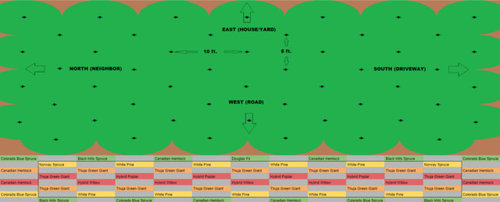
Middle - Fast growing, shade tolerant trees such as hybrid willow, poplar, and thuja green giant. As the trees grow, we will stop mowing this area and let it grow wild.

Near the outside - Fast growing, sun loving trees such as the Norway Spruce and White Pine.

Perimeter - Slow growing trees such as Colorado Blue Spruce, Black Hills Spruce, and Canadian Hemlock. We will also plant some ground cover and shrubs around the edge to fill in the gaps.


My thought process is that having the fast growing, weaker trees in the middle will achieve the screen from the road quickly, then surrounding it with more attractive, slow growth trees will ensure the screen will remain in place if years down the road the hybrid plants die off or get blown over.


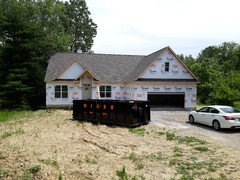
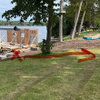
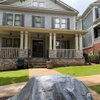
Below is my crude attempt at illustrating my tree plan. Right now, I have the trees 10 ft apart in offset rows that are 5 ft apart. I will also attach a photo of the house from near the road -- the front yard is larger than it looks in the photo, but it will give you a sense of what we are working with.


What do you all think about my plan? Should I move some trees around/use different species? Should they be planted closer or farther apart? Any advice would be very much appreciated. Thank you!


Comments (10)

  • 7 years ago

    Here is the house viewed from the front yard:

  • 7 years ago

    I don't see how your diagram and dimensions work out. I'd think you'd want at least 30' clear from the front of your house to your planned treeline. How much depth does that allow for trees? I've no comments on your tree plan other than I'd focus on screening 15' and lower. That's what, short of elevation changes, will block your view of the road. I'd plan a looser tree canopy with under story trees and larger shrubs filling in between.

    Robert Fischer thanked Leasa Brown
  • 7 years ago

    Hi Leasa, thank you for your response! The front of the house is actually about 100 feet off the road, and there is about 40 feet of clearance between the treeline and the front of the house. I am definitely open to suggestion and plan to make changes. I have never planted trees or much of anything before, so I'm definitely a novice. What kind of under 15 feet screening would you recommend? Preferably something that grows very fast, and we prefer evergreens when possible (at least on the perimeter). Thank you!

  • 7 years ago
    last modified: 7 years ago

    I think you have too much stuff. Many of the trees you have listed will get huge. But if you plan on thinning things out as the plants out grow their spaces then it could work. It'll look good for a number of years initially, yes, so that would fit your goal of getting things going quickly, but it's bound to be horribly overcrowded sooner than later. And I don't think blue spruce will do well long-term in your climate (too humid).

    Robert Fischer thanked L Clark (zone 4 WY)
  • 7 years ago
    last modified: 7 years ago

    Sorry for the small image! I will attach one with larger font below:


    Thank you Ken and Lane for the advice.

    To Lane -- I will reconsider my choice of blue spruce based on the humidity in our region. I do plan to cut down a lot of the hybrid poplar and willow stuff as it grows and as the more sturdy evergreen trees grow taller.

    To Ken -- I love oak trees, but I don't want more trees that are close to the house, and I mostly want to stick with evergreens as I love year round color and not dealing with leaves. I would consider planting them further from the house though. As for the soil, there is definitely a lot of clay (we are actually near Westerville) but I'm hoping that all the excavation will loosen some of the top soil.

    Also, I am fine with the planting ending up being a bunch of tall trees -- in fact, that's what I prefer. Basically, in 20 years (we hope for this to be our forever home) I would love to look out our front door and practically see a forest of mostly evergreen trees separating us from the road. I just want to make sure that I do it in a way that ends up crowded in a good way as quickly as possible without hurting the trees.

    I too worry about the lifespan and strength of "fast growing" trees, but I do prefer to have at least part of this planting growing as quickly as possible. So my thinking was to mix in 3 different species of these fast growing trees so that I don't have to worry about losing them all at once to disease, and surround them with better long-term trees so that as they die/loose limbs, I'll still be left with a little mini forest of evergreen trees.

    I hope this helps give a little more detail into what I am looking to do. I am definitely open to different species than the ones listed above, and I am fine with planting further apart if I can still achieve a dense, forest-like area in the future.

  • 7 years ago

    Ken, I forgot to answer your question -- to keep cost down, we are going to be planting very small trees. Basically, whatever the smallest/least costly option is of each species.

  • 7 years ago

    I too have clay and a new house. I assure you the building process only compacts the clay and makes it more difficult. Do you have a good independent nursery in your area. I suggest you get to know them and discuss your goals. People that know the local conditions are the best ones to get recommendations from. Alternatively, if you know a master gardener or have a botanical garden nearby. Also good resources.

    Robert Fischer thanked lannegreenelag
  • PRO
    7 years ago

    It looks like what you are creating is a forested natural area that is heavy on evergreens with some deciduous mixed in. Nothing wrong with that goal, but I think you are overthinking it, whereas if you did nothing at all, it's going to become a natural area, except short on evergreens. So adding a few around the edge would take care of it.

    To be sure, planting on a 5'x10' staggered grid is planting much too close together. Consider that it is not the central stem that provides the majority of screening. It is branches and foliage. But at that spacing, much foliage is going to be killed off by competition for sunlight, except at the outside of the outer perimeter. A 10'x20' grid is still on the tight side for trees, but much more reasonable. And as a natural area is the goal, one doesn't even need to be very careful about keeping their rows very organized. If you really want natural, plant nillywilly so as to get rid of the plantation effect.

    IMO, "tree time" is not that slow. Many trees sprout from seeds that become 5' to 8' whips the first year. The second year they are small branched trees that are substantially over one's head. I think trees that grow from seed planted directly in the ground move must faster than those grown in containers that are transplanted. Many of the latter take a year off from growth. Give the goal of economy, I would plant this whole project from seeds, most of which could be obtained from sellers on Ebay. The "secret" to fast growth is supplemental water when rainfall falls short. And a little fertilizer.


    Robert Fischer thanked Yardvaark
  • 7 years ago

    A mega-buck neighbor has done this with closely planted specimen size conifers on v large lot in city on main thoroughfare. Looks lovely, except some of his trees near the road have to be replaced each year because of salt damage. $$ Too, consider his example of sprinkling in some big junipers for excellent color & texture contrast.

    I would skip the poplars and willows as PIA PDQ & I endorse recommendation of oaks instead. Consider adding a layer of suckering shrubs that will add color and, ultimately, density, at around 8-10' tall. Consider red-twig dogwoods and bottlebrush buckeye, divisions of both of which you can dig from a pass-along neighbor or easily propagate yourself from twigs. Also for this layer, be watching seasonal sales for the big hydrangeas and viburnums....very common even at big box stores. Pamper the poor mistreated things near your current house through July & August, then properly plant in fall.

    Robert Fischer thanked samarnn