

Painted Maple/Plywood Cabinets Vs MDF
Back again, hope you guys aren’t too sick of all my questions! We are getting custom painted cabinets with maple doors and Painted plywood boxes and shelves. My contractor says that he really doesn’t like installing anything that isn’t plywood because it takes so much extra effort to avoid damage the MDF. We had this is exact setup in our other kitchen and we were very happy. But,I’ve also read a few posts where people said painting maple was a waste.
We are pretty set on our choices at this point, but what do you prefer as a base for painted cabinets?
Comments (28)
 7 years ago
cabinets should be water resistant, wipeable, and are usually melamine lined. I don't get the "painted boxes and shelves" . MDF or plywood are both used, commonly, in carcass construction. The important thing in todays components , esp if an independent local cabinet maker is doing this....would be the drawer box construction, and choice of glides, as drawers are now such an integral part of kitchens. Maybe go through specs with him a little more...did he say "white interiors" and you thought "paint" ?? I don't think painted interiors of custom cabinets would be considered standard.
Related Professionals
Elizabethtown Kitchen & Bathroom Designers · Charlottesville Kitchen & Bathroom Designers · London Kitchen & Bathroom Designers · Hot Springs Kitchen Remodelers · Kenosha Kitchen Remodelers · Rapid City Kitchen Remodelers · Middletown Custom Countertops · Trenton Custom Countertops · Vineland Interior Designers & Decorators · Minneapolis Interior Designers & Decorators · Columbia Bathroom Remodelers · Farmington Bathroom Remodelers · Manchester Kitchen & Bathroom Designers · Trenton Kitchen & Bathroom Designers · Missoula Kitchen & Bathroom DesignersMomofthree Ma
Original Author7 years agoThere is no mention of anything melamine, nor did anything in our last kitchen(different custom shop). How would I recognize melamine as opposed to painted wood?
- 7 years ago
So in your last kitchen....when you wiped off the shelves you didn't know if these were painted or lined surfaces? Best thing other than sheer blind trust in your cabinet guy is to get an issue of fine woodworking or even book at the library and read a chapter or article about cabinet construction: carcass/drawers/sides/backs/drawers/glides/hinges/doors /and hardware /finishing. Different people find aspects interesting ,valuable , or not. But using an individual, means his procedures/techniques are his own and if not questions then viewing the work would be the minimum I would do if all the technical things bored me or no time for it, whatever.
Momofthree Ma
Original Author7 years agoSo... in the last kitchen we were told it’s was painted maple with plywood boxes. I was a novice and didn’t know to ask any more. Our shelving was beautiful wood(not white on the inside), and I assumed it was maple, people on Houzz are telling me that is highly unlikely. I do not live in that house anymore, so l can’t prove to anyone what it was. But, this time we are doing significantly more cabinetry and downgraded to plywood shelves to save money, which makes my original point feel more valid, that I believe I had maple shelves before.
I guess, my only ask is...is there any downside to plywood boxes and shelves? We can afford it, but is MDF/melamine a superior surface for painting?Momofthree Ma
Original Author7 years agoThanks Cpartist! I don’t know why I am second guessing every detail this time around, but I am. I lived in the other kitchen for 4 years and I was very happy with my painted maple/plywood cabinets. Thanks for the input, I really appreciate it.
- 7 years ago
Paying extra for functional equivalency is just pound foolish, not penny wise. Furniture board boxes and painted MDF will be just a durable as anything else. It’s all Europeans have used for 70 years, with none of the dire issues that Americans seem to think happen.
Momofthree Ma
Original Author7 years agoGreen designs, can you point me to a highly respected cabinet company that does that kind of construction? Just trying to compare and I feel like it’s difficult because all I know is custom maple.
- 7 years ago
That is the standard construction for almost every line out there. Plywood is an up charge. The reason contractor’s like plywood carcasses is because it makes their installs easier. It’s about 20% lighter, because furniture board has more wood in it than plywood does. It’s denser and smoother as well. MDF is preferred by everyone inside the industry for paint. It expands and contracts less, is more stable, and provides a superior finished product.
 PRO7 years ago
MDF is preferred by everyone inside the industry for paint. It expands and contracts less, is more stable, and provides a superior finished product.
This.
When I first learned this cabinet factoid you coulda knocked me over with a feather - completely shocked.Momofthree Ma
Original Author7 years agoThe.n why are all the custom shows around here making everything out of plywood and maple? I wasn’t even given this as an option and this is the second time I am doing custom cabinets. I guess it’s consumer perception that plywood and real wood doors are better?
 7 years ago
Or some of the custom shops don't like to work with mdf. It's very dusty and requires some different techniques.
- 7 years ago
Because they like to tap into wood prejudice and ignorance to make more money. It’s marketing. Selling the sizzle and not the steak. Local Custom can be the worst quality cabinets that you can find. The word is NOT a synonym to quality. All custom means is adjusted to your needs. A lot of levels cal makers don’t build anything. They buy parts from everywhere and assemble. Or hack Chinese RTA cabinets. And then finish with housepaint. Or, foist that job off onto the job site painter.
- 7 years ago
I prefer plywood shelves over MDF. I don't want to worry about if they used the "right" grade of MDF to get the one that is strong enough for shelves and won't sag. My cabinet maker used plywood for all of my shelves and the bottoms of drawers. The boxes are plywood and are finished on the interiors with maple veneer and a clear coat to be very light in color.
One of his big things was, "I don't want any of that chinese plywood in my shop" and he has good relationships with a local mill ... so that may have also swayed his decision. I have taken apart furniture made from both kinds of wood and IME, furniture made from plywood resists destruction better than MDF. So that makes me biased toward plywood as a stronger option. Momofthree Ma
Original Author7 years agoGreen designs, I like plywood, lived with it for 4 years and had no issues, so I just don’t feel totally comfortable taking a chance in MDF, even though I’m sure it works for some people. But, I was looking for facts in order to make my decision /These are not small custom shops where one guy/gal makes and installs. These are large custom manufacturers in New England, we just happen to be lucky to have great options here. No cheap Chinese plywood either.
- 7 years agolast modified: 7 years ago
All of the major cabinet manufacturers use furniture board boxes and painted MDF. That is, a conversation varnish over MDF. Who knows what junk local makers use. A lot of them are just woodeorkers, not cabinet makers. They certainly don’t use the same tough finishes that a factory uses. Which is why so many have big issues with wear in just a short time frame. Manufacturers are structured around charging the heck out of people to “upgrade”, which it is decidedly not. Thats where the profits are structured a job. Actual wholesale Costs are virtually identical.
Fact #1. Particle board isn't furniture board and plywood isn't plywood."Particle board" is the crappy 14 pounds per square inch stuff that those "decorator" tables are made from. You know the ones that fall apart when you set a sweating cold drink on them. Furniture board uses similar size wood particles but uses much higher pressures and better glues. The higher pressure does a much better job of locking the wood fibers together, much like the difference between a hank of wool waiting to be spun vs that same wool that has been locked together into fabric by felting. The glues used could contain formaldehyde, or not. Most commercial cabinet companies use low emitting furniture board that is pretty green. Some use zero formaldehyde furniture board, for which you'll pay an up-charge similar to plywood.
As for plywood, well there are a lot of different grades of the stuff on the market. All the way from Chinese imported stuff that's full of voids and formaldehyde (and who knows what other toxic substances!) to high quality Canadian or European no VOC emitting cabinet grade stuff. Most manufactured cabinet companies use the low to no emitting good quality stuff. Most custom guys, well the vast majority of inexpensive "custom" guys don't exactly use the top grade stuff. How bad the plywood is will depend on how cheap your quote is. They have to cut costs somewhere to give you a cheap quote, and the cabinet boxes sound great if they tell you they are "all wood"! Ha! Cheap Chinese plywood is so much better than good quality particle board you know, because it's reeeeel wood!
You have to actually ask about more than just the type of box materials. You have to delve into their quality and sourcing as well.
Fact #2 Cabinets using both furniture board and plywood will both meet the fairly rigorous KCMA standards. These tests simulate years of actual real world usage. (Read up on it if you like.) If both are constructed properly with the appropriate methods for their type then they will look unfashionable to you before they have any structural failures from ordinary wear. KCMA testing has factually shown this to be the truth. Abuse is another story. None will stand up to abuse. The hinges will pull out of both boxes if you use the doors to lean on while you are rummaging through the interior and other abuses. Now, you can overbuild them to your hears content if you have the budget. I think titanium cabinets would be just super!(They'd be fireproof too, Antss!) But you will get no "better wear" returns for the money spent in the real world. You do get one-upsmanship bragging rights, if that kind of thing is important. And, it really IS important to some.
Fact #3 Neither plywood nor furniture board is "real wood" if you want to be absolutely factual. Both are wood by-products. One uses very thin layers of rotary cut veneers glued in cross linked layers while the other uses smaller particles of wood that are compressed into a crosslinked solid. The particle board is actually more wood per square inch than is plywood if you want to get technical about it. It has more wood fibers per square inch than plywood. It's heavier and denser. Which brings us to another trade secret as to why cabinet makers and installer like plywood better other than they can charge you more. It's easier on them to work with because it's lighter. Not because it's so darn superior as they would have you think. The terminology is clearly chosen to make you think YOU are inferior if you don't want to "upgrade".
Fact #4 There are minor , but not truly significant, performance differences.
Plywood is superior to furniture board in it's resistance to deflection. It will hold more weight on a shelf without sagging. That's why you don't see Euro cabinets (which have used furniture board for MANY decades with no problems) larger than 36". If you have plywood shelving, you can span further distances. If you don't have any cabinets larger than 36" or plan on storing your entire cast iron collection on a single shelf then this performance discrepancy should be a non-issue.
The water resistance thing is also a bit of often repeated propaganda. If a flood/leaking faucet/water event occurs, both substances will be affected. Plywood will delaminate and MDF will swell. The degree of affectedness will depend on the amount of time that the material is in contact with the water and if the materials are fully sealed on all surfaces. Shelving and side walls should have the cut sides sealed, and many cab lines don't offer that. Same with the portions of the cabinet that touch the floor of the underside of the base. This is where using a custom maker can work to your advantage. Or, just do it yourself for the sink base and the cabinet adjacent to the DW after they've been delivered. You could use polyurethane or whatever leftover paint you already have on hand. A couple of coats on the exposed ends and then caulk the interior seam where the cabinet floor meets the cabinet walls. I'd do this on plywood or furniture board. I personally have a painted (on all 6 sides) MDF panel in one of our sunroom windows (To be able to put a cat door into it.) We don't have enough overhang on the sunroom and the wind just creates these great sheets of water that run down the window and drown the panel and leak inside from the cat door. It was supposed to be a "temporary" solution, but that temporary solution is at least 15-16 years old now. Exposed to every rainstorm. Zero problems. An I have a plywood bathroom cabinet that had a bit of a leak a year or so ago. It looked fine at the time. It's now showing where the water delaminated it. Mold grew between those delaminated layers. It's DISGUSTING.
And we thought it was just fine right after the leak. It didn't have any visible damage.There is one other area where there is a bit of a performance difference. Plywood will hold screws better than furniture board will. But, that's very misleading. You really don't use screws to assemble furniture board cabinets. Remember what I said about the right hardware for the material? Camlocks, doweling, glues, and just a few screws designed for furniture board are what the right hardware is. If you use the wrong hardware, of course one is "superior" over another.
Yhe absolute truth is that well constructed cabinets of either kind will ling outlast your attempt to create a "timeless" looking kitchen and will become visually dated to a certain era and thus unfashionable. They;ll survive longer than your wanting a white Shaker kitchen will. Poorly constructed cabinets of either type may not even outlast their install before you have problems with them. You simply cannot say that one style is "better" than the other without using a LOT of qualifying statements. I replaced crappy thin plywood cabinets in my kitchen with middle of the road furniture board ones. The ones I have now are certainly better than the ones I had, and are certainly lower in perceived quality than Plain and Fancy ones. The only real long term wear difference that anyone would be able to tell down the road is for the doors, NOT the boxes. That;s where most of the difference in cost between cabinets comes from. P&F just have absolutely lovely finishes. And that's why I went with furniture board boxes in a brand that offered better finished doors than a budget line. (How much do you think KD's make? LOL! We're probably all on a budget for much less than most of our clients!) I only wish I could afford top of the line cabinets. But it would't be for "better" boxes!
- 7 years ago
So, we are in talks with an Amish gentleman to build all the cabinetry in our home. We are early in the process and don’t even have out layout done yet, but I do know I want painted cabinets in the kitchen. He suggests using soft maple for the cabinet doors. He says hard maple has a tendency to crack or split in the joints with paint. He says he would use the maple for the box as well and use plywood for the shelves and “back” of box. I suspect he doesn‘t do any work with MDF.
Momofthree Ma
Original Author7 years agoPam A, same thing here. Thanks!
Me, My contractor and our cabinet supplier doesn’t want MDF or Chinese plywood in their products. I was just wondering if I was missing something on the MDF, but no one has given me a reason so far why it’s better, so why wouldn’t I go with the real stuff?Momofthree Ma
Original Author7 years agoLive wire oak, we had a quote from showplace cabinets too and those were plywood boxes and shelves. The finishes on our cabinets are baked on factory finishes, we just happen to have lots of custom options in this area that are actual cabinet making factories, not carpenters. We are way too rough on stuff to not have a super solid product.
Momofthree Ma
Original Author7 years agoLive wire, thank you so much, this is a wealth of information, and so interesting! I don’t think I can do thermofoil, maybe I am having bad 90’s flashbacks, but I think it looks really plastic-y.
I like the look of wood, the little cracks that sometimes form on the door joints, to me that’s how you know it’s painted wood vs something else. When I looked at the showplace cabinets, they had MDF doors, and there was just something that looked off to me, but I don’t know if it was just bias. I kind of wish he had showed me both doors without telling me the material.
I have to talk to my contractor tomorrow on a different issue and he doesn’t like to install MDF, so I want to pick his brain again on that. I haven’t ordered my cabinets yet, so I still have time to make changes if necessary. We are talking about $30k in cabinets, so I just want the best, most durable painted product for our money.- 7 years agolast modified: 7 years ago
Find out the finish process and materials. That is far more impactful of durability than is the material underneath the coating. Once it goes through the paint line, you can not visually tell the difference in material. The only physical difference is a MDF door will be heavier. Any painted wood cabinet that isn’t as smooth as an MDF cabinet has not been sanded and prepped properly. Painted wood should not have any visible graining, ever. That’s an F in finishing school.
- 7 years ago
Just my 2 cents briefly on a few things.
Honestly, moving from plywood to MDF is a bit silly. In my opinion, good plywood will be better than good MDF, while poor quality plywood is probably worse than poor quality MDF. But the entire discussion is a bit silly to begin with, as they are both going to perform adequately and each have different failure conditions.
As I said on another thread recently, it is like choosing between a car with a top speed of 120 mph versus a car with a top speed of 140 mph for a daily commuter in heavy traffic. In most conditions you are not going to see a difference between the two. There are a few conditions where MDF will fail when plywood wouldn't and vice versa.
-----------
MDF has certainly gotten good recently, but the real reason it is preferred in cabinet making is because of its toolability. Plywood requires sharp tools to avoid tearout, where MDF doesn't. For demonstration purposes I have seen perfect cuts on MDF when running it backwards through a dull saw, if you try that on plywood it will look like a dog chewed through it. Blades are expensive and time consuming to change, so a product that increases the life of blades 10 fold is a godsend.
----------
Finally, you can't talk about the formaldehyde in plywood glues while advocating for conversion varnish. There is a reason that conversion varnish is illegal in Europe. Conversion varnish is catalyzed with Xylene (which is essentially the same thing as formaldehyde... in fact, all modern studies of formaldehyde include Xylene). Conversion varnish manufacturers will use chemicals to bind some of the formaldehyde in conversion varnish and special mixing techniques so that only free formaldehyde is catalyzed during tests. In reality, most manufacturers are going to want the far superior performance of more catalyst and they are going to use standard mixing techniques. So the formaldehyde that is released by conversion varnish in practice is many times what is being produced in lab tests.
Momofthree Ma
Original Author7 years agoThanks Bry and Live wire...I will double check the process, but I have actually laid my hands on their product and it’s better than anything else I have seen. My kitchen designer knows all of the cabinets product lines and says that this one is comparable to lines costing twice as much. I really just wanted to know what the fuss was about, bc the MDF vs plywood debate seems to elicit strong feelings. Thanks again for all of the info, really helpful!
- 7 years ago
Good information on here! My hubby designed and built all of our kitchen cabinetry. We went with maple plywood boxes and shelves (the plywood shelves were joined with solid maple at the front of the shelves to hide the plywood edge) and shaker style doors that are solid maple with a plywood inset. We painted our cabinetry because we thought it was most appropriate for our house and gave us the look we were going for. My hubby is a talented woodworker, and he has built freestanding cabinetry that IS all solid wood with zero plywood... but that has been out of walnut and we had no desire to paint that stuff. My hubby refuses to work with MDF (it’s so heavy!) but we like the natural characteristics of wood... and when we want painted wood we want it to look like painted wood and not like plastic. So with painted wood, you can often see a little bit of the grain show through ever so slightly, you will see tiny little cracks in the paint at some of the joints... we wanted that. Hubby went with plywood boxes because it’s cheaper than solid wood and it has great stability. He went with plywood insets in the doors because it’s cheaper, less work (because he didn’t have to join strips of wood) and because there wouldn’t be any paint cracking down the centers of the doors where real wood would’ve had to have been joined together. He could’ve used MDF in the same way, but he doesn’t like to work with it and we wanted a little bit of wood grain to show through. We wanted plywood for the shelves and drawers because we were going with very wide spans in a lot of places, wider spans than is typical.
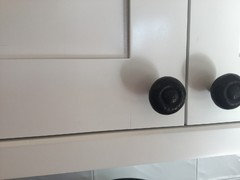
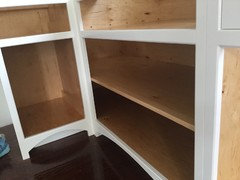
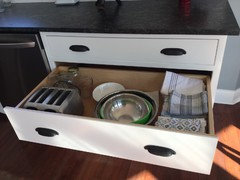
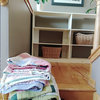
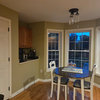
Basically, there are a gazillion different ways to build cabinetry. There are ways that are better for larger scale production. There are pros and cons for each method, but many ways will still give fantastic results. Many people think it’s a waste to paint solid wood... it does require a little more care to keep painted wood looking great long term compared to stained wood in my opinion, but we thought it was worth it. I included some photos that show our before/after, a closeup of our paint job (we did ourselves using Benjamin Moore Advance primer and paint with a spray gun in our driveway) and you might be able to make out some of the texture and very minor cracking, a closeup of a lower shelf during construction phase, and a photo of an open drawer that shows we left the insides of everything a natural color... the only product on the inside that I used was clear shellac. I did decided to use a mix of cork and plastic liners in my drawers and on my shelves after a while because shellac alone doesn’t look great if you get little water stains on it and I decided I didn’t want to wax everything that had been shellacked so we laid down liners instead. The insides of my cabinet doors are natural with just shellac as well. I hope there is helpful information for you in this. Basically, if you feel comfortable with the craftsman you’ve chosen for the job, they are going to have a fairly set way of how they prefer to build things, and there’s no one right way to build cabinets, so if you feel comfortable and it’s a price you’re ok with, and you have seen enough of their previous work, I’m sure it’ll all be fine.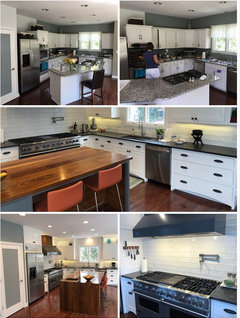
- 7 years ago
This subject always comes up and every time there is a bit of correct information mixed in with a lot of incorrect information mostly from people who have never built anything themselves. There are all types of products and all types of quality in the market place. Different shops will do things differently because they either don't know, don't care, concerned with cost or that's just the way they've always done it. I can site more than twenty possible options just on cabinet box construction alone. Here's just a few core materials I have laying around. Each has their place depending on what you are doing.
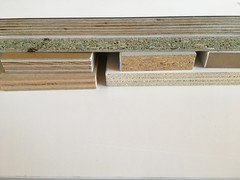
You want plywood. You want MDF . You can have both. Two of those pictured are plywood with MDF face.
Momofthree Ma
Original Author7 years agoSkmom, love your kitchen! You are so lucky to have the skill to do the cabinets yourselves and get a finished product like that, well done!


User