Software
Houzz Logo Print
labeachberry

How can I "pinch to an upward facing bud"?

7 years ago
last modified: 7 years ago

I have a 3-year-old manzanita that's getting too dense/bushy for my taste, so I want it to start directing more of its energy toward vertical rather than horizontal growth. I've read online that to redirect growth upward one can "pinch to an upward facing bud," but I haven't been able to find either online or in gardening books what it is that an upward facing bud actually looks like, or how you can go about pinching "to" it. Any guidance appreciated.

Comments (18)

  • PRO
    7 years ago

    post a picture of the whole plant from the view that's most important to you.

  • 7 years ago

    If you want it less dense then thin it out rather than attempting to fiddle with tip growth. Keeping in mind that once you cut something off you can't put it back.

    labeachberry thanked Embothrium
  • PRO
    7 years ago

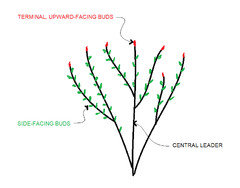
    In a typical tree grown from seed, growth of the above-ground parts often begins with the formation of a single upright stem. The terminal bud on this stem is an upward facing bud. Throughout the life of the tree, as the stem grows it forms the central leader and always terminates in an upward-facing bud.

    Along the side of the stem would be leaves. Where these leaves originate on the stems is the same location where side-facing buds are later formed, When they are ready, they will begin growing as side-aiming stems rather than upward-aiming ones. (This is the process of branching.) As these same stems continue growing, they will often turn upward as they are always seeking light. They started out as side-aiming stems but are later turned into upward aiming stems. Now, the buds at their tips are upward-facing terminal buds. Along their sides are side-aiming buds forming wherever leaves are.

    The illustration shows how the growth that begins as side-facing buds, branches, turns upward and forms stems which terminate in upward-facing buds.

    "Pinch to an upward facing bud" means to remove side buds and leave the upward facing bud untouched. Sometimes this is done while they actually are just buds. Sometimes it is done after their growth begins and they are small stems ... as it is easier to do and more obvious what direction. things are growing in.

    If you post a picture of the tree, it would be much easier to comment about what pruning would be useful. And describe your vision of the form of the finished product ... its overall mature silhouette including the trunk structure.

    labeachberry thanked Yardvaark
  • PRO
    7 years ago
    last modified: 7 years ago

    My explanation is not about Manzanitas per se, but about where the side and upward facing buds are on any woody plant, and how they got there (branching and upward inclined growth.)

    The word "pinching" implies that one is removing fresh, soft, new growth or buds with their fingers, not pruning tools. It means doing the pruning work early in the growth cycle in order that it can be done with bare fingers. If one removes the same plant parts a few weeks later, with cutting tools, it's just "pruning." One could pinch side OR upward facing buds. Or, one could cut the same plant parts with pruning shears. Thinning and pinching are not opposing actions. One could thin by pinching, if they did it early enough in the plant growth cycle. But this is usually not the case as it requires anticipation of the form that growth will take.

    Genetics and light are two natural factors that substantially influence a plant's form. A gardener takes advantage of these where he can. But pruning is another factor that profoundly influences a plant's form and is totally under the control of the gardener. If one wants a plant to grow upward, then he would not cut off upward oriented growth that falls within the confines of his vision (the overall silhouette) for the plant.

    A manzanita may not be a tree proper. But it is frequently grown in the multi-trunk tree form (with a canopy raised above and separated some distance from the ground.) The creation of this form shares many of the same pruning goals, regardless of the species. To foster this form, one usually needs only remove lower side branches, incrementally, as the plant grows. Because the overall growth direction of a plant is generally upward like a candle flame, a removal of older, lower growth usually spurs an acceleration of new top growth, as the plant tries to reestablish the balance between roots (of which nothing was removed) and top.

    I keep pleading for a picture because pictures often give clues about influencing factors that OPs don't know to mention. And pictures can make it easier to communicate information back to the OP. So can we get one?

  • PRO
    7 years ago
    last modified: 7 years ago

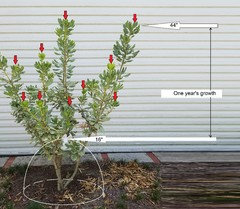
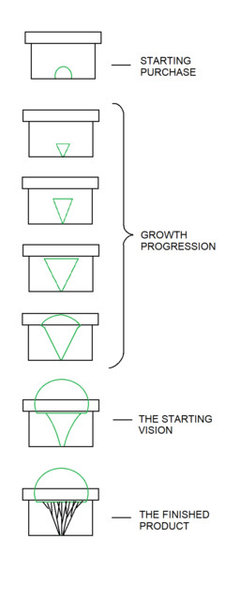
    Though this is a completely different plant (a Pittosporum, which is generally grown as a shrub) you might be able to glean some useful information from the process of my making it into a tree form. This plant was purchased last mid-summer -- so one year ago now, as a shrub. It was 16" tall and I've tied a rag around the main trunk to mark that height. The ghost dome indicates its overall form at purchase. It is now on its third flush-of-growth. All along, I've pinched off only side growth that falls outside of of the vision (see picture below.) As I've explained above, what starts out as side growth often turns into upward growth. (Red arrows mark the terminal, upward-facing buds.) This gets to remain as long as it falls within the outline of the vision. Since the vision is as a tree form (with a canopy raised above the ground) I'm not letting the plant waste a lot of time and energy growing side branches that fall outside of the final form. However, I'm neither removing anything that falls within the vision -- leaves or branches -- so long as it is generally upward aiming ... because this portion of the finished product will eventually be only trunks and this is the process of their formation.


    [I'd better head off the criticism that I know is coming about this little "tree" being planted so close to the building. It doesn't show in the picture but the depth of the bed is only about 4' as this is a narrow side yard, much of which is taken up by a walk that fronts this bed. The tree is at the center of the bed depth. And actually, as it's against a wall, it's only going to be the front half a tree, the same as a wall sconce is only half of a lamp. It's flat at the back side and not allowed to grow in that direction.]

    The top of the tree form is quite gappy but this doesn't matter now. There are many lower upward-facing terminal buds positioned to fill these gaps. If the highest trunks get too much ahead of the lower ones, I'll snip them a bit shorter ... but I doubt it will happen and usually this fixes itself as growth evens out over time. There may be a tendency for the outermost trunks to lean further outward -- outside of the vision outline. If this happens I'll encircle them with a cord, around the whole tree, and pull them in to comply with the vision, so it is really no worry. I preach all the time about limbing trees up, but am not very rigid about it during this trunk formation phase. In some cases I don't bother with it at all until the head of the tree begins to form. Some of it happens naturally as the bottom of the tree is shaded out by the top.

    Though they are both botanically "shrubs," creating a Manzanita tree form would include details different from doing the same thing to a Pittosporum. But the process of creating the multi-trunk tree out of either is predicated generally on the same principals. The many quirks and variables that occur from species to species just makes this process more fun and interesting.

    The sketch below illustrates the process of growing what one envisions.


    While there are lots of considerations, including coordinating with a plant's natural capabilities, pruning is primarily cutting a plant so as to induce the form you wish it to be. Hopefully, one would wish it to be in a form it is actually capable of achieving! But that is not difficult as plants are very plastic in their young years and wildly adaptable to various situations. In spite of the cruelty nature forces onto plants in shaping them, they prevail as if it matters not a whit.

    labeachberry thanked Yardvaark
  • 7 years ago
    last modified: 7 years ago

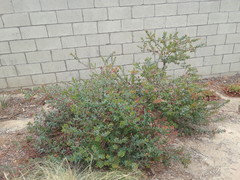
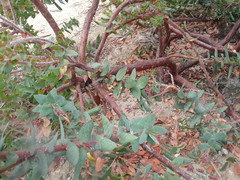
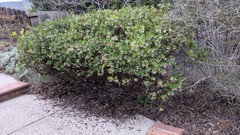
    These pictures are of the Paradise Pajaro manzanita in my garden. The first picture shows that a corner of the shrub is growing upward, but by far most of it is growing outward. That's why I wanted to know how to "pinch to upward facing buds" for more vertical growth.

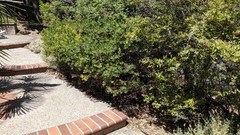
    The second photo, of the crowd of largely horizontally-growing branches at the center of the shrub, is something I thought I'd start dealing with in 3 or so months, pruning a few of them to begin "lifting" the crown of the plant.


  • 7 years ago

    The natural habit of this particular species is a sprawling mounding shrub and those are the attributes it's planted for. It isn't designed by nature to have a lifted crown. If it isn't the shape you want then perhaps it's just the wrong choice for you. I don't think there's any point fighting its genetic disposition and trying to force it to be something it can't. Maybe you have a better spot for it somewhere else and could put a differentshrub in that position which is more suited to being up on legs.

  • PRO
    7 years ago
    last modified: 7 years ago


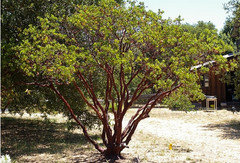
    I disagree that Manzanita is genetically disposed to to sprawl sideways. In most cases, It commonly grows in a form like the following, and the Pajaro has the predisposition to this form.


    In the desert of Mexico, plants in this form stretch on endlessly. (I wanted to take some home but didn't think they would like the Florida humidity.)

    If mine was squat, the first question I'd be asking is, "Is there enough light?" As long as it's in a full sun position, it should perform in spite of the house blocking off its back side. If it is less than 8 or 10 hours of direct sun, I'd move the plant to a better location.

    Now, I have no idea of your soil fertility, Manzanita's love, or lack of love for fertilizer, but I find that installed plants often don't have an easy time of finding fertility until they're in the ground for 2 or 3 years, in which case they can benefit from supplemental fertilizer. An easy way to explore this is with water soluble fertilizer like Miracle-Gro. Water with it and see if it brings any new growth. Water soluble fertilizer does not last long in the ground (2-3 weeds), so if it produces a positive effect, you'll need to develop a plan for fertilizing until the "tree" is connected to the soils natural fertility. Scratching some granular fertilizer into the soil at the beginning of the natural growth cycle (or midway if it has been missed) would be better than continuing with water soluble.

    After the light and fertility are verified, and if and when new strong, centrally located growth begins to appear, I would take the opportunity to lop off in their entirely any of the very lowest, side-sprawling branches, possibly removing as much as 1 /4 to 1/3 of the total plant. Removing the side branches will tell the plant that things are out of balance as there is too high a ratio of roots relative to above-ground portions. To the growth spurt that has already started it will add more oomph in order to compensate for the branch loss, and in an effort to replace them. But since the new growth is generally upward, there is a likelihood it will be the direction of new branches (which will become trunks.)

    As someone who has not been able to observe Manzanita throughout its natural life cycle, it is possible that the sprawling manner in which it is growing now IS its nature. Some plants sprawl when young and then head skyward a bit later, after they have their tentacles well attached. If that's the case, then having it develop the form you're after may require you to do nothing at all, but wait and see. Knowing that light and fertilizer are something to be considered, one has to test the waters insofar a what could be the problem (if any) and proceed according to analysis of their observations.

  • PRO
    7 years ago

    I meant to mention that "pinching to an upward-facing bud" is not really what's needed here. What I described above is more like pruning off lateral growth (when the plant shows signs of wanting to grow) in favor and hopes of upright growth.

    labeachberry thanked Yardvaark
  • 7 years ago
    last modified: 7 years ago

    Agree with assessment that trying to force the specimen asked about here into a tree shape is not likely to work out well - that it is too much going against the grain (the grain of the plant). With the sequence of diagrams posted above, where a rounded dwarf shrub somehow becomes one of the stick trees the forum participant seems to think are desirable being borderline absurd.

  • 7 years ago
    last modified: 7 years ago

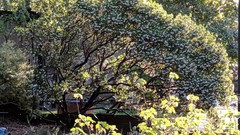
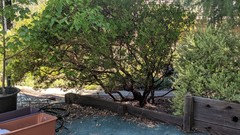
    I have two Manzanita's that might benefit from some direction, so I'm bookmarking. I would love to leave them alone, but they are growing in to paths.


  • 7 years ago
    last modified: 7 years ago

    Hmmmm......at least three responders who are quite familiar with this plant have countered trying to artifically impose an unnantural structure on a plant that is not inclined to grow in that manner. And yet there is a strange insistance that it can and should be by someone located in Fl that is as far from the plant's natural conditions as possible. This lack of familiarity is coupled with instructions to ferilize a plant that requires NO fertilizer at all and actually will react very poorly to it.

    Here are descriptions of the shrub from several local sources that sell it: " Paradise Manzanita, is a sprawling evergreen shrub, that can be used as a ground cover or small border. " "Arctostaphylos pajaroensis 'Paradise' is a robust selection, spreading in habit with zigzag trunks." "Paradise Manzanita is a showy, spreading evergreen shrub and can be used as a border or as groundcover. Expect a height between 3' and 6', speading to up to 10'."

    A low growing, sprawling shrub that wants naturally to be quite a bit wider than tall just does not make a good candidate to limb up into a tree-like form. It goes against its natural habit. Not all manzantias have this habit - some cultivars/hybrids are indeed more tree-like in form - but the selection in question most certainly does.

    Landscape design is not about the molding of plants into shapes you think they should possess - no reputable pruning site ever recommends that approach - but to select the correct plant for the look you want where you want it. Right plant, right place. If this is not the right look you are going for, then perhaps moving or replacing with something else as floral suggested is a better idea. The alternaive is to simply leave the plant alone and let it increase in height as it might naturally be inclined to do. At only 3 years old, it is not anywhere close to being a mature specimen so has not yet achieved a mature size in both width and height.

  • 7 years ago

    There are about 60 species of Arctostaphylos (botanical name for Manzanita), plus some hybrids and selections. Some species are low ground huggers, some are small trees, some are very open shrubs, some are a little denser. Some are adapted to cool areas with decent winter rain, others are native to Baja California with its much hotter drier conditions.

    The OP is best off buying a species or hybrid compatible with the location's climate, that will grow into the desired shape. Tip pruning the plant in question will probably make it bushier, not taller.

  • PRO
    7 years ago

    @nanelle, why aren't you narrowing the V-shape trunk system from the ground up, by pruning, in order to get your path back?

  • 7 years ago
    last modified: 7 years ago


    I guess.....but e trunk on that one is my favorite part!

    I think that one is Howard McMinn, maybe 25 years old. I think the other one is something about sunset. i love them better than I love the path, but it drives my husband nuts.

  • PRO
    7 years ago
    last modified: 7 years ago

    It is either true, or not true, that the OP's Manzy is capable of attaining upward size, and they are the one who'll have to make that determination. My advice (" you might be able to glean some useful information from the process of my making it into a tree form ...") is predicated on IF it is, then the advice applies. If it's not, then of course, it wouldn't ... as I'm not saying to take a plant that only grows low and spreading and make it into a tree! A supposedly intelligent person would understand that. Many Manzanitas are capable of it and do it naturally.

  • 7 years ago

    Nanelle those are beautiful. Thank you for sharing.