Software
Houzz Logo Print
riverrat1

About to meet with builder for the 4th time

7 years ago

We have been in the planning stages for our new home for 3 years. We've worked very closely with an Architect and have been very pleased with the process. It's now time to sign a contract with the builder and we would like for him to consider signing an AIA contract for our build. He is resistant saying "I have paid a lot of money on lawyers to draw up this contract and everyone has been OK with it". Well, I've paid a lot of money for an Architect and an attorney. There are several things in his contract we are questioning/concerned with the help of our attorney and Architect. He is aware of this and asked for a meeting today.


We really like his work and he's a personable guy. He's built 4 custom homes in the area that we would build. We've talked with several of his references and they all said things were great during their build and are very happy with the outcome.


We do have another builder that we interviewed twice that would be happy to sign an AIA contract.


I guess my # 1 question is, why would a builder not sign an AIA contract? Am I missing something? An AIA contract does a good job of protecting both the builder and the home owner. I'd like to hear what you guys think before I meet with him at 12:00 TODAY.

Comments (33)

  • 7 years ago

    Has the builder provided you a copy of his contract and has your attorney taken a look at it? Without knowing the details of the builders contract I’d venture to guess that there are additional or revised provisions in it that protect him more in certain situations compared to an AIA contract. If your attorney hasn’t taken a look at the builder’s contract I think that would be a good place to start. Good luck!

  • 7 years ago

    Yes we have had a builder contract in hand for 4 weeks. Attorney has had the copy for 4 weeks. Builder has a copy of an AIA contract for 4 weeks. I can't get into too many of the concerns on this website but for an example:


    At anytime he can change material without notifying the owners.


    I'm having a hard time with this one. We have planned/spec'ed everything down to the molding to be used.


  • PRO
    7 years ago

    Builder's agreements are written in favor of the builder.


    AIA contracts are generally acknowledged as the standard of the industry, and are written to be reasonable to all parties, while protecting important owner's rights.


    Your choice.

  • 7 years ago

    Thank you, Virgil. This is what I thought.


  • 7 years ago
    last modified: 7 years ago

    The substitution clause should be a deal breaker. Substitutions should be approved by the owner or architect.

    What AIA agreement form have you proposed? Will the architect be named in either agreement? Will the architect be providing construction phase services?

  • 7 years ago

    Yes, the architect will be named in both agreements and the architect will be providing phase services throughout the build.

  • PRO
    7 years ago
    last modified: 7 years ago

    If the first contractor is unwilling to sign an AIA agreement for construction services, and you have a second contractor, whom you like who s willing to sign an AIA agreement...it's a simple decision.

    Good luck on your project.

  • 7 years ago

    I am curious about which AIA Agreement form has been proposed. Some are not well suited for a house.

    Naming the architect in the agreement is not consistent with allowing the contractor to make material substitutions without notice or approval.

  • PRO
    7 years ago

    Why would anyone, any where, ever allow a builder to make material substitutions without notice or approval?


    But...it's certainly the sort of thing a builder would pay an attorney to include in a builder'a agreement.


    Which makes one wonder what sorts of other similar language may be in that agreement.


    Which is an excellent reason for owners to use an AIA agreement, rather than a builder's agreement.

  • 7 years ago

    Res, I'm not sure what AIA agreement that the architect proposed we used. I do know that this AIA is well suited for a house.

    Well, the meeting went well! He explained all areas of concern and we made all the changes on the contract that we had concerns with. The builder understood our concerns and is open to the changes.

    He will not make material substitutions without the architects or our consent. If a material is not available he will check with "the team" before changes are made. Very happy with the way the meeting went. The attorney will review the contract, with said changes, before we sign on the dotted line.

    We've done everything we can think of to have the best outcome for our new home build. Looking forward to getting started soon. Thank you all for your advice!


  • 7 years ago

    If you have a copy of the Agreement form its easy to tell what version it is from the first page.


  • 7 years ago

    AIA Document B105-2007

    Standard form of agreement between owners and Architect for a residential or small commercial property.

    We've just moved into a rental and I don't have everything set up in my office to give more information.

    Obviously, verbiage would change to reflect the builder.

    We've added a few things and the builder was fine with it.

  • 7 years ago

    Well done. Clearly understanding the ground rules and participating in this contracting arrangement shows that you are active and involved and entering into this as a business transaction. it sets the right tone and puts you on equal footing with the builder (who usually has the upper hand because he does this for a living) Well done!

    riverrat1 thanked just_janni
  • PRO
    7 years ago

    Ideally, a contract between owner and builder should appropriately balance both parties' interests. In my opinion, AIA contracts fall short of this objective. Our company has a 36-year history of fair treatment of our clients, employees, and trade partners. We never have, nor will we, enter into an AIA contract.

  • 7 years ago

    @Charles Ross Homes, This worked out well for the builder and for us. This is not a one-sided contract. Now we all know and understand that all parties involved in this house build will be treated fairly. This builder has a very good fair and balanced reputation but had never been questioned on his contract. We were not asking for anything to be unbalanced. I'm curious as to why you would never enter into an AIA contract?

  • PRO
    7 years ago

    Hi, riverrat1,


    AIA contracts are anything but fair and balanced. It's my view--and I'm sure it won't be popular with architects--that AIA contracts are written primarily for the benefit of AIA members, not clients and certainly not builders. AIA contracts insert architects into the construction process as inspectors and contract administrators--services for which their clients are typically billed at a healthy hourly rate. It goes hand in hand with the marketing pitch that an architect's services--from developing a comprehensive set of plans and specifications and then checking up during construction-- protect the client from the builder who would otherwise rip them off at every turn. While the architect's role as inspector might be appropriate if there are few or no inspections performed by local code compliance folks, that is not the case in the municipalities in which we build.


    It's been a while since I read an AIA contract, but the last one I read required the client's deposit to be credited fully to the first draw. That requires the builder to finance the project cash flow from that point on. Further, the AIA contract also contained a retainage clause which specified that 10% of each construction draw would be held back (to be paid upon project completion) as incentive for the builder to see the project to completion. That's typical in commercial construction, but not residential. If you feel you need that kind of protection from your home builder, you've simply picked the wrong one.


    riverrat1 thanked Charles Ross Homes
  • PRO
    7 years ago
    last modified: 7 years ago

    Well...from so many postings here on Houzz, these conditions would have helped a lot of owners with the builder on their project.

  • 7 years ago
    last modified: 7 years ago

    Of the many residential builders I know, none would agree to use an AIA contract for the reasons listed above by Charles. It's not surprising that AIA contracts benefit architects. In my area, they are more likely seen in commercial vs. residential.

    Along the same lines, for "turn key" built homes, you would be hard pressed to find a builder that would agree to build a turn key home (usually fixed price) on the NAR MLS contract. MLS usually has some variation of low refundable deposits as norm, and lots of contingencies, aka "outs" for a home buyer. Also included is usually some language that says even if the buyer is in breach and fails to buy the turn key home, commissions may still be due. Again, it's not surprising that MLS contracts benefit, guess who, agents. They certainly don't benefit builders.

    Yes, an ideal contract should be balanced, but also a fair representation of proportionate risk to both sides. RARELY in a build job is actual risk proportionate in equal amounts by builder and homeowner. The type of build is important to help determine risk level on each side, and who is carrying the greater load.

    “Turn key” and fixed price contracts carry the greatest amount of risk for the builder, and lowest amount to the homeowner/buyer. Risk starts becoming transferred more to the homeowner in a true cost plus contract, although the builder isn’t and shouldn't be exempt from all risk.

    Contracts are frequently misunderstood in building. Sometimes what one may feel is “fair” on an emotional level does not always correspond to the amount of risk one is actually absorbing compared to the other party.

  • 7 years ago
    last modified: 7 years ago

    The AIA Agreement proposed for this job (and all such agreements to my knowledge) contains no requirement for a deposit or how it would be credited nor does it contain a requirement for retainage although there are spaces provided for those terms to be inserted if the parties wish to use them. Payment terms are entirely a matter of negotiation as they should be.

    In no AIA agreement is an architect required to inspect the contractor's work but he/she is required to visit the site on occasion to become generally familiar with the progress and quality of the work. If work is found to not be in compliance with the construction documents the architect would inform the other parties and, in extreme cases where it is necessary to avoid additional costs or danger, the architect can stop the work. Of course, any of these terms can be crossed out and often are. I've worked on projects where the architect's name and duties were deleted but I still observed the work and advised the owner.

    Municipal building inspectors have no obligation to the owner to find work that is not code compliant nor would they intervene in matters not controlled by the building code.

    I have only found one contractor to be hostile to an AIA standard agreement or my involvement. He had been a production carpenter and this was his first time as a GC. He had a serious aversion to shear wall nailing requirements and said he couldn't find the sheathing nails the engineer had specified so I delivered them to the site and at one point I had to secretly finish the nailing myself on a weekend. Years later my partner ran into him and he said he had subsequently used that AIA contract on all of his jobs and it had made him a wealthy man.

    The other advantage to a contractor of the design architect providing construction phase services is that it relieves him of design discussions with the owners and allows quick clarifications in the case of unusual conditions or insufficient design information. I try to not get in a contractor's way and to not involve the owner with corrections and clarifications unless additional money is involved.

  • PRO
    7 years ago
    last modified: 7 years ago

    Well...when it comes to agreements for the construction of a home, many consumers are woefully uninformed. The OP, here in this thread, is an example of an informed consumer looking out for his rights, while understanding the importance of fairness and trust for a respected builder.

    Unfortunately, many other consumers are not so informed. For example, many consumers don't understand that there are at least three primary types of construction contracts: lump sum, cost plus and time/materials, each of which has very different implications.

    Unfortunately, many other consumers don't know that they have a choice as to the source and terms/conditions of an agreement for construction of a home. The OP fully understood this, however, and after a positive meeting with a builder, the builder agreed to use an AIA agreement with wording addressing the concerns of both owner and builder. It was a win-win situation.

    Unfortunately, many builders fully understand the lack of consumer knowledge and only offer their own agreements which are designed to favor the builder at the expense of the consumer. Thread after thread here on Houzz provides painful testimony to this situation and the issues that consumers have learned the hard way.

    When a builder says they would never use an AIA contract, it simply means that they believe they can meet their annual business goals using their own contracts.

    For every builder who refuses to use an AIA agreement, however, there are other builders who do not object.

    When buying a home in a tract developer-builder project, a consumer may have little to no choice as to the construction contract and terms/conditions. When it comes to a custom designed home, particularly one designed by an architect, however, a consumer has as much choice as they wish to exercise.

    Many (most?) architects will recommend an AIA agreement for construction, and for good reason. AIA contracts are acknowledged as the standard of the industry and have been held up in court actions, time and again.

    The fact that some builders do not like some of the terms and conditions of AIA agreements may be the very best reason to use them, or, as the OP describes, have a constructive meeting with a builder to see if there are reasonable and agreeable terms/conditions which may be modified by mutual agreement.

    Why would an informed consumer choose any other course of action for a construction agreement for the construction of a custom home?

  • 7 years ago

    There are currently about 30 AIA standard construction agreement forms and not all of them involve an architect and those that do can have the architect's role diminished or eliminated.

    Here's an example:


  • PRO
    7 years ago

    Many of the contract-related issues homeowners post about here on houzz stem from the fact that they didn't have an attorney review the proposed design or construction contract (AIA endorsed or otherwise) before signing it.


    Home owners would be well served to have any new home construction or remodeling contract reviewed by a local attorney who is knowledgeable about construction laws in their state before they sign it.

    riverrat1 thanked Charles Ross Homes
  • 7 years ago

    The smartest thing a consumer can do is also what the OP did and that is have a construction lawyer look over the contract. My DH was a lawyer (not construction) and he insisted a construction lawyer check our contract before we started.

    riverrat1 thanked cpartist
  • PRO
    7 years ago

    I certainly agree: the very best thing a consumer could do for a construction agreement is to have a knowledgeable construction attorney create an owner-builder agreement for them.


    It would solve the issue of builder-oriented agreements, and result in a lot less postings here.


    The next best alternative would be to use AIA agreements which have stood the test of time in considering owner interests, and have been upheld in the courts.


    The worst thing would be to blindly sign a builder's standard agreement for construction.

    riverrat1 thanked Virgil Carter Fine Art
  • PRO
    7 years ago

    If the builder's standard agreement is so far out of whack that some simple edits by your attorney don't relieve any issues, you've probably picked the wrong builder. It will cost both you and the builder more in the end for your attorney to start from scratch and have the builder's attorney review the new agreement.

    riverrat1 thanked Charles Ross Homes
  • PRO
    7 years ago

    Missed the thread until today.


    Similar to @Charles Ross Homes, my contract dates to the mid 90s and is similar to one drafted by my father's attorney in the 60s who signed it a few years later when building his own after being reminded he drafted it. In CA we must also reference and add a few pages due to the license board.


    It sounds like a good discussion for my local custom builder's group. When I was a member of a Builder 20 group it was rare and we all exchanged contract forms for tips.


    I've run into the AIA question a few times. A signing last week for a commercial contractor who initially asked about the AIA forms but whose opinion was they were not as applicable to residential. We made a few changes to mine and got it done. Hopefully I will not have to review it again during the course of construction as is my goal.


    Its time again for me to review my documents and will get the AIA forms for review. Ultimately it might be an easier comfort level for clients and licensed architects if I use it, so it will be considered, but like other builders here have said, there are some risks. When our local market becomes more architect driver, it may become more common.

    riverrat1 thanked Jeffrey R. Grenz, General Contractor
  • PRO
    7 years ago

    There are a wide variety of AIA owner-contractor agreement forms intended for a variety of projects and scopes. And of course they can, and should, be modified where appropriate and by mutual consent, depending on project type, scope and roles/responsibilites.


    Advice of counsel is always a wise choice.

    riverrat1 thanked Virgil Carter Fine Art
  • PRO
    7 years ago

    I think @Jeffrey R. Grenz, General Contractor raises a good point. AIA contracts would likely be more demanded in markets which are more architect driven. According to a 2016 article by architect Duo Dickinson (whose work I admire, btw)


    https://commonedge.org/architects-design-just-2-of-all-houses-why/


    around 2% of the homes in the U.S. are architect designed. It might be greater or less on a local level, but with an average market penetration of only 2% pushing an architect-driven contract is kinda like the tail wagging the dog, even if the dog is a pit bull.

  • 7 years ago
    last modified: 7 years ago

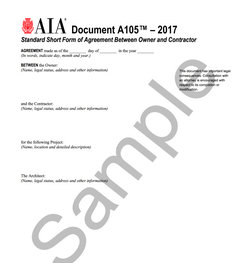
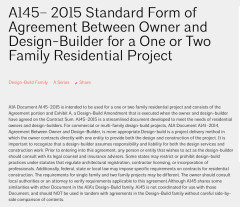
    I wouldn't expect a builder to use an AIA A105 Owner-Contractor Agreement if there was no architect involved (the OP does have an architect) but if a builder is going to design the house, A145 is a good place to start. Its written for homes not commercial or multi-family projects. These forms can be bought and edited online. If nothing else, it can be used to make sure your lawyer knows what he/she is doing.

  • PRO
    7 years ago
    last modified: 7 years ago

    That "2%" number is very misleading.

    Large tract home builders seldom use an architect for their repetitive housing additions, since they simply repeat building the same 5 houses over and over, year after year, location after location.

    And by definition a tract does not contain custom houses.

    Even small development builders repeat building the same houses year after year.

    A much more meaningful statistic would be the percentage of architect designed homes among custom homes, excluding tracts and builder's subdivisions.

    That said, it's really a meaningless statistic.

    Either one wants a custom home by an architect or one doesn't. That's all.

  • 7 years ago

    I thought I would update this thread. I'm the OP.

    "If the builder's standard agreement is so far out of whack that some simple edits by your attorney don't relieve any issues, you've probably picked the wrong builder." @Charles Ross Homes are right! I did pick the wrong builder the first time.

    After the last meeting with the builder and he agreeing to all of our changes, etc. my gut said NO! Don't build with this guy. I did a little more personal research and this was not the builder I wanted to build my house. And, I was right! He reneged on some things before we signed the contract. Anyway, We are now with a new builder with an A105 contract with some additions and revisions. We are much happier and my gut is finally saying yes! So is the attorney :-)

    I would also like to say that we live in an area where architects are not commonly used.

    As soon as the steel and cages are ready we will break ground.

    I want to thank you all for this lively discussion, your time and expertise.


  • PRO
    7 years ago

    Thanks for the update. I'm glad things worked out and that you've got the right builder on board. Best wishes for a successful project.