Software
Houzz Logo Print
hlozik

DIY waterproofing a walk-in shower

13 years ago
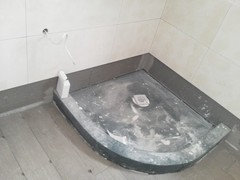
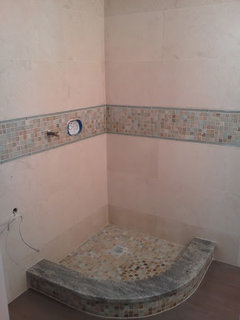
I am building a walk-in shower, but not using a shower pan, because the footprint is as long as the width of the room (which is small). I planned to use cement to build up the foundation for the tiles, at an angle leading down to the drain. I have experience with this method, so it is the least daunting for me. I am wondering if there is any reason not to use spray-on water barrier such as Redguard or Hydroban? I've read that it is best to use these products with a tool that can measure the thickness of the application. I'm thinking that they will be both easier to install and will allow me to waterproof higher up the wall. I've found that installing a flexible membrane can be tricky in corners and around the shower threshold. Is the membrane superior to spray-on products for some reason -- other than the fact that it is used so frequently? I understand that if you use it all the time, installation wouldn't be particularly tricky, but I've only tried it once and it was difficult for me. Thanks!

Comments (13)

  • 13 years ago
    Such a great question. I'm answering so it'll bump you back up to more recent comments and hopefully, one of the builders will see it and give you an answer.
    hlozik thanked creeser
  • 13 years ago
    Hydroban rocks. Use at least 3 coats. Also use fabric strips coated in the hydroban in any joints of the shower (wall to floor, wall to wall, etc). Give it some time to cure between each coat also. It's good to get your shower pan flood tested to see if it holds water overnight.
    hlozik thanked annaclink
  • PRO
    13 years ago
    There is a ton of variables to your question. To many to ask in a simple back and forth. I do help many people out privately come up with a game plan. If you would like to discuss what I charge please send me an email to sales@no-curb.com
  • PRO
    13 years ago
    Redguard and Hydroban are waterproofing coatings, NOT waterproof membranes. A coating is just that: a coating applied to another material. The coating is only as good as it's application, and only as continuous as the material to which it is applied. If the material to which it is applied cracks after application, so does the coating. A membrane is a continuous barrier that is independent of the material to which it is attached so continues to act as designed regardless of the condition of its substrate.

    You need a waterproof membrane on a sloped pan sloped to the drain weeps under your shower floor as described by @Ironwood or you *will* get leaks at some point. Leaks into sub-slab voids will give you migrating moisture problems in surrounding floors, leaks into sub-floor framing will give you mold and water damage.

    That membrane can be a pre-fab pan, a hot-mopped membrane or any number of PVC or PCE pan liner products by Oatey or any number of others.
  • PRO
    13 years ago
    @ReSquare - Where are you looking up your facts. Hydro Ban and Red Guard are both approved waterproofing membranes. They both have ANSI 118.10 approval and both can be used in shower construction. You can look this up at the IAMPO website for proof. Showers require by building code (US and Canada) to have a waterproof membrane meeting ANSI 118.10 - there are dozens and dozens of options.

    These products (Hydro Ban, Red Guard, Ardex 8+9, Kerdi, NobleSeal TS and on and on) are approved for use anywhere in North American and in much of the the world.

    There are more ways to build showers other than a Hot Mop or Rubber Liners - do you live an work in California? You boys in California seam to forget this fact if in fact you do work in California....
  • PRO
    13 years ago
    John, I'm a California transplant, like most of us here. Yes, our code is stricter than other areas of the country or the world....but I've been doing vinyl shower pans for many years, both in NorCal and elsewhere...where it was not required. My track record continues to this day...no failures, no call backs...ever. We use a lot of Redguard...but not to hold water. Everyone has products they love or hate or just plain trust. I trust a well installed seamless shower pan that can hold 6" of water for a minimum of 24 hours.
  • PRO
    13 years ago
    last modified: 13 years ago
    @John: Someone can build it anyway they want to, and a manufacturer will sell you on their product if they can get you to do it that way. And maybe some State codes will even allow it that way. But pretending it's as good as the better way doesn't make it so.

    The fact remains that Redguard, HydroBan, etc. .. all great products, are *coatings*, not actual physical membranes. Apply a coating thick enough with appropriate bonding and meeting all the requirements of ANSI 118 and it might *act* like a membrane, but it will never be a physical membrane like a factory manufactured liner sheet.

    I've seen enough Redguard and HydroBan on cracked slabs to say with full confidence if it's going to be called a "membrane", I've not seen it applied in a way that makes it one good enough for a mortared shower pan on any of my jobs I will warrant for leaks.

    The question I have is given how easy a PVC liner is to install... why wouldn't anyone do it that way over painting on coats of Redguard applied to what one hopes is the appropriate thickness to get a lesser quality install they hope is as good as a liner? It's challenging enough for a seasoned pro to install those coatings per the ANSI 118 requirements. To suggest someone do it as a DIY? Not me.

    @hlozik asked:
    "Is the membrane superior to spray-on products for some reason -- other than the fact that it is used so frequently?"

    For the sake of a more critically sound position, I'll revise my previous statement to say:

    "You should consult a local pro for your local code requirements and ideally have a pro install it for you to minimum code standards, but in my opinion, a true physical membrane product with a factory calibrated thickness and elasticity is better than a field painted coating that rates as a membrane especially if you aren't going to have a pro do the install."

    ;-)
  • PRO
    13 years ago
    Here we use a sloped mortar bed, the vinyl shower pan, a second sloped mortar bed, a shower drain that has a secondary drain. Then we use HydroBan on top of the second mortar bed and all the way up the walls (and around seats and curbs) over the permabase. No callbacks in 10 years for leaking showers -but we sure take out a lot of leaking showers. Maybe it's not the newest technology, but it's successful. I do agree that the vinyl shower pan can be tough to install in corners and around certain areas of the shower. It takes some work and some experience. May be worth calling in an experienced plumber or tile setter to do that part.
    hlozik thanked Brickwood Builders, Inc.
  • PRO
    13 years ago
    Rubber membranes when installed correctly are durable and 100% waterproof. I generally notch the framing in the corners so the folds in the membrane do not kick the cement board out of plumb. I recently installed a curved shower base from KBRS. This is a neat product. It is tile ready, sloped to drain and sits atop a mortar bed. It also requires the framing to be notched to keep the wall plumb, but it sure beat the heck out of building a curved base with wood and membranes. You tile right over it. We placed a granite cap stone on the curb.
    They can fabricate any shape, just send them a drawing.

    Check them out at kbrs.com.
    hlozik thanked TMK Remodeling
  • PRO
    13 years ago
    KBRS are great!
  • PRO
    11 years ago

    does anyone think to use thin lead for a shower pan??? it is super maleable and totally waterproof if soldered in the corners.

  • 9 years ago

    It seems to me a very big plus in using a spray-on water barrier such as Redguard or Hydroban is that only a single sloped mortar bed is required. This reduces time/complexity and just as importantly, reduces the height of the shower floor. This becomes particularly important when using a linear drain at one end of the shower which for example for a 5 ft shower length that the height of the farthest end is 1 1/4" higher. Doing this twice and in combination with a minimum mud depth of 1 1/2" at the drain each time is a significant factor.