

Help! Washing Machine Keeps Tripping the Circuit and Shutting Off
I have a new washing machine (LG) in a new construction home and both are under warranty. When I do laundry, the washing machine sometimes trips the electrical circuit and shuts down. It doesn't happen all of the time, but it's frequent enough to be a problem. There doesn't seem to be a specific pattern or type of laundry that causes it to happen. I've reached out to both the builder's electrician and the appliance store service and they have given me conflicting answers.
The electrician suggested plugging the machine into another outlet in the laundry room using an extension cord and advised that if the problem continued to happen, something is wrong with the washing machine. We did this and it kept happening.
The service technician checked out the machine and found nothing wrong. He said that the problem is that the washing machine is connected to a GFCI circuit. The outlet where the machine was connected by an extension cord is also connected to a GFCI circuit. The service technician said the appliance should be connected to a standard 20 amp circuit.
When I went back to the builder with the service technician's response, the builder's electrician replied that the electrical code requires the washing machine to be connected to a GFCI circuit. Here's the code that I was provided by the builder: GFCI Protection in Laundry Areas
Something is clearly wrong here, but both sides seeming to be saying, "not me." One thing I was wondering is whether the code requires the washing machine to be plugged into or connected to GFCI outlet/circuit or whether it's just requiring a GFCI outlet in the room.
Has anyone dealt with this before? I'd appreciate any advice or suggestions!
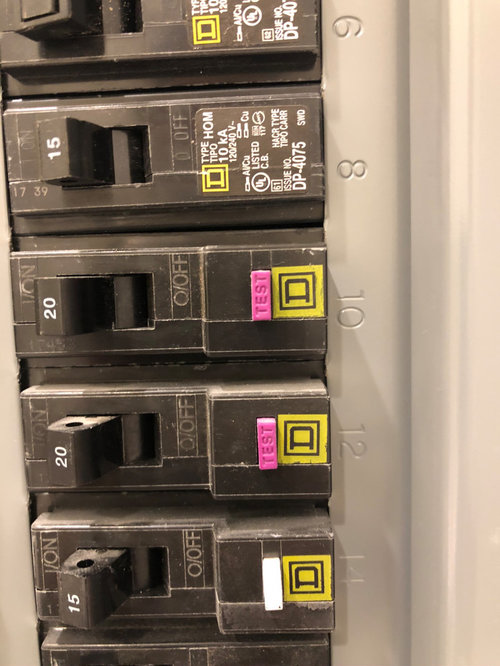
(The washing machine is hooked up to #10.)
Comments (183)
 5 years ago
Yes - that is correct. Europe and Australia as well as some Asian countries use 30mA, not 5mA. The Shurter paper refers exclusively to 30 mA. They also discuss Class A up to B+ which have different frequency responses. They seem to say, in that paper, that a Class A (which I think we are talking about) should be sensitive to sinusoidal frequencies only - which is what you want for this case.
- 5 years ago
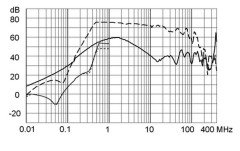
If you go to the Schurter page you can see the frequency response diagrams much more clearly.Here is the attenuation curve for type N at 16 amps. You are correct, it is unclear that it is attenuating much at 10Khz (.01 MHz). I misread the scale on the small diagrams as KHz, not MHz. With that scale, the range of interest was 1-10 and there is lots of attenuation there. But looking at this correctly, we are down at the very left end of the scale, which may have 10db attenuation. Not sure that is enough......
Related Professionals
Aberdeen Kitchen & Bathroom Designers · Milwaukee Bathroom Remodelers · Ottawa Bathroom Remodelers · Terre Haute Cabinets & Cabinetry · Oklahoma City Kitchen & Bathroom Designers · Mount Vernon Bathroom Remodelers · Pittsfield Bathroom Remodelers · Flagstaff Bathroom Remodelers · Waterbury General Contractors · Duluth General Contractors · Mount Vernon Home Remodeling · Yuma Home Remodeling · Winston-Salem Bathroom Remodelers · Santa Rosa Bathroom Remodelers · Vancouver Bathroom Remodelers 5 years ago
... particularly as the attenuation is falling as it heads to 6 kHz and below.
I wonder what frequency that 6 mA spike is all the way to the left -- 60 Hz or 120 Hz.
There must be a filter out there that looks like the circuit of the example but scaled for lower frequencies.
- 5 years ago
Lower frequencies often mean larger components - which is unfortunate. It's also kinda hard to do these things as digital filters in high power.... I'll keep poking, but have not found a suitable filter yet. Using one of these might be a fun experiment, but....
- 5 years ago
This is why I earlier suggested SurgeX. Not inexpensive, but big enough packaging. However, I wouldn't buy one for this application without talking to them. (My SQ washer doesn't need one, and the breaker is a Siemens/Murray GFCI -- not sure at the moment from what year's batch.)
- 5 years ago
I've been looking at the SurgeX stuff. The problem(s) I have are 2 fold:
- No detailed electrical characteristics are available except via a call.
- These devices are designed to protect products in your house/office from an noisy supply (utility).
The case we are studying here is the opposite - the product putting noise on the line. It is not clear to me if the products would help in that way (maybe if you install them 'backwards') It all depends on the circuitry.
I've sent them an email asking that question. I'll post a reply if I get one.- Bob
- 5 years ago
"I'm unclear how UL certification occurs when the device needs a 30 mA leakage threshold to operate but isn't going to get it in the USA."
At this point in time it has a lot to do with big money by it's not the UL.
Kaseki, UL is just a third party private certification lab, OSHA approved and certified by ANSI. The ANSI is a private non-profit organization which oversees most codes we live by including the national electric code (NEC), so It's not the UL but the ANSI That set the standards. But these are merely codes written by a private non profit company which ARE NOT binding by law unless a state, county or city adopts the codes as law, and they all do.
Safety is a good thing but some code changes make no sense to us but means big bucks to the ANSI. It needs to generate revenue and does it through the sale of code publication material, and membership fees from 270,000 companies. If nothing changes there is no need to buy the new code books, and no need to be a fee paying member (who in the back room may or may not lobby the ANFI to change a code so they can sell their products.) ANSI can only continue to exist if there is change, they don't get public funding so the finger is pointed at the ANSI. I may not live long after writing this but the ANSI and the membership companies with influence make Billions changing the codes.
UL doesn't actually test much product in their labs. It's all done by 4th party labs certified by UL to test items to meet ANFI standards by means of UL testing standards. 4th party labs are required do the tests the way the UL standards are written and it's kind of like a franchise in a way, We don't know what conditions the lab standards are, what equipment is used or how it's tested without buying a a UL publication for thousand's of dollars to find out. The National electrical code (owned by the ANFI) set the GFCI limit,, the UL determines the testing standards on how to determine the limits and the 4th party labs do the testing, and certify the product if it passes. Anyway a little grease will get you a long way in this cascading layer of potential fraud, it's big business. - 5 years ago
Looking at the Schurter filter schematics, they are quasi reciprocal. However, with a resistor there to settle resonances, this type of filter should be internal relative to the power switch. In the case of a washer, that switch may be a relay on a board and not amenable to being intercepted on its output. So using such a filter external to the washer would result in bleed current being drawn like a parasitic wall-wart power module.
I'd still try a cap across the line to see if it helps. A 'scope would provide some quantifying support, but blind experimentation might also lead to a favorable result.
- 5 years ago
Yes the Schurter filter would waste a small amount of power,
This is the response I got from ESP/SurgeXAll of our product filters are bidirectional.
ESP [multistage] shunt suppression works both ways, but SurgeX ASM [Advanced Series Mode] protection works best keeping a surge from going through the input to the product.
Web: ametekesp.com, surgex.com, powervar.com
Since these are designed as external devices - they'd be easier to put in this application.I expect they have a bit of parasitic load as well.
- 5 years ago
I've emailed amtek to see if they can provide detailed specs for 2 products.
The ESP Compact Series S1 and the ESP Digital QC D11416T. Both these are 20 amp products that may work. The SurgeX products do have frequency specs, but not listed below 30Khz. The ESP products say contact for detailed info (they say call - but I tried email instead cause I hate sitting on the phone).
The S1 is ~$30. The D11416T is like $100. So - the S1 is a better option if it works.S1 https://www.ametekesp.com/esp/compact-solutions/compact-solutions-120-208v
D11416T https://www.ametekesp.com/esp/digital-qc/digital-qc-120-208v
BTW - the Envision products include some very need diagnostics including a s/w scope. But they are $200+ and probably not for non-engineering/electrical tech types
Ill let you know if I get a response.-Bob
- PRO5 years ago
So I went to my building department and talked to the building inspector about this issue and was told that a GCFI outlet was not needed at the washer. The only code violation would be if there was a duplex outlet and only 1 plug was to be used do to the fact that there is an electric dryer which we know takes a different plug. He said the same at a sump pump to only have 1 single plug for the pump only.
- 5 years ago
Generally, local interpretation takes precedence. However, I think in such a case of a metal frame with water about, that I would go belt and suspenders and tie (bond) the washer chassis to a water pipe or other ground that is known to have low conductivity to the grounding point of the breaker box. In the case of a copper water line, there must be jumpers whenever the line is interrupted by meters, filters, or whatever. The breaker box will usually be grounded to the water line input to the house, if municipal.
- 5 years ago
My 'local' inspector - actually State Electrical Board required it - I had to add a GFCI.
- PRO5 years ago
kaseki couple of questions. What gauge wire would be appropriate to use? Now this one might be a stupid question but if a refrigerator has an ice maker (water) and you can never rule out a problem then in your statement above (metal frame with water about) would not or should not a frig need a GCFI outlet or breaker. Same with a dishwasher or are the 2 just different then a washer? Maybe my thoughts are just off track.
- 5 years agolast modified: 5 years ago
First, my SZ 632 (4 ft wide) unit is on a 15A GFCI breaker. I generally use GFCI breakers for most applications that are anywhere near accessible grounds that one might be able to touch while at risk from leakage current. Certain direct wired motor circuits would be exceptions. This is accommodated in the code. The dish washer, garbage disposal, toe-kick heater blower, and anything else powered from below the sink are on GFCI circuits. A review of my breaker arrangement label shows that every circuit in the kitchen is on GFCI except the induction cooktop, induction wok, and wall ovens.
I would have to reread the kitchen part of code to be clear whether I was conforming or being cautious. However in the version of the NEC relevant at the time, which I no longer have, I think GFCI wasn't required above some height such as six feet, and I think the refrigerator receptacle is lower than that.
Wire size is a subject that occupies a large portion of the National Electrical Code, and its counterpart NEC Handbook that anyone thinking of messing with his house wiring should have handy and study. Nominally, for a 15A circuit, 14 AWG conductors within a 2 conductor + ground cable would be used. My kitchen is at least 50 ft from the relevant breaker box, and my reno involved adding conduit fed wireways into the basement to avoid a horrible thicket of Romex on beams and joists. Generally, I wired each circuit that handled a significant portion of its rated current one step higher in wire gauge for the path from breaker box to the interface with the drop from the walls above. So for this circuit, 12 AWG would likely have been used. The object would be lower path resistance, and less required derating for the bundle of conductors in the 1-1/4 conduit portions.
If the question is my SQ washer, the circuit is 20A GFCI, and would nominally use 12 AWG cable. In my case I might have used either 12 AWG or 10 AWG within the wireway. The drop to the washer receptacle is 12 AWG Romex.
So in most cases (somewhat influenced by temperature), the washer circuit should be 20A using 12 AWG cable, but I don't think that there is any prohibition against a 15A circuit for this case, so long as the washer is the only device on the circuit. (I would read that part of the code before doing anything, of course.)
- PRO5 years ago
In regards to bonding the washer to water pipe what gauge wire would appropriate? I've seen very heavy gauge wire used to ground the panel and jump water meters and pressure regulators.
- 5 years ago
The wire size for this purpose has two drivers: Actual likely current before a circuit breaker disconnects, and resistance to damage failure. Hence for the latter driver the 6 AWG solid conductor used in swimming pool area bonding to avoid hazard currents in the microamperes. Breaker boxes need to bond the neutral to various grounding schemes as well as to the utility drop. So their grounding wire sizes depend on various factors.
To the point: While a 14 AWG conductor would be sufficient, I would probably use 12 or 10 AWG, and given potential motion and movement, use green insulated stranded with crimp devices on the ends. One end might be a screw hole lug for attachment by a washer panel screw; the other might be a crimp sleeve that would fit into a grounding clamp that fit the target water pipe. You should use a proper ratcheting crimp tool for most crimp applications.
Note to home owners: If you want to address every possible modification that you might make over the next 20 years, you will likely end up with a lot of tools (+++) and a lot of space taken up with rarely used adapters and fittings (---).
- 5 years ago
"So in most cases (somewhat influenced by temperature), the washer circuit should be 20A using 12 AWG cable, but I don't think that there is any prohibition against a 15A circuit for this case, so long as the washer is the only device on the circuit. (I would read that part of the code before doing anything, of course.)"
The code is silent on the size of the circuit but would require that the wire match the breaker - 20amp needs 12-2w/g. 15 amp needs 14-2w/g. The driving factor on the circuit size would be the appliance draw in this case. The code also does not say "dedicated circuit"- that is from the appliance manufacturer. They recognize that the load of a washer is higher than 'typical outlets" so they don't want to share. Modern washers do have heaters - so they take some power.
Both the GE and the Samsung washers I worked with said"Connect to a 15 or 20 amp dedicated circuit". So they would both operate on 15 amp circuits. I think most installs will be 20 amp. Mine is.
- 5 years ago
- PRO5 years agolast modified: 5 years ago
I recently installed this type of breaker for my entire house. It is a Square D homeline Dual function GFCI and AFCI combine breaker. I had 2 issues that I encountered that were both my fault. 1st, I didn't have the neutral(white wire) goes into the breaker as instructed, so when I turn on a high amperage appliance it would trip the circuit. If your main panel is a SquareD QO with plug-on-neutral design, then you probably don't have to worry about wrong wiring. If you have just a QO panel, then check the pigtail and neutral wire for the breaker to make sure they are connected properly and snug. The 2nd issue I ran into was I had an outlet that has the ground wire almost touching the hot side when the outlet is pushed in to the box, wires got jammed together and pushing on each other. So I'd check that wire connection to the receptacle to make sure no wire is connecting. Also, if you use this dual function breaker, you can't use a GFCI outlet in top of it, they won't work together. Hope it helps.
- 5 years ago
Just got this reply from amtek. The apologized for the delay - said the request got lost in the holiday rush.Since we don't know the source of the noise (if that is what is tripping them), I don't know if these filters would be effective. It would be fun to try - but since my Samsung is working just fine (as opposed to the GE). I would go with the S1....
Both models have a VPR of 330V in all modes, conform to UL Std 1449 and are certified to CSA Std C22.2 No. 8.D11416T:

S1:
Bob riellebee
Original Author5 years agoIn case there are any other laypeople out there following this thread, just wanted to provide another update. I finally had the service tech from the appliance come out to look at my (new, replacement) washer that still trips the circuit and he said that nothing is wrong with the machine. I'm wondering if it would make sense for the service tech to actually observe a load of laundry go through so he could see what is happening when the machine trips the circuit.
My next step is to hire an electrician who can hopefully help me resolve this issue so I can wash laundry without having the machine cut off once or twice per cycle.- 5 years ago
So Frustrating! Wish I could help more. I was pretty much 100% sure the tech would point the finger. The Electrician may not, but may not have a solution if it is the washer.
riellebee thanked Robert Gann  5 years ago
We are having this same issue right now in our new build but it is a Maytag. Same thing, electrician says nothing is wrong and we have someone booked to look at the washer on Tuesday! Please help!
- 5 years ago
A few muses:
This might be a bit nuanced re NFPA 70, but I wonder whether one could be compliant by using a dedicated "motor" circuit (no receptacle outlets) with flex between the box and the washer, and a plain breaker.
I would first buy one of those filters @Robert Gann found and experiment as that would be the approach requiring the least amount of my time, but for an electrically informed DIY-er with time available a dedicated "motor" circuit might be less expensive to incorporate.
In any case, whether adopting filtering, or having to spend time with a series of "investigators," one is using up resources that are entirely due to inadequate filtering in the washer. Maybe replacement with a Speed Queen will solve the problem -- another expensive experiment.
- 5 years ago
Clever way to get around the code requiring GFIC protected plugs in the laundry area.
Technically - since it is hardwired, there is no plug and you don't need the GFCI
Of course, since you are defeating the purpose of the code - to protect you - you are loosing that protection. To maintain that protection - you'd need to have a GFCI breaker - and if you are doing that, I would just start with a standard plug and a GFCI breaker. If that does not work, probably this would not work.
It might be interesting to see if the hardwired version works better than a GFCI Breaker/Plug approach. I don't know why it would unless the hardwired version provides some filtering the non-hardwired version does not. I can't see why it would electrically. Maybe using shielded cable from the washer to the wall would help(??) - see below.
If you were to do something like this, you need to be careful about wiring and connections.
- The cord(wire) required to run into the washer and the wire in the wall are incompatible. You can't run Romex or armored cable into the washer and you can't run flex through the walls. So you'll have to make some connections. They need to be done correctly.
And by the way - I'm not a licensed Electrician - I'm an EE and not a licensed one, so this is just friendly advice, not authoritative. Check with local code or an Electrician.
If you were to do this;- Use code appropriate wire from the breaker box to the wall box
- I would use armored cable from the wall box to the washer (the flexible metal wrapped cable)
-> Use the appropriate cover plate and clamp at the wall box location and make sure grounding is correct.
-> When you connect the armored cable to the washer, the connection needs to be legal which means you probably either need to use an integrated 'box' the washer (if it has one) or install a box on the outside and run through a proper hole to connect to the washer. This is very interpretation based... Probably, if required, it has an integrated one.
- Use a GFCI breaker.
BTW - you're probably invalidating the warrenty.
Of course, you can simulate all this with:-> put standard plug in the wall
-> replace the breaker with a GFCI breaker.
-> If that does not work - this elaborate wire-around probably does not work.
But it is an interesting experiment. If I was desperate, I might try this before putting on the filter discussed. Putting in the filter is going to require adding boxes and stuff anyway.
-bob
- 5 years ago
Just use a 15 amp GFCI wall plug with a 20 amp AFCI breaker out in the box and you should be fine. That's what did it for me after weeks of jacking around with all other suggestions.
- 5 years agolast modified: 5 years ago
Sight may be being lost of the issue here -- washer motor control generated high frequency noise interfering with the breaker behavior. One can filter the noise or one can use a breaker not affected by it. Filtering is the best way to go, but since (a) the victims of bad washer design and/or bad breaker design are adverse to or unprepared for electrical experimentation, (b) many attempts have already been tried without success using different breakers conforming to the code requirements for laundry room outlets, and (c) the victims may not wish to incur the expense of replacing the washer with a different model, then what is left as a 'last straw' approach is eliminating the GFCI breaker altogether, and that requires careful conformance to code requirements where such a configuration may still be allowed and, in the context of the particular conditions, deemed safe. I haven't investigated the exact wording of the code (it may depend on which year's code is applicable) to see what wiggle room is potentially available.
- 5 years ago
You are absolutely correct kaseki. I solved my problem by replacing my new GE (both of them) with a Samsung. But I had the benefit if great Lowes customer service that allowed me to return it (them). Still - I spent a couple hundred bucks (per irs mileage deduction) driving to/from various Lowes and at least 12 hrs (and 2 backs) installing/removing in a basement stacked configuration.
I suspect joeb333 managed to find a GFIC (plug) that is not susceptible to the noise from his washer. Perhaps he could share the brand/model/lot# of it.
I would love to see somebody try the filters - I would do it - but since my Samsung is not tripping the GFI - I can't. - 5 years ago
My current GFCI wall plug was the same that was in there when the washer was tripping the GE 20 amp GFCI breaker.
I simply ran across an article that stated there were issues with using the 2 GFCI's in the same circuit.
So me not wanting to go with a plain breaker if I didn't have to, installed a GE 20 amp AFCI breaker and the machine has ran like a champ since.
I don't know how or why, I just know there's peace at our casa once again!! :)
- 5 years ago
Ah- I saw AFCI breaker and read GFCI breaker. I have a conventional (not AFCI) breaker in my system. You are correct, two GFCI's are problematic. Glad there is peace.
- 5 years ago
The 2014 NFPA 70, National Electric Code, Article 210.12(A)(1) - (6) list all areas that are required to be Arc Fault protected (AFCI), Article 210.11(C)(2) require the laundry receptacle to be fed from a 20 Amp branch circuit. Article 210.8(A)(10) requires all 15 & 20 amp receptacles installed in laundry areas to be GFCI protected. General lighting in the laundry room is permitted to be on another circuit per Article 210.11(C)(2). This is the current code cycle being used in the state of PA. in the end, the (AHJ) Authority having jurisdiction (state or local government) has the ability to omit certain articles of the code. In PA, the AHJ did not omit any code articles. What we have found to fix the issue is exactly what joeb333 stated above. Install a standard AFCI breaker in the load center and a 20 Amp GFCI receptacle at the clothes washer. Thank goodness It's been working like a charm with all makes and models.
- 5 years ago
HU-885141950 This configuration:
What we have found to fix the issue is exactly what joeb333 stated above. Install a standard AFCI breaker in the load center and a 20 Amp GFCI receptacle at the clothes washer. Thank goodness It's been working like a charm with all makes and models.
Does not work in all cases. Sometimes the opposite works - GFCI breaker and not GFCI receptacle. Both configs have worked, and have failed. Seems to be install specific - which is not surprising if the hypothesis of VDM noise injection is correct.
Glad it is working for you. For me the solution was replace the GE washer with a Samsung.Luckily I was able to do that because it was 2 (two) brand new GE washers that I could return under 30 day policy. The Samsung never looked back.
- PRO5 years ago
Glad to hear that there seems to be a fix to this issue. I need a Square D AFCI but all I can get my hands on is a CAFCI which is supposed to be a newer version of the AFCI with extra protection. So the question is will this extra protection (versus AFCI) continue to have the same issue that has been happening or simply more protection?
 5 years ago
I also have a GE front load washer 2020 model and it trips the breaker. GE tech came out today and says these washers have problems with GFCI outlets and GFCI breakers and to switch to non-GFCI. Nothing wrong with electrical, it's a washer issue.
 PRO5 years ago
The breaker or plug could be faulty both can trip independently or the machine has a ground fault
 5 years ago
washing machines tend to send a imbalanced load over the 6ma range on the nuetral. It is acceptable to replace the breaker with a equipment GFCI colored brown instead of white. This still will protect personnel while utilizing the washer but at a higher threshold. Its now required to 2020 code to put GFCI in laundry areas. You may contact your local AHJ for building codes etc. to see if they will accept an Equipment GFCI breaker over the traditional 4-6 ma GFCI breaker
- 5 years ago
It has been required to put a GFCI for the 120V 15A and 20A receptacles in the laundry area since the 2014 code. What changed in 2020 is that a 240 receptacle also requires it.
What is happening here is not that the neutral has an unbalanced load, that would be impossible unless there really was a ground fault. What is happening is that these new He washers typically use a variable frequency drive to allow efficient multiple speed drum rotation. These things dump some of the energy back as higher harmonics which the GFCI doesn't detect. It's not that the current is imbalanced, it's just that it's returned at a frequency that the GFCI can't detect.
The answer is that your washer manufacturer did a lousy design. You can design VFDs to not do this or at least provide filtering to stop it from happening. - 5 years ago
My ancient Kenmore dryer (no VFD) uses 240 Vac for the heating coil, but only one phase to neutral for the electronics and motor. (And the chassis is neutral. ) This is naturally unbalanced.
It isn't yet clear to me whether I can remove all internal power returns from the chassis so I can ground it, but I do know that if the chassis or vent duct contacts something grounded then (as expected) a GFCI breaker will trip because the sum of the currents (L1, L2, N) will not be zero, as some of the neutral current is returned via a ground path.
I consider this design, that I only recently discovered when upgrading to a GFCI feed, merely one step removed from the old (really old) ac/dc radios that had one side of the line connected to their chassis.
- 3 years ago
I'll tell you exactly what the problem is. That's an AFCI/GFCI combo breaker and it's probably situated in the panel directly across from another combo breaker or AFCI breaker. Move it across from a regular breaker like a 20 amp bathroom breaker and the problem will
- 3 years ago
Interesting; I've never had an issue with positioning and I have over 200 breaker poles among four panels. What effect is believed to be the cause, EMI between housings, EMI across their common phase bussbar, something else?
 3 years ago
I recen ran across this issue
its called nuisence tripping
try to change your breaker with the the one that has white test button for 20 amp and run
 3 years ago
Wow! You REALLY have a problem! One would not expect to have to have this happen and I have no idea what these guys (probably) talking about. I understand what a GFI is , but why would an electrician not know all this stuff and be able to come to your house, do what is needed and leave you a happy camper? No wonder you are posting for help! And this is a recently built house?
- 3 years ago
i just realize that this is an old thread! I hate when that happens! I forgot to check the expiration date!













Ron Natalie