Software
Houzz Logo Print
blueberrybundtcake

Screws that won't snag my stuff

I'm making a shelf from plywood for inside my armoire. (I've posted about it without much response ... so new question new topic.) I had a small shelf that used to hang, but issues with the hanging weight and swinging made it more practical to have it be a normal shelf, so I flipped it onto its legs, but now the screws are a problem. They protrude out of the usable surface, where they can damage things.

I'm sizing up the shelf, since it's no longer hanging, and I was planning on reusing the dowel legs, since they're the right height, but I need to address the screw issue. Right now I just have the new board cut and sanded for staining. If I should be drilling any holes or anything, this would be the time, so I can resand those areas before stain and varnish. Board is 1/2 inch birch plywood and will be stained espresso.


My first thought was to countersink the screws, but since the shelf is plywood, that seems like a recipe for a splintered mess.

I've looked at funnel head screws that are designed to self sink in plywood, but I wonder how that actually works.

I've also seen covers that snap over the screws, and that kind-of fixes the snagging, but flush would be better.


Or is there another way to do this that doesn't involve screws?


Any ideas welcome!

Comments (11)

  • 6 years ago

    Photos?

  • 6 years ago

    "I had a small shelf that used to hang...so I flipped it onto its legs"

    "I was planning on reusing the dowel legs"

    Question is not clear. How a shelf can have "legs"?

  • 6 years ago

    Countersink the screws. If you're worried about splintering (which is likely to happen), get a countersink drill bit and predrill the countersink - no splinters (but you may need to touch up the finish around the outside of the screw if you sink it below the shelf surface at all).

  • 6 years ago

    Or get shelf liners.

  • 6 years ago
    last modified: 6 years ago

    @salex is there a specific type of countersink bit that works best with plywood? From what I was reading (I know, always dangerous ...), countersinking into plywood can be more challenging because of the layers.

    Also, would you go with panhead, or flathead? (Flathead is potentially a flatter surface, but potentially over constrains the system and possibly still need a cover, though maybe just a piece of felt; panhead would probably need a filler/cap over its hole; I might be able to get creative with my 3doodler, a wood plug, or buy something.)

    This is the little shelf ... the bigger shelf will go all the way across the armoire like the lower one. The screws aren't super easy to see, but they're the shiny bits sticking up aligned with the legs. They're normal panhead screws that I colored black. (Sharpie works surprisingly well on metal fasteners.)


    It used to hang, then I took off the eye bolts and put on the rubber feet, now they're legs. The doors of the armoire recess back in, so everything inside is free standing or hangs. Hanging organizers swing and sag too much, though there are some in there now, until I get my larger board finished. (Shelf is 19"x34" so not a standard size, hence making them myself.) The lower one sits on racks, but I don't have more little stuff to make more racks practical.

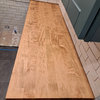
    The new shelf is currently just a cut and sanded piece of wood, so not very interesting to look at.

  • 6 years ago

    Countersinking is usually done with bugle head screws (likely what you referred to as funnel head?). If you're buying new screws, get coarse threads rather than fine.

  • 6 years ago

    Why not use shelf brackets instead of these legs? It’s inside an armoire, I’m sure you can use those little peg shelf holders.

  • 6 years ago

    So should I skip the clearance hole? Usually when I put wood together, and I think we did this with the little shelf, I put a clearance hole in the top piece, the threads only really affect the lower piece, in this case the dowel.


    I thought about brackets, but I'd be concerned cantilevering the weight off the back of the piece. I could run the calculations, but I suspect it would require adding strapping to the back of the piece for additional support.

  • 6 years ago
    last modified: 6 years ago

    Pictures might help.

    Are you trying to put the screws through the side of the cabinet into the 1/2" edge of the board to hold the board in place because, if so, you'll just end up splitting the board.

    How thick is the side of your armoire?

    A more practical way to add a shelf to your armoire might be to first attach two 1"x4" boards horizontally front to back to the sides of the armoire and then just set your board/shelf on those side supports.

    If you do this, make sure you leave enough room for your door to open and close.

    Even if the side of your armoire is very thin -- the thickness of the 1"x4" support boards would be about 3/ 4" so you could put short screws through the outside of the armoire into the support boards without the the points protruding all the way through the two support boards into the armoire to tear your clothes.

    Alternately, you could put your armoire on its side and GLUE the side support boards in place one at time, letting the glue on the one side set before flipping the armoire to glue the other support board in place.


    Putting another 1"x4" support horizontally across the back of the armoire would enable your shelf to hold more weight and decrease the likelihood that your shelf would warp.

  • 6 years ago

    The screws are intended to go through the shelf into the legs. Sides of the piece cannot be altered without interfering with the doors' ability to slide into the piece. This is the armoire:

    The doors open and then recess back in, which is nice so that the right door doesn't block the light when its not bright outside.

  • 6 years ago

    Gluing in side and back support for your shelf is the obvious answer unless the doors sliding into the piece would be an issue. If so, create a box shelf that you can either set on the bottom or attach to the top of the armoire.