Software
Houzz Logo Print
mxk3

Dark blue or purple annuals

6 years ago

Looking for other dark blue or purple annuals -- I grow heliotrope and salvia, and I know there's petunia and nierembergia. What else?

Comments (22)

  • 6 years ago

    How about lobelia, violets, perennial salvia? I'm sure there's more.

  • 6 years ago

    Browallia, larkspur, bachelor buttons.

  • 6 years ago

    Million bells/Calibrachoa, Verbena, petunias, pansies.

  • 6 years ago

    Don't forget ageratum!

  • 6 years ago
    last modified: 6 years ago

    There are also several red-purple foliage plants such as perilla, some of the dark leafed basils, and some of the darker coleus, though I don’t know if that fits in your color wishes or if they are too red. There is one plant that has really purple areas of the leaves, Persian shield/Stobilanthes dyerianus.

  • 6 years ago

    Also morning glories, and the leaves of tradescantia pallida (common names Purple Heart, Purple Queen.)

  • 6 years ago

    I love Monarda citriodora. It’s native to my area and has interesting layers of blossoms. Pollinators love it.

  • 6 years ago

    Larkspur (gorgeous purple color IMO). Chinese asters. Zinnias. Lupines (I treat them as annuals and let them reseed). Torenia. Osteospermum. Sweet peas. Bachelor's buttons. Lisianthus. Statice. Gomphrena, though the purples lean toward magenta. Nigella? (not as dark as the other suggestions but more blue, IMO). Convolvulus?? It's a dwarf morning glory and I'm trying really hard to dig deep in my memory, so not sure of the name, but I recall them being a nice dark shade of purple/blue.

    I LOVE persian shield but it doesn't seem to be readily available around me. I'll have to look into whether I can grow it by seed.

    :)
    Dee

  • 6 years ago

    Agastache 'Blue Fortune' and A. 'Blue Blazes'.

  • 6 years ago

    I've never seen a blue or purple zinnia -- I grow "Benarys Giant Purple" and "Purple Prince" -- and those what I would consider more of a magenta. I'm looking for blue-purples not red-purples. This is hard. I want all-summer bloom out of the annual, attractive foliage, and a rich, deep color. Bah! Convolvulus, verbena, and some of the other suggestions above were lovely the first half of the season but petered out, so those won't work. I love ageratum and have it every year, but I'm looking for a darker color. Bachelor's Buttons were gorgeous in bloom but I'm glad I trialed them in the vegetable patch because man did they look bad after the first flush. Is there an annual larkspur? I've never tried it, I'll have to look into that.

  • 6 years ago

    I don’t see any mention of angelonia, they come in a nice dark purple and for me flower all summer.

  • 6 years ago

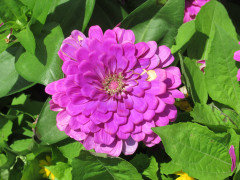
    There actually are a few kind-of-purple zinnias if you're...willing to stretch the point. I'm growing Park's Pick Lilac. They're magenta-pinkish-purple. Hold on, they're not looking great--it was a terrible summer for zinnia here--but I'll get a photo.


    The color is actually more magenta-purple than this, my camera over-captured the pink tones. Do not blame the plant, the plant is not at fault.


    https://parkseed.com/parks-picks-purple-zinnia-seeds/p/02236-PK-P1/ This is a bit closer in terms of color.


    https://parkseed.com/parks-picks-lilac-zinnia-seeds/p/02204-PK-P1/ Lilac might be another option? I haven't tried it.


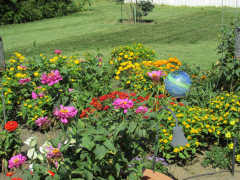
    And frankly, this set of zinnias does not look good and is not up to my standards. Again, do not blame the plant, the plant is not at fault.


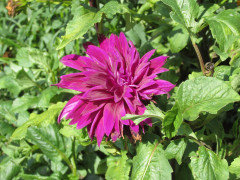
    Dahlia, "Thomas Edison" is a pure and perfect purple. Photo below but, again, my camera is not capturing the color correctly with the sun bouncing off the flower (I'm clearly getting infrared off the flower expressing as pink-magenta) and this flower isn't great to begin with.


  • 6 years ago

    Yes, Thomas Edison is a gorgeous purple, as morpheuspa says, a perfect purple. I didn't think of dahlias although I have them coming out of my ears, lol.

    mxk I was actually thinking of this thread as I was out in the garden yesterday. What I was thinking about was how you said you wanted all-summer bloom, and while that's always what I thought annuals were supposed to do, I was thinking yesterday how in my experience, that's not always what they in practice do. Not in my garden. For instance, my larkspur was gorgeous back in June, and there is a rebloomer here and there, but for the most part it's done. Same for nigella and buplerum. And cleome. My zinnias and rudbeckias and cosmos are in full bloom now, but didn't really start till mid-July. Things like nasturtiums and calendula and craspedia, are way done and over for the most part. Even my petunias are in a big lull now. The one thing that has been a constant bloom machine were those darn wax begonias I got early in the season, the only things left at the garden center when I finally ventured out for patio pot plants. I don't even really like wax begonias lol, but after this year I may change my opinion of them!

    So I started wondering, are we being sold a bill of goods on annuals? Was I (am I) under the wrong impression when it comes to annuals? Do they only bloom constantly with successive sowings? Or hard cut-backs? Or am I just doing something wrong? Hmmmm. Funny how in all my years of gardening I never really paid attention to this aspect of annuals. I just grew them thinking they, like perennials, had a "season" and moved on to the next one when one was done. Something for me to ponder....

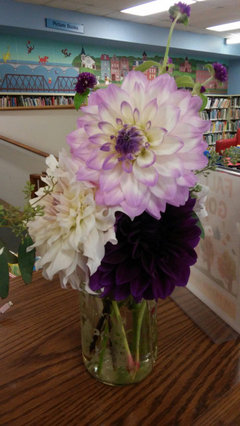
    Good luck in your search! Oh, I found a not-too-good photo of a Thomas Edison in a bouquet. It's the dark purple dahlia on the bottom left. Hard to see and the photo shows it as a bit darker than it is, (the camera exposed for the lighter flowers) but it is a beautiful dahlia. I liked it much more than I thought I would.

    :)
    Dee

  • 6 years ago

    "So I started wondering, are we being sold a bill of goods on annuals? Was I (am I) under the wrong impression when it comes to annuals? Do they only bloom constantly with successive sowings? Or hard cut-backs? Or am I just doing something wrong? Hmmmm"


    It depends. I used to have that problem. Many of my gardener friends still do.

    If an annual isn't in the light it likes...big issue. And I find that they tend to under-sell the amount of light they like in the stores. :-) Even those that say part sun really do prefer full sun for the best blossoms.

    I used to have spotty marigolds, dahlia, zinnia, ageratum, and everything else. Then I got my soil tested. And yeah, then I spent three years correcting the soil because that kind of made sense. Nothing likes fighting for calcium, magnesium, potassium, iron, phosphorus, zinc, boron, and manganese all at once, in a low-organic-matter situation besides (which was the easiest part to solve; start mulching with good hardwood mulch and let it rot in over the years).

    Nowadays, it's a bloom factory, but I set the soil such that most plants are into luxury consumption, and the sunlight levels are such that no plant ever has to compromise. If a section of the garden classifies as part shade, it won't ever have a full sun plant put there. Or, if I do, I won't expect much out of it.


    I do have to say that some annuals are tested in the gardens (I have about 2,000 square feet of them, so I can test a few plants of a dozen types and you'll never know) and rejected. Really, only one may make the cut every year and get added to the cycle. This year, I may choose the new zinnia color (the lilac above) to add to the cycle in small numbers as it performs identically with the Magellan Scarlet. Or, this year, not that well, but it actually did better than the Scarlet.

    So I've been picky and rejected even "proven" varieties for not making the grade in terms of bloom power, or simply not having the color I want.


    Which has also rendered me down to growing all my own annuals from seed under lights because local nurseries don't carry the specific cultivars I want--or the specific crossbreeds I've bred myself over the years where I've combined characteristics I liked.


    So I've also worked a lot at this.


    I do have bad years, this being one of them, but even so, I'd hardly call this year shabby. It's just that the zinnias were disappointing and I had to let the Melampodium volunteers take over in parts of the garden to cover that. So I have a very golden garden this year rather than the mixed fire tones I usually have.


    Sorry for the book, there. In order, I'd say...test your soil, choose your plants carefully, rejecting ones that don't work, and definitely match a plant to its appropriate lighting...or a little brighter if you know it can handle it (when presented with full sun/part shade, just put it in full sun...it'll do better, all things considered, if you can keep it watered appropriately).

  • 6 years ago

    I think your best bet is still petunias or calibrachoa. I had good success with torenias this year - blooming non stop - but they are bicolor, and grow much better in shade.

  • 6 years ago

    Dark blue is a somewhat rare color in the world of plants. Not really sure why, but I think it has something to do with the animals that pollinate them. You have to remember that insects have very different eyes than we do, so the colors they see are obviously very different than us. Anyways, these are some of the genuses (is that the plural for this?) I know of with blue flowers. Many of these genuses have multiple species with blue flowers.

    -Cynoglossum

    -Aconitum (more of a dark purple but kind of blue)

    -Delphinium

    -Meconopsis

    -Gentiana

    -Hydrangeas (if you have acid soil)


    The ones I mentioned above are all perennials. I know of other plants with blue flowers, but most of them are either annuals or tropical plants.


    Now purple on the other hand...there are literally HUNDREDS of plants with that color. If I wanted to list every single one I knew I'd probably NEVER stop typing, but if you'd like I'll write a list of the ones I know.

  • 6 years ago

    @perennialfan275

    Plural of genus is "genera." ;-)


    As mentioned, "true blue" flowers are actually very rare in the plant world. The vast majority of "blues" are actually more lilac or purply.

  • 6 years ago

    Thank you for the correction Paul. My vocabulary improves every day (if I remember lol)! Another blue perennial I forgot to mention is amsonia. The flowers are very light blue, but still very pretty imo. Some species you might consider growing are amsonia hubrichtii, amsonia tabernaemontana, or amsonia ciliata.

  • 6 years ago

    Thanks, all. I am looking for annuals specifically.

  • 6 years ago

    Morpheus, where do you purchase your seed?

  • 6 years ago

    Park Seed, mostly. While more expensive, the quality tends to be extremely high and if you have a problem, they'll make good on it.

    I've had...issues...with some other big name companies.


    Other seeds for blue things like S. farinacea I breed myself and collect yearly. I currently have a bowl of spent flower heads waiting to be hand-ground and de-chaffed to find the seeds. :-)

    Ditto with ageratum, but there I just collect the spent heads when they fully brown, save the whole thing, and crumble it onto soil when I plant those in flats in March. The seeds are like dust.