Software
Houzz Logo Print
tcscwi

48" Wolf Range and Hood, too many options! help!

6 years ago
last modified: 6 years ago

Wolf says one thing, my builder says another, the HVAC says something else.. its all over the board. We are set on a 48" range, most like Wolf with a double griddle and 4 burners config.

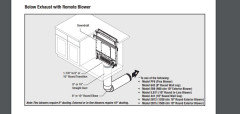
The hood I can not figure out for the life of me. (apparently my builder cant either). I have to duct it and put in a remote blower in the attic. That is all fine. What I dont understand is are the hoods. Do I really need a 48" Pro Wall Wolf Hood for $2500?? Its a hood with lights right? Or am I missing something completely why its $2500? Is there another 48" hood brand I should look for the half the cost?

On top of that, the make up air from my hvac guy said its another $1k for the damp/motor and duct run.... this stove is getting expensive! :) Any thoughts or tips would be great!


Edit: I believe we want an remote blower because Im not sure a 1000 CFM is going to be "quiet" in the kitchen. Any thoughts on how loud a 1000 CFM would be?

Comments (20)

  • 6 years ago
    last modified: 6 years ago

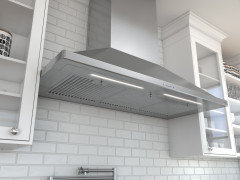
    We just installed a 48" Zephyr range hood this weekend and I absolutely love it! LED lights, great power 1200 cfm. Yes, about $1,000 less than yours.

  • 6 years ago

    Nice! If you have a picture that would be awesome. Thank you!!


  • 6 years ago
    last modified: 6 years ago

    This is the stock photo . Our backsplash isn't installed, and we don't have cabinets right next to it. Looks awesome above a 48" range. This one does not have a remote blower, but honestly, it's not too bad. I can still talk over the 3rd speed, 2nd is comfortable, 1st is just a background humming noise. Yes, the 5th one is loud but I will barely ever use it.


  • 6 years ago

    How many CFMs did you get? My biggest thing is if I should consider a remote blower if the CFM is over 1000. I dont want a hood/fan in the kitchen that sounds like a jet engine everytime we turn it on.

  • 6 years ago

    1200 fcm, I added to my comment...it really isn't that bad.

  • 6 years ago

    My probably is the getting to the roof. Our second floor is challenging to say the least. Trying to figure out routing options.

  • 6 years ago

    The OP wrote, in part: "The hood I can not figure out for the life of me. (apparently my builder cant either). I have to duct it and put in a remote blower in the attic. That is all fine. What I dont understand is are the hoods. Do I really need a 48" Pro Wall Wolf Hood for $2500??"

    Well, you could read all the hood threads here and figure it out, but that might take a while. What you really need is a 54-inch Wolf hood so it overlaps the end burners. Cooking plumes expand as they rise. If you could see a relevant Wolf hood, you would see nicely done welds, adequately thick and stiff stainless steel, and a lot of metal pieces involved in the baffle assemblies. How much of the cost is related to USA vs. foreign fabrication and to SZ/Wolf actually answering their phones and providing help is unknown to me.

    The OP also wrote: "Edit: I believe we want an remote blower because Im not sure a 1000 CFM is going to be "quiet" in the kitchen. Any thoughts on how loud a 1000 CFM would be?"

    Blowers normally generate significant noise due to blade tip air turbulence. A remote blower helps attenuate this, but what you want to include is an in-line silencer such as Fantech makes. My Wolf 1500 CFM blower (on the roof) and Fantech silencer (in the attic) reduces full power noise to mainly baffle hiss. A normal conversation can be held under the hood. Wok cooking noise is louder, I think.

    The requirement for a 9 square foot aperture (residential) hood is 9 x 90 CFM or 810 CFM. You should choose a 1200 CFM rated (at zero static pressure) blower to obtain this flow rate in the presence of (mainly) baffle pressure loss, along with other pressure losses. The Wolf/Broan 1200 CFM external blower can achieve 810 CFM at about 0.8 inches, w.c. That should be enough for the baffles and at least 10 ft of duct. In-line blowers such as from Fantech may do slightly better, but then the roof cap pressure loss needs to be counted. And the MUA has to be well enough balanced to not add more pressure loss to the hood air circuit.

    "Any thoughts or tips would be great!" They are all over this forum, but then you would be back to reading a lot of insights and opinions.

  • 6 years ago

    Thank you very much for the detailed response! The other option we are trying to figure out that was suggested was to 180 the duct into the wall and run back to the floor/crawlspace and then outside. It all depends on the depth of the wall cavity and the duct size requirement. My estimate to replace a 10" duct to a rectangle for the CFMs needed may not even work. If I could use an 8" equivalent, it may work.

  • 6 years ago

    Jalarse, it is always such a treat to get a peak into your beautiful kitchen,

  • 6 years ago

    I would use a 10-inch duct for 1200 - 1500 CFM blowers. (Keep in mind that these will be actually moving 800 -- 1000 CFM. This is because the duct velocity should be in the 1000 - 2000 ft/min range. You may need to start thinking about how a chase, internal or external, might be used with your second floor dilemma (which you haven't clarified). Also, horizontal ducting at the ceiling might work if the ceiling joists were re-framed or a soffit is used.

    180-degree turns are going to be a significant pressure loss, and rectangular ducting capable of 10-inch equivalent flow will have to be commensurately larger than any standard wall cavity. Use on-line calculators for comparing various duct sections, sizes, and bends. Any plan that includes a lot of horizontal ducting may run into code enforcement objections, so clear any plan early.

  • 6 years ago

    So new thought came up today. Looking at a Best downdraft 48" which is flat and get to the crawl space with the need for a large box. http://www.bestrangehoods.com/store/products/productdetail.aspx?id=9249ea6c-26cf-4a9d-b512-63588466825b


  • 6 years ago

    I have addressed this type of system often enough to not want to do it again. You are welcome to search for comments. Instead, I suggest you imagine a meter per second rising cooking plume being deviated to the (tiny) entrance aperture of the downdraft, taking into account that the velocity of the hood air current a small aperture dimension away from a hood aperture is a fraction of the velocity at the hood produced by the hood blower. Somehow this pittance of transverse air flow at the plume is supposed to completely remove the vertical momentum of the plume and make it horizontal. Leave these devices to what they can accomplish -- collecting a part of a back burner's steam plume -- and embrace the fact that configuration deviations from standard commercial practice mean reductions in efficiency and/or performance.

    Even a real hood on its side attempting to do this would have to have a lot higher flow rate than when it is above and letting the natural momentum of the plume bring the plume to the hood. One of the smaller sized turbofan engines would probably work as a blower, but might be a tad noisy. And if the plume can be fully deviated to horizontal, so can the burner flames.


  • 6 years ago

    A downdraft with a Wolf 48 inch range? Nope.

  • 6 years ago

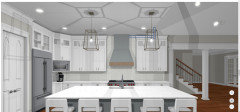
    Thank you all for the comments. My builder still thinks a recirculating hood is a great idea.. nope. I can see all the issues with downdraft with a 48" as well. Off to the cabinet guy to figure out how to run the 10" in some upper cabinets and to the right and up to the attic. The attic access is upper right, but id have to get into the great room ceiling because there is a structural beam I cant through and a bedroom above the hood. This is our dilemma (little blue lines are the ducts possibly Id hide in the cabinet but have to figure out where it goes into the ceiling/attic as its exposed.)

    .

  • 6 years ago

    A recirculating hood is a much different thing than a downdraft or pop-up side draft vent system. The recirculating hood is an overhead hood and can perform the needed functions of capture and containment just like externally vented hoods. While reasonably sized recirculating systems probably won't be able to deal as well with hot greasy cooking, they have one advantage impacting several issues; no make-up air is needed.

    The rub is how well a recirculating system filters the cooking plumes before releasing the air back into the room. At this writing, the only system I am aware of for which a member of this forum has provided useful descriptive comment on and who asserts that its filtering operates well is the Vent-a-Hood ARS system. Try this link for the thread: https://www.houzz.com/discussions/2347276/vent-a-hood-ductless-ars-range-hood-update#n=65

  • 6 years ago

    Thank you for the ARS commented. Will take a look at that as well. I didnt realize they made a charcoal type insert to capture. The question how well does it actually work. (which they seem to cover a bit)

  • 5 years ago

    @tcscwi Did you finalize your hood system yet? I also found that with these Pro rangetops, often a makeup air system (MUA) is also required-- did you end up installing an MUA as well? BTW how is your Wolf range? We were going to get one but discovered there are persistent issues with the blue enamel chipping and possibly contaminating the food and are wary of the purchase now. We may go back to Thermador (which we've liked in the past but don't like the bells and whistles on the newer models).

  • 5 years ago

    Kitchen is super delayed... but we did order the Wolf 48. I ended up ordering a Z-line hood with a remote 400 CFM blower. Code in our state is anything over 400 CFMs requires MUA... I decided to go with a 400 CFM and get it all put in and start using it. Worst case is that if the 400CFM is not performing well, we will swap out to a bigger blower and add MUA. My stance on it is that Im probably never going to use both ovens, all 4 burners and the griddle at the same time nor cook for 20 people 8 hours a day to justify a massive blower and MUA cost as well. I havent found a requirement anywhere for MUA, only when you are over 400 CFMs.. not really a range issue, more of how much air are you tryin to suck out of the house.

  • 5 years ago

    Its really an inadequate air velocity into the hood to contain the higher temperature plumes, along with all the issues of pulling air through house leaks. Depending on the house, you may only get 200 CFM at the hood.

    I would also buy and set up a CO sensor alarm near any combustion appliances you may be using that take their air from inside the house.

Sponsored
Snider & Metcalf Interior Design, LTD
Average rating: 5 out of 5 stars25 Reviews
Leading Interior Designers in Columbus, Ohio & Ponte Vedra, Florida