Software
Houzz Logo Print
corkball1

plant wild food for Florida?

5 years ago
last modified: 5 years ago

I would like to do something a bit lazier than gardening... I want to plant plants that can give me food, but I could just let them go nuts in the wild. I have a couple of acres, and I have started an orchard, but I also want to create foraging crops for humans. My main issue here in central Florida is the sand and nematodes make most garden crops a bunch of work. I want to just plant stuff - in the sand - and walk away, and if I come back later great, if not, no biggie. I don't want amended this or raised bed that.


Looking at some videos, some candidates might be:

  • sweet potatoes
  • muscadine grapes
  • katuk?
  • moringa


Can anyone comment on the fire and forget method? Add or remove from the list?

Comments (18)

  • 5 years ago

    FWIW, I have a macadamia nut tree that's doing very well so far. Took a number of years to start bearing though.

    Blackberries grow wild in FL as well.

  • 5 years ago

    I am a bit concerned about some of the suggestions - we are about on the 9a/9b boundary, and we do get 20s and even (very rarely) teens here. I don't really want to plant anything that is sketchy. I currently have various fruit trees - I SHOULD plant mulberry - I am just not a huge fan.

    I have blackberries, and they produce a fair bit of fruit, but they are favorites to get chewed on, and so don't run rampant like my raspberries did up north. I also have wilde blackberry, but they never fruit. Can anyone suggest a variety/source that will run rampant and still make decent fruit?

    Thank you Sultry night, but I think a bunch of your choices might be sketchy here, and I want to avoid too much work composting and winter protecting. It sounds like grapes will work great though! Which honeysuckle? I always thought they were inedible except for the siberian haskap.

  • 5 years ago
    last modified: 5 years ago

    I am in 9a, Jax area. I do use a carport frame with some plastic over it in the winter for some things. If it happens to go down below 32F I put a propane heater in there. During the day I open the 'door' to prevent overheating.

    Many bananas will freeze to the ground and return. I dont typically put them in the gh unless its a new baby variety that's still in a pot. Most years they dont freeze all the way down and I get fruit. Raja Puri and Dwarf/Namwah do well here.

    I use the wild honeysuckle flowers to make jelly. There's recipes online.


    There are also passiflora that will fruit here.


    Lots of Citrus will grow here: Satsuma, Other orange varieties. kumquats, some grapefruit varieties. I know a few people who have Meyer Lemons in the ground. Limes are iffy without winter protection.


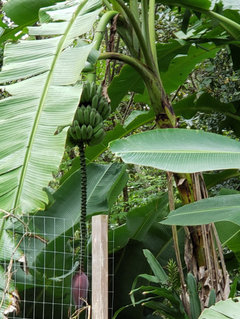
    A hand of bananas on one of our Namwahs


  • 5 years ago

    Chickasaw plums are native.

    Try this link for some edibles for FL:

    https://floridata.com/plants/edible


  • 5 years ago

    There aren't too many food crops that will produce much without some care. Bananas need a good amount of fertilizer and water. Have you tasted muscadine grapes? I have many vines and I let the birds have all of those grapes. Cocoplum is edible -I rhink mainly used for jelly, and elderberry is an easy plant. I have seen pineapples grow in non cultivated beds, but I believe the soil needs to be amended a bit to get a good fruit. May need supplemental watering in dry times. Also takes months to mature. I've been able to get native blueberries to fruit with no care, but the plants can be difficult to source and the berries are very small. There is a plant called spinach tree (or something like that). and a type of ginger plant that produces red tips that are edible. A local small nursery would probably be a great source for information.


  • 5 years ago

    Sounds like I will have to talk to nursery. Thanks guys!

  • 5 years ago

    You may want to look google "eat the weeds" website devoted to foraging edible plants.

  • 5 years ago

    These have all done well in my poor soil:

    Malabar spinach is a great summer green that will reseed itself every year.

    Elderberry is easy as pie. A cutting can grow 6 feet or more in a year. You can make jams and wine with the berries, but be sure to plant enough for you and the birds.

    Amaranth is also a great summer green, and reseeds itself.

    Sweet potato is a great ground cover and edible summer green for places where there are a lot of roots. I discovered this accidentally when I planted some to dig, but couldn't because of the tree roots, so I just eat the greens now.

    Cranberry Hibiscus (H. acetosella) has edible leaves, is very pretty, and reseeds itself. The leaves also make lovely tea. Same for Hibiscus sabdariffa (Florida cranberry), which has edible leaves and sepals that make a love drink with ginger or tea. Toss out some seeds in the winter, and you'll have plants galore come up in the late spring

    Loquat is cold hardy and has lovely fruit for eating out of hand or making jam.

    Chaya grows like wildfire. It's not actually cold hardy, but if you cut it back hard in the fall and stick a bucket filled with leaves over it during cold spells, it will survive one of our 9a frosts. Otherwise, just take some cuttings in late winter or early fall and root them to keep over the winter. You have to cook the leaves to eat them, but they're really delicious.

    Figs practically grow themselves. I'm told they don't like nematodes, but Brown Turkey figs seem to do very well in our native soil.

    Pigeon peas are extremely easy to grow and produce a crop the first year. If you put them into a sheltered location, like under trees, they may survive the frost, but all you have to do is toss out a handful of the peas in the winter, or let them reseed themselves and they'll come back up.

    Taro will so grow and come back. The young leaves and roots are edible, but must be cooked.

    Edible gingers like kitchen ginger and turmeric are very easy to grow, multiply, but they need shade.

    Potato mint grows well in sand, makes a great groundcover, and has lots of tiny potatoes when it dies back in the winter. Leave a few in the ground, and it will come back.


    That's all I can think of right now. BTW, I don't fertilize my bananas at all. I just pile leaves around them every year and toss all the kitchen scraps out around them. They bear every year. If you're close to Gainesville, I can give you a pup.


  • 5 years ago

    Thanks dirtygardener, that is exactly the kind of list I was looking for. I have looked at 'eat the weeds', and that is actually really cool, but for the most part (other than a couple of exceptions like winged yam') you arent going to get a ton of calories that way. If I can get a food forest going, that would be really cool. I already have an orchard with typical central Florida fruit - mulberry, bananas, blackberries, etc., but some ground crop ideas would help flesh out.

    PS: any tips for getting my bananas to fruit? They grow large each year, and there are lots of pups, but I rarely get fruit. Should I be cutting the pups down?

  • 5 years ago
    last modified: 5 years ago

    A mother banana can take up to 3 years to bloom, so don't give up on them. They are not a carefree crop. Bananas like LOTS of water and LOTS of organic matter. They need about 100 inches of water a year, so they have to be watered during dry spells. Mine are literally growing in a compost pile. I toss all my kitchen scraps around them and pile oak leaves high up around their trunks every fall, which draws earthworms in. I didn't fertilize mine at all last year or this, and got 4 hands last year and 3 this year. When I did add extra fertilizer, I got 8 hands.

    The pups don't take nutrients away from the mother plant. They have their own root system. If you remove ALL the pups, you'll never have fruit again, because the mother plant dies after it bears fruit. If you want fruit every year, but need to remove some pups, leave the largest and fastest growing pup and remove the rest.

    Just try watering more and start fertilizing once a week in the spring with some good, organic fertilizer. Also, mine usually get frozen leaves in the winter, but if you cut those dead leaves off the top so they don't block the new leaves, they will usually come back out. If it freezes to the ground, and it's a cold-hardy variety, it will come back from the corm IF you've protected the corm by piling leaves around it in the fall.

  • 5 years ago

    hmm.... I do have a pile of rotted brush. Maybe I can try bananas out there... thx!

  • 5 years ago

    It seems to me what you want is a food forest. Which overtime becomes easier and easier and more and more productive. Soil building is key. A good way to start is with tree mulch. You can get it free dropped off at your house. Contact your power company and find out who trims the trees around powerlines for them. Around here they are bright orange trucks and I just flag them down when they are in my area. There are actually a crazy amount of things that will grow here with little work if you set things up right. Permaculture design can help. Thing like chop and drop can also help build your soil and support plants such as Mexican sunflower can be used as green manure. You can make your own biochar to improve your soil and trading for plants can help get the cost down. https://youtu.be/7ehNgeTYK30 

    That's a biochar video on how to make it yourself.

  • 5 years ago

    For your bananas you might want to consider a banana circle. Cassava and true yams are very easy to grow. Tea grows well here as well as coffee. I've managed to get dill and mustards to go wild in my yard and come back on there own every year. I've managed to get Everglades tomatoes to go wild in a friends yard. The key to that was chickens that wonder his food forest. I will be trying to get pok choy to go wild next.

  • 4 years ago

    A fall update on the food crops I tried this season:


    Winners:

    1) African potato mint. the stuff is bullet proof and goes everywhere. What is more, you can propagate it from a single leaf that you just stick in the ground.

    2) bananas - they seem bulletproof, even in drought, although I seem to have a problem getting them to actually sprout bananas

    3) mulberry - just grows.

    4) peaches - maybe tending towards mixed. Lots of healthy fruit, but the trees don't do well in mid-summer and just look unhealthy.


    Mixed:

    1) Elderberry - seems to do very well in our soils, but some sort of predator eats everything up to like 4 feet. Once it gets bigger, it seems to do ok.

    2) Pigeon pea - healthy growth, but not safe from predators until 4'. Not sure about cold hardiness yet

    3) peanuts - same as above. I get peanuts, but the plants get all chewed to heck

    4) green tea - we'll see - very slow growing and prone to predation

    5) blackberries - seem to grow ok, but lots of predators eat the leaves, and berry production is weak in the spring due to lack of rain


    Losers:

    1) Amaranth - just did not thrive. Got crazy chewed, and the ones that didn't did not get very big.

  • 4 years ago
    last modified: 4 years ago

    I live in zone 10 and can not grow it, but if I lived further north I would have a paw paw tree. I love the fruit and it attracks butterflies; it is a host plant for either the tiger or zebra swallowtail. Can't remember which one.


    Also elder berries would grow there. They use to grow wild in Missouri. You could make, jam or jelly or even wine from the berries. The flowers can be be dipped in a batter and fried as well.

  • 4 years ago

    This is a really interesting thread, especially the real results.


    Corkball, might your predator that eats plants up to 4’ or so be deer?


    i wonder whether you might be able to add different plants to your food forest over time since the established plants will provide shade and shelter from cold winds.


    i have a fruiting passion fruit vine that’s enormous, makes good fruit and needs little care, but it’s also a thug that overruns everything nearby.


    Because it’s a thug, It might be better to plant one of those running up a big tree or covering a fence than in a food forest. Passion fruit falls when ripe so you would not have to climb to pick it.


    I do water mine (on a drip irrirrigation system with other plants), but I suspect it doesn’t need watering that now that it’s established. It sailed through last winter (Panama City area) with no protection, and even made a few fruit in February.

  • 4 years ago

    LOL I agree, it could very well be deer eating my stuff, but I am surprised that they don't seem to touch anything above 4' - they could easily reach it.

    Passionfruit might be an option - it looks kinda gross, but who knows?

Sponsored
Peabody Landscape Group
Average rating: 3.5 out of 5 stars8 Reviews
Columbus' Reliable Landscape Design & Contracting