Software
Houzz Logo Print
jordan_swogger

Can LED "canless" recessed lighting be used directly on drop ceiling?

5 years ago

Hello all, I'm new here to houzz, having used it for the past few months on a casual basis to browse and get some answers.


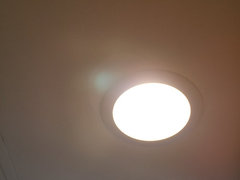
We're in the middle of a kitchen reno, and we've come to electrical now. We are going to be replacing our old central fluorescent fixture that sits in the drop ceiling. We are keeping the drop ceiling because we would have to redo all the plumbing and electrical higher if we wanted to drywall, which is outside our skillset and budget. We'd like to do recessed lighting instead this time, but can't really swing putting real traditional cans up in to the ceiling of the kitchen the way it is. I was excited to see the availability of the "spring clip"/wafer type LED lights, seeing that contractors just pop them up into the ceiling drywall with no need for cans or a bracket/brace. So, I thought we'd be good to go, but as I did more research, I found that in some circles, the advice is that doing this on a drop ceiling tile is not supported. I even found a "pan" that can be used directly on a t-bar above the tile we want in order to provide support. I'm really looking for guidance in general with this lighting project, but my main question is, can I just pop those lights into the tile (traditional mineral fiber) like they do with drywall, or is the "pan" a must in our case? We do have a licensed electrician willing to install these for us, so wiring is not an issue. I'm just wanting to make sure we do it "right". If I can get away without the pans, that would be a savings, but I also am aware of how much I just don't know about all this, so if it's needed, it's needed. Could anyone provide advice to that end? And, would all "canless" types work for this type of install, or would I need a certain kind? I don't know what the rules are here for brand recommendations, but I am absolutely open to suggestion in that regard.


Another general question I had is in terms of layout. Having never used recessed lighting, I'm at a loss as to the placement and number of fixtures needed for the kitchen in order to meet, and preferably exceed, the light level the large central fixture gave us. It seems that opinions online are very conflicted, and I'm sure I'll have some contrasting opinions here too. That's okay, I just want to minimize the holes I put in the tiles before we're settled on a good layout. We are planning on a small pendant above the sink, under cabinet lights, and a somewhat dark-looking (from the photo) semi-flush mount, upward facing Tiffany-style light centrally in the room. The basics of the kitchen are: L-shaped layout, no island just the L shape using wall mounted cabinets, and the room is 12x22'. Ceiling height is 8 feet.


And, if it's more appropriate for me to ask the layout part in a separate thread, please do let me know and I will separate it out. Being new, I'm not 100% sure of the etiquette in this community yet, but I thank you all in advance for your wisdom and advice!

Comments (6)

  • PRO
    5 years ago
    last modified: 5 years ago

    I can't see any reason why those style lights wouldn't work for your situation, as long as they come with an electrical box to safely make the wire connections, which the ones I've used in the past did.

    As far as lighting layout I like to put plenty. Staying about a foot away from cabinets, one every 4 or 5 feet on a grid, maybe lining up with the centerline of your upper cabinets or other features you have going on. Throw some pieces of blue tape on the ceiling where you think you'd like them and try to imagine how much light they'll give.

    As far as brand, choose whatever has the most pleasing aesthetic to you, and comes in a color temperature you enjoy, some even have the option to change the temperature. Otherwise any reputable brands LEDs should last for years to come.

    On a side note about keeping the drop ceiling vs drywall, I find it hard to imagine why you couldn't frame in the electrical and plumbing and have drywall instead of ceiling tile, albeit at the same height, if you wished.

    Jordan Swogger thanked Christopher Lynch
  • 5 years ago

    WD Cruise's information is incorrect. He is basing his reply on the old fashioned 'Can' style recessed lights. You clearly stated 'wafer' style LED's. I want to do the same job and I'm debating to use a backing plate on the top side of the tile. The other consideration is using a more robust tile instead of the fibreglass wafer ones.

  • 5 years ago

    @montmurf correct, I meant the very thin wafer type with remote junction box, no real can whatsoever. I checked with a local licensed electrician and he said it was totally fine even without the mounting plate, and we asked him to help us do the rewiring. He did a great job! I simply cut holes in the new drop ceiling tile with an adjustable hole saw and popped in the lights connecting them to the junction box (simple screw on connection). Our local electrical code does not require the remote j-boxes to be mounted but some do, so make sure you check yours out before proceeding. Lithonia lighting told me the mounting plates are there to just provide extra support if the tiles you have aren't especially strong and also to provide a place to mount the remote j-box; they are not required in all applications, depending on the local electrical code. I don't think it hurts to do it either way. Using the mounting plates would give you extra peace of mind though, especially if your tiles are flimsy. I used Lumawash tiles from Armstrong and they have been great. Been running the wafer lights for about 2 months now, no issues thus far, but I'll pop back in with a summer update too.


  • 5 years ago
    last modified: 5 years ago

    @Jordan Swogger - Looking to do the exact same thing. Have existing can lights in an exposed basement ceiling. I want to put in drop ceiling 3-4 inches below it to conceal the plumbing/ductwork, but really don't want to swap the can lights. I've already swapped the lights with the retrofit LEDs which nicely screw into the old can light fixture. It all seems pretty simple, and assuming there is no safety/fire risks with plugging the LED retrofit directly into the ceiling tile, should work fine. Just checked and there is even plenty of slack in the existing connection wiring.

    One question - how did you keep the retrofit LED lights mounted tightly to the ceiling? How do you keep tension on the backside so that the light does not fall through? Also, no concern or risk of heat from LED directly onto ceiling tile?

    Any help greatly appreciated!

  • last year

    The flat LED retrofit lights weigh very little even with the j box the spring mouse trap clamps hold the lights up just fine

Sponsored
Wannemacher Interiors
Average rating: 5 out of 5 stars26 Reviews
Customized Award-Winning Interior Design Solutions in Franklin Cnty OH