Software
Houzz Logo Print
emir_ibrahimovic

New Lawn - Turning slightly yellow

5 years ago
last modified: 5 years ago
Hi Everyone - My first post on here!


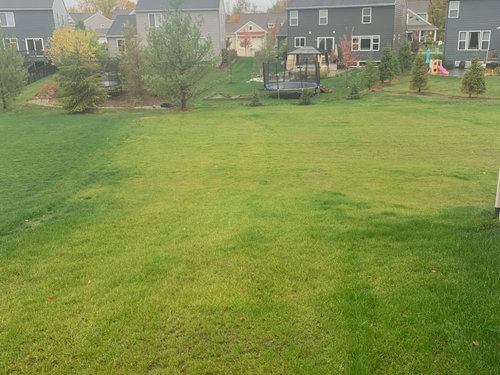
I have a new lawn that is 8 weeks old it was hydroseeded in mid-August 2020. I live in Grand Rapids, Michigan (West Michigan), so obviously cooler climates. The hydroseed mixture that was used includes Kentucky bluegrass and Ryegrass. I have a clay soil in my backyard, with 2inch top soil layer in the front yard.

At the 4 week mark the lawn was looking great and had a green rich color! It was still thin in a couple of spots, but I figured this was normal and it needed a few more weeks. I also fertilized at the 4 week mark using the recommended 16-32-3 (Starter Plus) mix. This is essentially 16% Nitrogen, 32% Phosphate, 3% Potash, and 6% Sulfur.


At 6 week mark I mowed for the first time. Some spots were several inches long (+6 inches) while the thin spots were still short (1-2 inches). The mow was nice as it evened everything thing out.


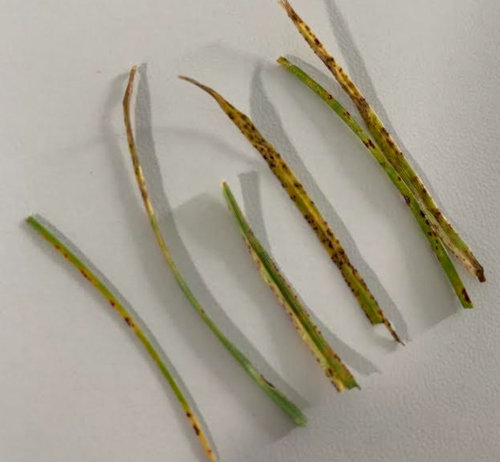
At 8 week mark I am now noticing some of those original thin spots are starting to turn yellow. I pulled a couple of pieces of grass for a close up shot. As you can see the grass looks similar to a banana. It's green, with yellow, and several brown spots. I was worried that this might be a disease! I went to my local HomeDepot and the clerk told me not to worry that this is because it rained a ton here between week #6 and week #8. Given that I have clay soil the water just sits there and is drowning the grass. This won't be a concern next summer since the water will evaporate quicker.


So I am coming on here to confirm if that theory might be true. Should I not be worried about the yellow/brown spots and hope that it will come in great next spring/summer. I just want to make sure I am proactive to fix this problem before it's too late. As a side note the front yard looks amazing, which is where I have the 2 inch top soil layer, so I believe this confirms that theory.


Thank you!


Comments (9)

  • 5 years ago
    last modified: 5 years ago
    That looks like a fungal disease. As you noted, it's rained a lot.

    While unusual for October, newer lawns are certainly going to be the ones that get them.

    I just had pretty much the same issue on another lawn, much further south, but your problem is much worse, you don't have much time left on the clock, and so I'm not going to copy that advice here.

    At that point, try DiseaseEx from the Home Depot and ignore anything any salesperson says. It's a wide-spectrum curative, will prevent fungus for 2 weeks, and that should give you enough time to start moving into winter.

    Expect losses with that much damage, on a young lawn, and with having to apply a fungicide (although I chose the most gentle one I could with a wide spectrum) both on a young lawn and just before a Michigan winter. You did catch this about as early as you could, it's just that this went pretty far pretty fast.

    Strictly secondary, but it's more likely that your ion balance is out of whack. We have a saying around here that basically reads, "You don't have clay soil." :-) Although about 2% of people actually do, it's exceedingly rare, and even then, it's usually a clay loam, which is not clay.

    If it drains that poorly, a soil test from Logan Labs would be in order, as the ion balance is probably quite poor (as I noted). That can be fixed.

    Emir Ibrahimovic thanked User
  • 5 years ago

    Great pictures. I agree with the fungal disease diagnosis.

    In addition to Mother Nature, what is your watering schedule? How often and for how long do you water?

    Emir Ibrahimovic thanked dchall_san_antonio
  • 5 years ago

    You mentioned Ryegrass, any idea if it's annual or perennial? Because the grass blades in the images you provided look too broad for perennial. In general mixing annual Ryegrass for a permanent lawn is a bad idea.

  • 5 years ago

    Neither you nor the hydroseed company is responsible for rain. They will fight you on that. As for thin spots, they should work with you.

    Are you still watering after the rain?

  • 5 years ago

    @adel - The Hydroseed company gave me an extra large bag of the following:

    25% - SR2100 Kentucky Bluegrass

    20% - Fiesta 4 Pernnial Ryegrass

    20% - Wild Horse Kentucky Bluegrass

    20% - Fielder Kentucky Bluegrass

    15% Sideways Perennial Ryegrass


    No idea what it could be if it's not the Bluegrass or Ryegrass. Unless the extra seed bag mixture they gave me is different from the initial hydroseed. I figured they used the same mixture as the bag they gave me.

  • 5 years ago

    With that much damage, it's hard to tell, frankly. My guess, given the tips, is ryegrass. Perennial. There are plenty of cultivars in that broadness range if I'm reading the lengths correctly.


    Annual PR is rougher than that.

  • 5 years ago
    last modified: 5 years ago

    As a second opinion, and since you live in Michigan, I suggest reaching the MSU Extension as soon as tonight.


    Also, I found this MSU Home Lawns page to be very informative and suggest looking over "Performance of Kentucky bluegrass cultivars in Michigan", "Mow at the highest setting" articles; quote from the former, "This grass species does not tolerate poorly drained soils." You should consider aeriation in the near future after your turf get well established.


    Regarding the seed mixture, and even though this is most likely what the company used, still it won't hurt to verify! And don't forget storing the bag in a cool place, not the garage, and maybe use it as soon as possible before the seed is forgotten in storage and gets too old.


    Earlier you said, "I also fertilized at the 4 week mark using the recommended 16-32-3 (Starter Plus) mix." Now I am wondering if you also added a starter fertilizer before seeding, which in this case would be too much and might have contributed to the problem.


    Update: Turf flooding is another interesting read.

  • 5 years ago

    I'd put down some more fertilizer. If it were me, I'd put down Scott's starter with pre-emergent because you still are under threat of weeds that mesotrione can mitigate. Hopefully some of the affected grass is just the perennial ryegrass. You don't want that crap anyways, just as a nurse grass. I feel like any fungal issue needs to be dealt with for a new lawn--even more benign stuff like rust and powdery mildew.

Sponsored
High Point Cabinets
Average rating: 5 out of 5 stars21 Reviews
Columbus' Experienced Custom Cabinet Builder | 4x Best of Houzz Winner