Software
Houzz Logo Print
pvecholane

Help with Orchid Cactus Cutting

6 years ago
last modified: 6 years ago

On June 3rd a friend gave me a very long stem of about 22” from her Orchid Cactus. I set it down on some garage furniture and forgot about it. Excess paper grocery bags wound up on top of it until the other day when I needed a paper bag and spotted the tip of the long forgotten Orchid Cactus peeking out. Poor forgotten thing seems very much alive sporting two skinny sprouts about 4” long with thorns on them. The odd thing is that one sprout is at one end and the other at the other end, leaving me wondering which end is up???

I’m motivated to plant it but I don’t really know how to proceed. Which end goes in the potting soil? Both ends have sprouts with thorns. Should I cut it in half and plant so that the thorny end is sticking up on both pieces?

I've prepared some soil for a wide but not too deep clay pot consisting of regular container soil plus well mixed in perlite and orchid bark. Does that sound good? But then what?

Comments (11)

  • 6 years ago

    Could you post a picture of what you have? I'm totally curious as to what it looks like after the neglect. Sometimes plants surprise us, don't they?

  • 6 years ago

    I’ll take a photo tomorrow. It’s too dark now.

  • 6 years ago

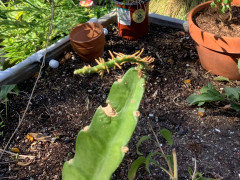
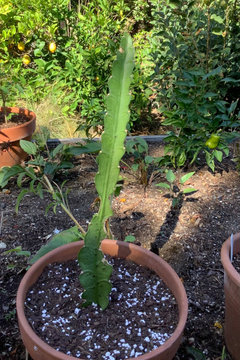
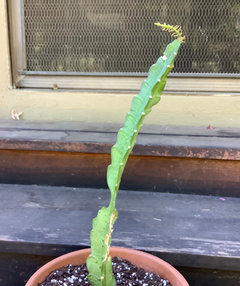
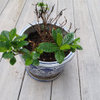
    Here are a couple of photos. I did plant one end in the container mix I have at the ready just to get a better photo, but that means I’ve buried thr other sprout. And the question still remains, which end to plant or maybe I should cut it in half and plant the cut ends?


  • 6 years ago
    last modified: 6 years ago

    Are you sure it is one of the epiphyllums = orchid cacti/cactuses? It looks more like pitaya/dragon fruit to me = Hylocereus . I can't tell from your photo, but is the plant flat or 3-sided? I was waiting for your photos, since as far as I know epiphyllums do not have spines. (at least not noticeable)..

  • 6 years ago
    last modified: 6 years ago

    The stem is very strongly three-sided. I did read the Orchid Cactus will occasionally show thorns. Don’t know if I can find that reference again, but I’ll look for it. The friend who gave it to me is a landscape designer/architect and presumably knows her plants and she definitely said it was an a orchid cactus. mine is supposed to have red flowers.

  • 6 years ago
    last modified: 6 years ago

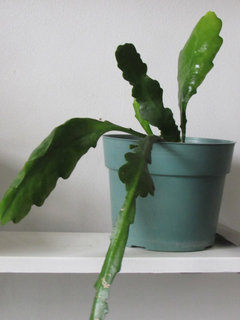
    I do not know if orchid cactus has so many spines, I really doubt it. BUT you said it was forgotten and underneath some paper bags, so maybe that new growth is different because of that. Most are flat, few could be 3-sided. Colors of flowers could be red, pink, white...But I am not an architect/landscape designer and I could be wrong. Hopefully some that have this plant for a while will chime in...I have just a young plant which was grown from very small (maybe 1.5") cutting - but it is very flat, has scalloped edges, and no spines at all. Maybe I am just confused and my plant is not one of the 'orchid cactuses' (common name that could be used for few different plants) at all.


    Leaves/segments are also much softer, where hylocereus is much 'stiffer' - I used to grow it but got rid of it. Mainly because it was getting too big, and I didn't like the spines...Did your friend give you a proper - botanical name?

  • 6 years ago

    I’ve been reading articles and they are a bit confusing because so many epis are hybrids.. I, too, wish my friend had used a botanical name!


    Here’s a paragraph that caught my attention because it says stems can be flat or 3 angled. Mine is definitely 3 angled, although I would say triangular.

    also it says the stems are 18 to 30 inched long which fits mine.

    How can I know a plant is an Epi when I see it?
    Epis usually have flat leaf-like stems (although in some hybrids the stems are 3 angled). In mature plants the stems can be 18 inches to 30 inches long (45cm to 75 cm) and their general habit is to grow new stems from the base of the plant. There are exceptions where a new stem will develop somewhere along an old stem. This will usually happen if the growing tip of an old stem has been damaged or if indiscriminate pruning is done.


    another paragraph:

    Along the edges of the stems are usually indentations which may be shallow or deep. The shape and depth of some of these indentations adds lots of interest to the overall appearance of the plants. Areoles (little furry tufts out of which the spines grow) can be found along these indentations.


    My stem has these indentations. I’m assuming I have a ”little furry tuft out of which spines can grow”. Except they are growing at each end! That’s terribly confusing.


    Then to thoroughly confuse me, there is this paragraph about adventitious roots. Do I have a root instead?

    Why do some stems put out long stringy things and others do not? Should I cut them off?
    Those long stringy things are adventitious roots! Do not cut them off. It is quite natural for many epis to produce these roots. If they appear in large numbers, however, this may signal problems exist such as perhaps the plants may be too moist, too dry or in too much shade. The adventitious roots could be reaching for the moisture, light and even food that the plant is not receiving in sufficient quantities through watering, natural light and fertilizer.

    When these adventitious roots appear, you should ask yourself if you are giving the plants enough water and/or fertilizer, if there is enough humidity around the plants and perhaps you should check the soil in the pot for signs of pest infestation which might be damaging the roots. Also, although I will tell you later that these plants do better if a little pot-bound, it is just as possible to underpot the plants which can also force roots to be produced along the stems.


    This sounds appropriate for my terribly neglected stem. But the spines suggest what I have is not a root.


    I still don’t know what I should do with my stem. Which end should I plant?? Or should I cut it in half.?

  • 6 years ago
    last modified: 6 years ago

    Thank you! That fits with the impoverished circumstances my neglected stem found itself in. I’ve read that I should let the cut ends dry for several days before planting. But since my stem seems to be behaving differently I’m still confused. Should I bury the ends with the spiny stems/roots, which seems logical. Or the cut ends, which is recommended for cuttings.

  • 6 years ago
    last modified: 6 years ago

    echolane

    I was referring to many roots visible on new growth, which you said were 'thorns':


    Those look unusual to me for orchid cactus, but I could be wrong. I wasn't aware they could grow aerial roots, but had them growing on the pitaya I had. They grew from anywhere of the leafs/segments, were long and were quite stiff/hard, and I didn't like it. I kept cutting them off without any problems, and had that plant for about 2.5yrs. It didn't die, I just tossed it...I know, that's bad :)

    I think hey are just regular roots as Embothrium said, grown in conditions plant was in. If you leave it as is, they may eventually dry up and die off. If they were "real" air roots, I believe they would become harder and longer - hat is bit unusual for epi IMO (but I may be wrong!)

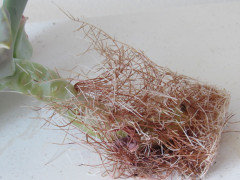
    Many succulents grow aerial roots, and there is not much to worry about. Aeoniums, Adromischus cristatus and more. And many plants will grow roots that should be in the mix, if left out of it for a while. I have number of different plant cuttings that were left out for too long and have roots. Like this cutting that was in an empty square pot for few months - roots growing in the shape of pot :) So it was in similar conditions as your cutting: no soil, dry, dark and forgotten:


  • 6 years ago
    last modified: 6 years ago

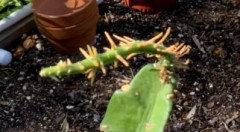
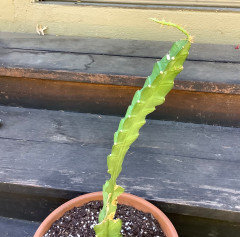
    I took a better photo today. If you look closely, you can see the triangular nature of the stem and that spiny looking growth at the tip which is duplicated in the buried end.


    if they are aerial roots, that suggests I should plant the cut ends.