Software
Houzz Logo Print
owen_witesman

Remote Range Hood Blowers: hood brand or generic?

5 years ago

I've done a bunch of reading on the forum, and I feel like I continue to have ah-ha moments, but I can also sense big gaps in my understanding as well. Thanks to @kaseki for such generosity in sharing with the community.


Here's my setup: 48 inch Bluestar rangetop with 12-inch griddle (already delivered). Looking at pairing with a 54-inch range hood, probably also from Bluestar and probably 24 inch deep. There will be cabinets immediately to either side. I know deeper capture would be better, but I feel like 24 inch is probably a good middle ground solution for our kitchen.


Based on this setup, I believe I need at least a 1200CFM blower and a little more wouldn't hurt, like 1300-1500. I'm working on MUA, but given how leaky the house is (built 1905), I believe I only need 800CFM, but I may just go ahead and match the exhaust blower CFM so I know where the air is coming from. This will probably be tied into our HVAC, but maybe it will be independent. MUA will be triggered by a universal pressure sensor in the exhaust duct. (Or can the direct-wired Broan dampers be wired to any hood???) On the exhaust side, I know I will want a Fantech duct silencer. But none of this is really the question.


My question is this: is there any need/point to buying my exhaust blower from Bluestar (or whoever I get my hood from)? Or, should I just buy e.g. a Fantech inline blower (10 inch for 10 inch ducts?) since I'll be using their silencer as well? Who manufactures the blowers for all these appliance makers, anyway?


And, if the more generic solution is the way to go to avoid paying luxury brand-name markups, who makes the best fans (inline and external)? Is it Fantech or someone else? In looking at Fantech, I also noticed that their CFM ratings seemed not to line up with what the appliance manufacturers are selling. Are they being more honest or testing differently? Is a Fantech FKD10XL (1266CFM) going to be similar to a 1200CFM blower delivered by an appliance brand or something else? I ask because I'm not seeing them selling higher CFM blowers for 10 in ducts. I feel like I'm missing something!


Finally, last question, if I go inline vs external, which seems to be cheaper but with similar noise isolation features vs in-hood, are there other things I need to be buying besides the silencer and maybe some automotive sound dampening material? Like a certain roof cap or special straps or something? Or other parts? Basically, I want to have all my fancy components ready to go so my GC only has to have someone connect it all with smooth ductwork. Unfortunately, past experience has left me with zero confidence in any trades getting technical details right without me holding their hand.


Any suggestions (and critiques) would be greatly appreciated!

Comments (7)

  • 5 years ago
    last modified: 5 years ago

    54-inches (4.5 ft) x 2 ft = 9 sq. ft. Desired volumetric flow rate to achieve 90 ft/min across the hood aperture is 90 x 9 = 810 CFM. Blower rating needed to pull 810 CFM with decent MUA will be around 1200 CFM, as you noted.

    Fantech provides 'fan-curve' data in the form of tables, and also plots. A 1200 CFM unit (at zero static pressure) will show a value near 810 CFM at some pressure drop (about 1.2 inches, w.c., for the FKD10XL). Excluding MUA, most pressure drop will be from the hood baffles, unless one has several tens of feet of duct. It would be useful for you to obtain pressure loss vs. flow rate data from Bluestar.

    Fantech in-line blowers are, I think, axial blowers (like a turbo jet pressure section) rather than a flat plate with radial fins (like turbo chargers use). Broan blowers, including inline, appear to all be the plate type. There is nothing wrong with these, but they may have a different characteristic fan curve shape than Fantech's blowers. I've never plotted both together. (It is important for residential blowers operated at uncontrolled pressure losses and any speed from low to high that they have monotonic fan curves. Else they might 'hunt' at some setting. That would be annoying.) Plate type blowers are least conspicuous built into a roof cap.

    Commercial up-blast blowers use induction motors often tied to the fan assembly via a belt and sheaves. These can be tailored to provide the desired CFM at lower fan speeds, thereby reducing noise. They are, however, significantly more conspicuous on the roof.

    The primary advantage to using a hood manufacturer's specified blower is that it will directly adapt to whatever fan speed controls are built into the hood. Other blowers may require some type of adapter or control replacement. So a Blue Star hood's control nature might have to be determined.

    My Wolf hood adapts to my Wolf blower, made by Broan/NuTone, and likely would work with any other single wire pair induction motor blower up to some motor power limit.

    The Fantech FKD10XL data sheet show curves for a 5-step transformer control, and for no control. One would have to check with them for compatibility with whatever the Bluestar hood uses, such as phase control.

    If you use an in-line blower, you also have to find a suitable roof or wall cap. Fantech many sell these. You should have a damper at the hood and also at the roof cap.

    You need to plan out the entire hood duct path. Is there room for a silencer? Can the duct path rise over its entire length (desirable)? What elbows are needed? Fantech makes some duct couplings that may prove useful. Hanger strap material will be needed. Sound dampening material may or may not be needed depending on blower assembly vibration, which is mostly, I expect, due to blower fan assembly balance quality.

    Best to match MUA actual flow rate to hood actual flow rate (ex: 810 CFM). This avoids all (well most) pressure drop in the house, conferring safety with combustion appliances and keeping the wall dust in the walls. If active MUA is needed to do this (depends on combustion appliances and their MUA, if any) then a blower that can provide the required CFM at the MUA path pressure loss (usually any air filters, but could include the heating scheme if hydronic).

    As usual, the duct diameter in the hood exhaust should support a full speed flow rate of 1000 to 2000 ft/min. The otherwise clean MUA path is not grease deposition constrained, but larger will reduce pressure loss if there is room -- useful particularly with passive MUA.

    I'll skip MUA control in this message, but it needs to be addressed. Commercial rigs usually run at constant speed (exhaust and MUA), so tuning is easy. Residential variable flow rate, along with perhaps a need to deal with other exhaust fans and fireplaces, imposes more difficult conditions for blower control. You might need a Fantech MUA setup, or their 10V control type blowers run by a controller trying to keep house pressure relative to outside within some bound.

  • 5 years ago
    last modified: 5 years ago

    Alternately, I could go directly vertical with an external blower on the roof, but then there would not be much space available for straight ductwork between any dampers and the silencer. Maybe 10 inches before the ceiling, then the thickness of the ceiling, and then another 4 feet to the roof joists. The roof pitch is pretty low, so there would also be a little space in the roof curb. I'll have to go measure exactly how tall that attic space is, but it isn't very tall.

  • 5 years ago

    The interior of the silencer looks like straight duct with perforations. I don't think any deliberate airflow 'straightening' is needed at each end. It will need a coupling at each end, I think.

    In any case, the roof cap needs to be at least 10 ft from any air intakes, and preferably downwind (relative to prevailing winds). Plan the duct path to get from the hood to the most desirable point on the roof. A little extra duct won't hurt anything, and the elbows used for offsetting will be relatively shallow angles re. 90 degrees. Don't forget that 3 dimensions are available, so the ducting sections need not lie in the same plane.

    Don't do anything until the MUA plan -- at least the physical part -- is also defined.

    If the Bluestar control in the hood is intended for 115 Vac, then that is the blower motor spec you want to use. If Bluestar's control can do either, then the question is whether giving up two breaker positions is worth the lower current drain. I vaguely recall that this motor was only around 5A.

  • 5 years ago

    For MUA, it looks like tying into our HVAC is going to be impossible. The house is from 1904, with a cobble foundation everywhere except the kitchen, which is a 1940s addition with a slab foundation. Basically, to connect any of the HVAC returns to an outdoor intake would be a major excavation operation and likely block important mechanical access.


    Note that we're on the Wasatch Front in Utah, so we do have cold winters.


    So, I see two options:


    1. A passive system with two 10-inch ducts using the Broan pressure-triggered dampers. I used their MUA specifier online tool, and this is close to their recommendation, with the remainder made up by permanently open vent holes in our ancient basement. Both ducts would dump into the kitchen, one at the entry to the dining room to create an air curtain separating the kitchen from the rest of the house and the other at the back of the kitchen at the access to the laundry room. Note that the kitchen is only about 13x17. This solution is cheap but I worry about winters

    2. The Fantech MUAS 1200 system with a MUAH 10 heater. This should take care of the heating issue. I think I have space for it in the kitchen attic. My concerns are that I am now adding an inefficient electric heater to an already inefficient home and introducing some additional noise. And of course the extra $2700, but that isn't prohibitive if the system works well.


    So, any thoughts, Kaseki?


    Is there a simple answer? Like, do the MUAS if it fits, dummy! Or, passive is usually fine, dummy!

  • 5 years ago

    The thing about inefficiency is that it is bad when high duty cycle, but possibly more efficient in total resources when low duty cycle. Running the hood on high in cold weather might require less than an hour per day of electric heating. A propane heater might be equally expensive to run, and more expensive to purchase. I have an oil-fired hot water system heating my house, and I used a hot water to air heat exchanger for my MUA heating. This exchanger is only 10 ft above my furnace plumbing. I could have equally easily, (I think without actually evaluating it), used electric heating, given that I would have to have added yet another breaker box intended for high current flow from the primary feed. It would in some respects be simpler because I wouldn't need to protect the heat exchanger in winter with sensors that will initiate heating it if the attic gets too cold.

    An electric heater should not be much of a pressure loss, although I haven't looked into Fantech's device design. You may want to ask them what it is (pressure loss vs CFM).

    In any case, you will definitely want to heat this MUA when operating at the high end of your hood blower's range. So either in-line heating is needed for both / all MUA paths, or the MUA should dump into a room such as the basement where a deliberate ADDED room heater pre-heats it as it passed through to the kitchen and curtain space.

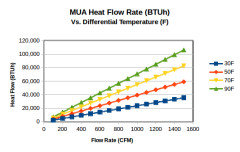
    If you haven't seen this chart below, use it for estimating. You can convert BTUh to watts using Internet tools if necessary.


  • 5 years ago

    Thanks kaseki!