Software
Houzz Logo Print
christopher_madden27

Young sugar maple pruning questions

5 years ago
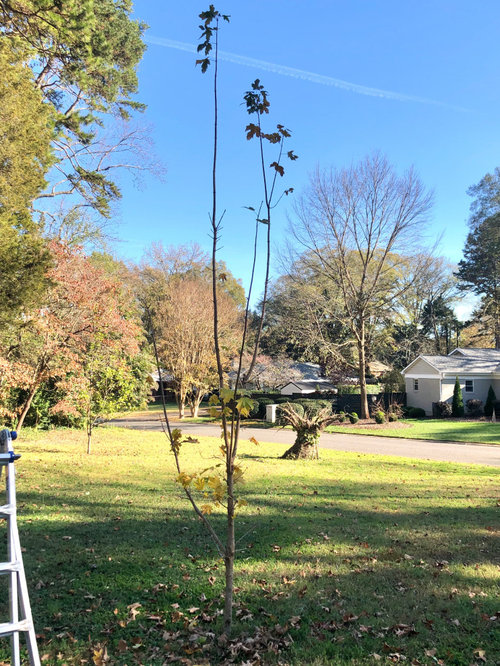
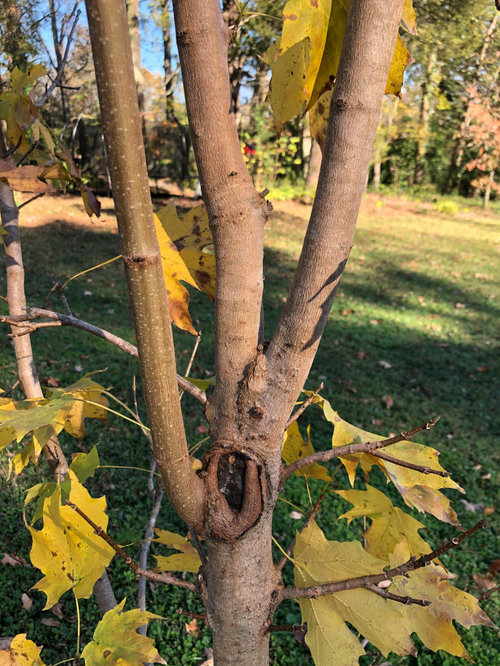
Hi. I've in Charlotte, NC and I've got a 4-ish year old sugar maple. It's doing fine but I'd call it gangly looking and I'd like to prune it. It's got 2 competing leaders, the tallest of which is about 15 feet tall, and a third branch- growing out of the trunk, but not quite as tall, also growing straight up (I think it might considered a water sprout?). I'd say all 3 tall branches make the tree look a bit ungainly, as they are mostly branch with sort of tufts of leaves at the top. Anyway, I'd like to just have one leader, two at most. Here are my questions:


1. Would cutting off the competing leader and the tall water sprout be too drastic. They are long, but they're not loaded with leaves. As I mentioned, the leaves are mostly at the top of each of them.

2. What about cutting just the water sprout and leaving the two leaders. The leaders make a "V" where they meet, which I've read is possibly problematic (weaker and possible prone to damage and/or decay?).

3. Whether I keep 1 leader or 2, they are quite tall so that the main mass of the leaves on the tree is down lower, then there is more or less a stretch of unleafed wood and then tufts of leaves at the top (looks kind of giraffe-y). Could I prune the top to encourage more branch and leaf growth lower on these long leaders, or would pruning the top just cause the tree to shoot up even higher?


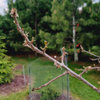
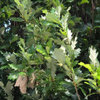
Here are a couple of pictures of the tree showing it's general shape and the junction where you can see the "V' where the 2 leaders meet, as well as the water sprout growing out of the trunk below this.


Thanks in advance for any advice!

Chris

Comments (21)

  • 5 years ago

    i have to still mull this.. but for sure.. whatever you decide to do.. ought to be over teh next 3 to 5 years ...


    you should not remove a significant portion of the canopy in one fell swoop ...


    and it appear gangly.. because its a very young tree ... thats how they do it .. sorta like teenagers ...


    what bothering me right now.. is thzt huge gaping wound ... and how i would clean up the whole mess .. and i might go as far.. in a few years to remove everything above it.. and encourage that sprout below it...


    and i do not think that would properly be called a water sprout ... its a sprout in regard to the damage done that made the wound.. such triggered a dormant bud ...


    so just put away the ladder.. until we ponder it all out ...


    and do not.. the VEE crotch of the two above.. is probably worse than the wound ... go figure on that ... so one of those should probably go also ...


    well.. that sets the premise on that part ..


    if you insist on doing something today.. or this weekend ... remove the grass in a 3 to 4 foot circle around the trunk.. and properly mulch it... if for no other reason.. to keep the nut with the weedwhip away from the tender young bark ...


    with trees.. we talk in tree time.. counted in decades ... so this thing is very young ... and just getting established ...


    every leaf is a food making machine.. so we dont want to cut too many off in one growing season ... so whatever we decide.. it should be done over the next few years.. not all in one day ...


    lets see what others think....


    ken


    ps: at a min.. we might want to head back the competing leader ... so the other takes dominance for now ... even though we might end up removing both ...

  • 5 years ago

    Thanks for your thoughtful comment Ken. Gotta get ready for work but I'll try to digest what you said. Let me know if you get any more insights.

  • 5 years ago

    yw....


    if not for the wound.. i would probably take off everything above the wound.. and work back up from the sprout just below such .. over a 2 or 3 year period ... maybe in 20 or 30 years ... what i never had an answer to is whether cutting across a healing wound is good or bad .... [where tom waldo???]


    the tall V will be where it breaks again.. as bark gets included ... maybe in 20 or 30 years ... and then one side or the other will fall ....


    so fix it now.. and in 5 years.. you wont even remember it all ...


    ken


    https://duckduckgo.com/?q=included+bark+damage&t=ffsb&iar=images&iax=images&ia=images


    https://duckduckgo.com/?t=ffsb&q=included+bark+&ia=web

  • 5 years ago
    last modified: 5 years ago

    The fork to the right in the close view has a bark ridge which means that it can be expected to be structurally sound. In that there is not included bark and a future breakage point beneath it.

    Whacking away at this tree may not be the best approach. Try searching "pruning training maples" on the web and see if you get any useful guidelines. Maybe you can even get something about sugar maples specifically to pop up.

  • 5 years ago

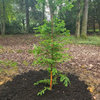
    IMO it's not right to try to keep maples singled-trunked. As you can see one of mine below (and another in the left background), they are naturally going to branch low. My suggestion would be to cut the center "trunk" so then there'd be the max separation between the remaining two. The branch even lower down? That's up to you.

  • 5 years ago
    last modified: 5 years ago

    ^ I agree.

    Acer saccharum tend to grow more of a 'ball' form.

    https://www.mapleleavesforever.ca/pruning-young-sugar-maple-trees/

  • 5 years ago

    Okay, great. Thanks everyone. Sounds like I have options. Very helpful.

  • 5 years ago

    Here's where I'd cut. Just me tho.

  • 5 years ago

    Need for that cut questionable as there is a bark ridge between the stem that would be removed and the one to the right of it. Which is taken as an indication of the crotch being structurally sound. Also the stem selected for removal can be seen to be the tallest one in the first photo and therefore the currently functioning leader. And where you have the line would be too far into the tree to cut, likely to result in another comparatively large and lingering wound like the one facing the camera.

    You really should get more background on pruning and training of maples before doing anything additional to this tree. More background than can be gained from social media - try doing a web search to see if you can get anything particular to maples being shown and described. Otherwise there are print pruning manuals at the libraries of colleges that have horticulture programs, where the specific treatment of individual genera or even species of trees and shrubs are discussed. If you can't get into any such facilities that may be present within reasonable driving distance during the pandemic your tree can wait until afterward.

    In the meantime as the saying goes "Once you cut it off you can't put it back".

  • 5 years ago

    whatever you decide ...


    start by removing hanging weight .. and use a good tree saw to remove just the small remaining part ... and if you arent familiar with a tree saw ... learn how to use it.. before you go for the surgery ....


    do NOT try to do it all in one cut ...


    ken


    https://duckduckgo.com/?q=folding+tree+saw&t=ffcm&ia=web

  • 5 years ago

    Okay, thanks I’ll think about this and do some more research. I am curious Embothrium about the bark ridge you mentioned. What does this signal and what would that fork look like if it were going to be problematic in the future?

  • 5 years ago

    Included bark looks like this:

    This Old House - What not to do (gardenweb.com)

    And is what one sees where future splitting apart may be likely.

  • 5 years ago

    Ahh.. okay. Gotcha. Thanks.

  • 5 years ago

    I'd remove the right fork in the second picture immediately. While it is a strong joint as already pointed out, it's too low on the tree for my liking. I prefer my trees to have a single trunk until at least head height or just above. And more importantly, if left to grow, it will likely prevent that straighter, center, natural leader from developing branches on that side of the tree. Think of it as "hogging the sunlight" as it continues its vigorous growth. I'd then cut the other two remaining large branches back a couple feet to slow them down. Those can be removed at a later time once the tree has begun to develop more branching on the current leader.


    How tall was the tree when planted? If it was a seedling or short whip, that is a remarkable amount of growth for only 4 years. Which leads me to not worry that much about stunting growth with what I have recommended to prune off above. Plus, in my opinion, any loss in vigor is an acceptable trade-off for pruning to create a fuller-looking young tree with better shape, better branching.


    As Embothrium has suggested, you should try to find a pruning manual with good illustrations to help you out on your future tree trimming.

  • 5 years ago
    last modified: 5 years ago

    A bark inclusion that small at that young age will get grown over quickly & won't be an issue if the branch causing it is removed.

  • 5 years ago
    last modified: 5 years ago

    If you're talking about the fork to the right of the red line in the last shot there is a bark ridge there and not any signs of bark becoming included (as far as can be seen in the picture - I have seen trees that had a combination of both at the same point of forking). With the latter phenomenon being something that routinely goes away as a tree develops being an idea that is unfamiliar to me. I have on the other hand seen trees that split apart after many years of growth, to show that they had crotches with long present included bark at the breakage points.

  • 5 years ago

    That large wound from the missing branch, right below that crotch, makes things even more interesting, with possible heart rot in that area making the trunk even weaker.

    A better idea may be to cut everything down into the old wound, leaving the far left most branch, giving the new wound a chance to heal properly.

    The established root system should put forth generous new growth next season.

    Removing the grass in a few foot circle around the trunk and mulching with wood mulch will help retain moisture and nutrients making for a healthier tree.

  • 5 years ago

    Something like this:


  • 5 years ago

    Thank you everyone. With regard to how fast it’s grown, we’re in Charlotte and compared to my native Northeast, the trees seem to be on steroids down here. I think, based on what I read before I bought it, we’re at the very warm edge of the sugar maple’s range.

  • 5 years ago

    If you think about it, give us an update sometime in the future so we can see what you decided and how the tree has responded.


    Bill - While discolored/darkened, the wound really isn't all that big and will heal over long before rot sets in. The cut you are suggesting would create a larger wound in diameter than the one that is there.

  • 5 years ago

    Now we're splitting hairs. :-)

    I would just do what ever it takes to give the tree it's best form with as few left over crotches as possible. Any of the above suggestions won't be noticeable in a few years, or only to the one that pruned it.

    Giving advice by looking at pictures can be less than ideal anyways so I digress.

    :-)

Sponsored
Mary Shipley Interiors
Average rating: 4.8 out of 5 stars34 Reviews
Columbus OH Premier Interior Designer 10x Best of Houzz