Software
Houzz Logo Print
kay_thompson35

30 inch hood for 6 inch ducting

5 years ago
last modified: 5 years ago

I recently purchased a house that was completely remodeled. I have a GE profile range that requires 625 cfm. I have read however if you do Asian cooking that you should add 200 - 300 cfm to that. The kitchen has a vissani hood 375 cfm with 6 inch duct to the roof. I checked and the ducting is flexible. The hood is not strong enough for the high meat sears and high heat cooking I often do which is causing the smoke alarm to go off.

I live in southern california. No fire place. Water heater is electric. There is a window right next to the kitchen that I open every time I cook. The stove is against a wall. The hood is wall mounted. The kitchen is open to the dining and living room.

I am willing to increase duct size if that is necessary. It seems like the best thing to do is to buy a new hood and get a bigger duct size. I have also read things about getting an inline blower or rooftop blower, but I'm not really well versed in this.

Currently my hood is 8-9 sones at highest speed which seems wayyy too loud.

Would like to know your recommendations for hood brands or even particular models. I'm not picky about appearance. Just want something that is stainless steel with the best capture for smoke and grease.

Comments (12)

  • 5 years ago

    6" is unlikely to transport anywhere close to the amount of air you need. We typically see recommendations for 8" and sometimes even 10" ducts (depending on CFM, length of duct, number of bends, ...). A HVAC contractor can easily look these numbers up in appropriate tables. Also, flexible corrugated ducts are in violation of building code, as grease can easily build up and pose a fire hazard.

    Typical back-of-the-envelope calculations suggest that you should have around 800 CFM for a typical installation of a 30" range. See a plethora of postings by @kaseki for much more details on how to compute your specific needs and how to pick a hood design that stands a chance to actually work.

    Kay Thompson thanked M
  • PRO
    5 years ago

    Definitely look up @kaseki previous posts. Simple answer is if you are concerned the only was to exceed 600cfm realistically is to enlarge the hood vent. 8" is ok, 10" is common. Inline and remote blowers are options but will dramatically increase complexity and cost.


    Brand wise, be aware that most hoods are made by someone else. The biggest names in the appliance world, buying their hoods from brands like Broan, Faber, Elica and others. So if you fall in love with a particular look or style from a name brand, don't be dissuaded by price, you have other options.


    One caveat to this that may change this conversation. In newer construction, make up air is a factor. It's something you should look up before committing to anything since it may take what feel like a small job to a much larger one.

    Kay Thompson thanked Joe Henderson
  • 5 years ago
    last modified: 5 years ago

    Is the hood mounted between two upper cabinets? Or, is it "standalone" with nothing on either side of the hood for at least 3"?

    If you have at least 3" on either side of the hood, consider getting a 36"W x 24"D hood (assuming a 30" range), especially based on your cooking style. A hood 6" wider than your cooking appliance and 24"D is usually recommended to adequately collect the effluent (or FOGSS - Fumes, Odors, Grease, Smoke, Steam).

    I'm guessing the reason your smoke alarm is continually going off is because the hood is undersized -- both in size and cfms.

    If you don't have room for a wider hood, at least get a 24"D hood.

  • 5 years ago

    Make up air is usually is a concern. But last time this question came up, California was a notable exception, where the building code doesn't (yet) require MUA. Normally, it would still be a good idea to plan for it, as it can have a big impact on safety and air quality. But a Southern California climate probably means that windows are regularly open 24/7, and OP mentioned that there are no other gas fired appliances.

    So, this might in fact be one of the rare cases where MUA is not a major consideration.

    Kay Thompson thanked M
  • 5 years ago

    Plethora of prolix postings kaseki here. We note that 600 CFM through a 6-inch duct is 50 ft/s air speed. One would need a three-phase 400-Hz aerospace ducted blower to achieve this (depending on duct length). (See Rotron.) And the whine of this type blower would exceed even the noise of the duct flowing air at this velocity.

    So, as usual, we recommend starting at the requirements and working toward hood specs, then toward a hood. For wok cooking, even on induction, a hood intake air speed of 90 ft/min is desirable. This is 90 CFM per square foot of hood aperture, which itself needs to overlap the pans side-to-side and front-to-back by enough to encompass the rising and expanding cooking plumes.

    For example, a two x three foot hood aperture would require an actual 90 x 6 = 540 CFM. But wait, there's more -- a lot more. The hood or in-line or roof blower CFM rating needed for this varies with the pressure losses (air friction) that the exhausting airflow meets leaving the house, and which its replacement air meets getting back into the house. Without analyzing these, a guess at a needed blower rating is 1.5 times the required air flow rate, which gets us to 540 x 1.5 = 810 CFM. Call it 800 CFM blower rating (zero static pressure).

    The duct velocity should be in the 1000 to 2000 ft/min range, not the 3000 ft/min one might hope to get in a 6-inch duct. Go for 8-inches of steel duct for 1550 ft/min. (Recall that we are making an assumption about the hood, so correct these numbers when the hood is selected.) 10-inch duct is even less restrictive, but more difficult to work with and it takes up more attic room.

    Consider a external (e.g., roof) blower with an intermediate silencer (Fantech) for a reasonably quiet full power hood.

    Hood should have baffles for filtering at these velocities, and these will function even when dirty.

    A means of providing make-up air is necessary to even achieve the 1.5 rated flow rate factor. Screened open windows will probably have low enough pressure loss, where such is allowed. However, for those reading this that have combustion appliances in use, sufficient MUA is mandatory for safety against back-drafting carbon monoxide.

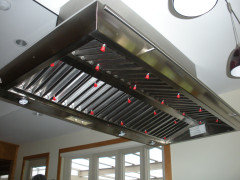
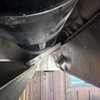
    It is helpful, particularly with wok cooking, that the hood have some reservoir volume under the baffles. But this is usually slight for residential hood offerings. The attached image shows the underneath volume of a Wolf Pro Island hood as an example. (This works for me. Under the distant end of the hood in the image there is a Cooktek induction wok hob.) A completely flat array of baffles is not desirable, but may be needed if there is some reason the hood has to be "thin."

    Other aspects of residential hood selection involve aesthetics and price, but I won't delve into these. Hoods are fairly simple things, as are conventional blower motors and fans. One can add electronics in proportion to how much one wants to degrade the mean time to failure. I can note from experience that if the hood has halogen lights that will be over one's head, choose a hood that allows replacement with available LED lamps.


    Kay Thompson thanked kaseki
  • 5 years ago

    "I checked and the ducting is flexible."

    If this is referring to flex duct of any sort then that is a significant safety problem and regardless of size s/b replaced with smooth rigid duct.

    Kay Thompson thanked opaone
  • 5 years ago
    last modified: 5 years ago

    spent most the day looking at ventilation systems.

    Thinking about replacing current system with 10 inch rigid ducting, broan external blower 1200 cfm (not that much of price difference compared to lower CFM https://www.homedepot.com/p/Broan-NuTone-External-1200-CFM-Blower-for-Broan-Elite-Series-Range-Hoods-335/100025769#product-overview, and broan hood shell 30 inch with 24 inch depth https://www.homedepot.com/p/Broan-NuTone-Elite-30-in-Range-Hood-Shell-with-Light-in-Stainless-Steel-E60E30SS/202905883?#product-overview. I didn't look too much into silencers but I think this is what you all are speaking of in the forums I've read so far... https://www.supplyhouse.com/Fantech-LD10-Galvanized-Steel-Silencer-for-10-Duct. 

    Waiting for broan to respond about a duct cover since i dont have a cabinet there.

    I looked at faber, but nothing is available with higher than 600 cfms at 30 inch depth (must keep that depth because my cabinets are in the way). Also looked at prizer, abbaka, bluestar, z line, dacor, GE, stuff at home depot, stuff at costco, stuff at friedmans but something was either the wrong size, cfm, or not available. There is a fivestar that works but no pictures to see if the inside of the hood is "tent" shaped as recommended by @kaseki. @Joe Henderson any other recommendations for good value brands? I looked at wolf too but the duct cover was so expensive!

    I started my journey contacting HVAC professionals in the Los Angeles area to see what they would recommend, but I haven't had much luck finding someone who does vent hood installation or would recommend something roof mounted which I found frustrating and odd. One company did recommend a KOBE internal hood with 600 CFMs https://www.homedepot.com/p/KOBE-Range-Hoods-30-in-600-CFM-Stainless-Steel-Wall-Mount-Perimetric-Range-Hood-with-Flame-Temp-Sensor-Auto-On-Off-and-Fan-Control-CH7730SQ6-WM-XX/310852212 which would cost 2500 including hood, installation, and "ducting changes". I found it a little odd that his recommendation for hood CFM was so low and the hood actually does not require any ducting changes whatsoever (Duct Width 6 inch). Another company had someone come in for an estimate and then said they wouldn't be able to give us a quote for a month due to covid. Another company I called for recommendations said just pick the appliance and he will install it. When prompted about what he would recommend he said usually the more expensive the better... Would love to have any recommendations for installation in Los Angeles area if possible since changing the ducting does require cutting a hole in the roof and futzing around my attic. i feel as though this is a VERY important part.

    havent heard back from friedmans (who sells appliances in our area)

    @M yes, I was on houzz forums last night reading about flexible ducting and fearing a house fire X__X larger rigid ducting is definitely at the top of my list.

    @Buehl I am limited by cabinets on each side, will definitely look at something deeper at least 24 in, seems like there aren't a lot of options that are deeper than that.

    I appreciate everyone's input. You've been more helpful than the professionals that I've contacted!

    I've been looking through houzz forums I can't believe @kaseki responded directly to my post! thank you so much it really seems like you know what you're talking about I will definitely look for 800 cfms and up.

  • PRO
    5 years ago

    Broan branded is ok, but some of the finish work isn't great underneath (around the filters in particular). Best (Broans higher end brand) is a good crossroads of price vs performance and they definitely have duct cover options.


    http://www.bestrangehoods.com/store/products/productdetail.aspx?id=132719c0-aaeb-49fc-80f7-895541c52c03


    Zephyr (owned by broan) might be an alternative from a look/price standpoint.


    https://zephyronline.com/product/tidal-ii-wall-range-hood/


    If you can find a dealer I know prestige makes "tent" shaped baffles. A little pricey and would require a different blower, but good quality. Might be hard to find on the west coast though, as they are distributed out of NJ.


    https://www.prestige-america.com/prolinebullnose

    Kay Thompson thanked Joe Henderson
  • 5 years ago

    "So, this might in fact be one of the rare cases where MUA is not a major consideration."

    Agree. Even here in MN we often have a number of windows open and while we often need MUA and so couldn't forego installing one, we don't necessarily always need to use it. We've contacts on a number of lower level windows and if our system knows that we have a certain amount of open window then it will only use how much MUA is needed or none at all.

    Here, a lockout to prevent turning the hood on unless X windows are open might be a good idea. Keep in mind that windows should likely be on the same level or lower as pulling air down from higher up (working against stack effect) could be difficult or impossible.

    Windows should be upstream of the kitchen so that air flows through the kitchen to the hood.

  • 5 years ago

    OP, 24" depth is quite shallow, especially if you're planning to wok which will most likely be on the front burners. I'd try for 27" or 30" depth.

    More: https://www.gardenweb.com/discussions/5161173/hood-faq


  • 5 years ago

    @Charles Ross Homes I thought about that but I'm setting off the smoke alarms on a daily basis. I dont really want to lug food outside every day;


    @opaone I live on one floor. What do you mean by upstream? I have an open concept kitchen living room dining room with four windows.


    @opaone The only 27" in deep hoods I found were wolf which is more pricey than I'd like and Zline which only comes in 400 cfm. I did see one that came 30 inch deep but with lower CFMs around 600. What brands would you recommend? I will definitely look through that thread today!