Software
Houzz Logo Print
pootyihl

Lamium galeobdolon - Plant ID

5 years ago
last modified: 5 years ago

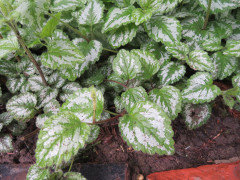
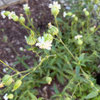
Please tell me this is not Yellow Archangel.

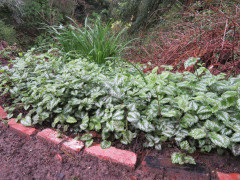
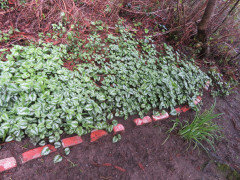
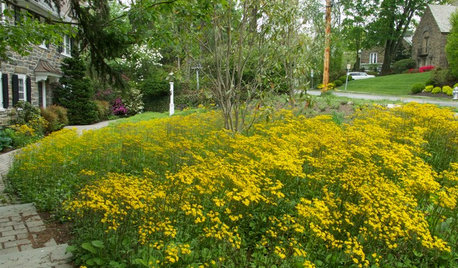
We bought a house back in September and are in the process of moving in. There is a spot in the backyard that I want to turn into a kind of cottage garden and make it into a special place to sit and relax. I noticed this ground cover growing in that area in September, although it wasn't as lush then as it is now.

I fell in love with it at the time; it's beautiful, it grows in the shade and the deer leave it alone - what' s not to like - the perfect plant, right? I noticed that it spreads, but most ground covers do and I figured I'd just pull up any plants that crossed the brick border I made for it. But, then I decided to try to find out what it is and that's when I started to get a sinking feeling in my stomach.

If it is Archangel, is there any hope of keeping it contained in its space if I am diligent about pulling, trimming and being very careful with how I dispose of the unwanted plants? It's so lovely, I just hate the idea of getting rid of it, but I also don't want to nurture an invasive non-native plant either.

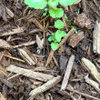
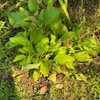
Pictures to follow.


Comments (21)

  • 5 years ago
    last modified: 5 years ago


  • 5 years ago
    last modified: 5 years ago

    It is Yellow Archangel. You could contain it or keep some in a pot. Left as is, it will keep spreading indefinitely. You could try to find another more well behaved variegated foliage plant. The Lamium would definitely wreak havoc in a cottage garden imo.

  • 5 years ago

    Thank you, Jay.

    After spending quite a bit of time looking at online photos last night, I was pretty sure that was going to be the answer.

    The area where the Lamium is growing backs up to a ravine that contains large redwoods, ferns and other native plants. It's too steep to be accessible to humans and that's where this plant is heading. Normally, I'd take the time to pull it by hand, but we aren't living here yet and are going back and forth between this new place and our other house which could means a couple of weeks for the Lamium to grow unchecked.

    I don't like to use it, but I'm wondering if this is a job for an herbicide like Round-up. Just to get it done and over quickly and to try and keep the Lamium from spreading into the forested ravine.

  • 5 years ago
    last modified: 5 years ago

    I think digging them out after the soil is loosened will allow more roots to be removed. I would definitely use a herbicide to prevent them from invading the adjacent natural redwood area with all its native vegetation. Lamium can be eradicated without too much difficulty compared to say Aegopodium podagraria or Ficaria verna.

  • 5 years ago

    i agree L is a job for the big guns ...


    with aggressive stuff ... you might have to spray .. and then come back in 6 to 8 weeks.. and see if anything reappeared.. and spray again ... etc ...


    ken

  • 5 years ago
    last modified: 5 years ago

    Thank you both for your help and advice. I'm going to start going after it today. Unfortunately, it's raining this morning, but it's supposed to let up this afternoon. The good news is that because of all the rain we've had these past few days, the ground is nice and soft which should make pulling it from around the plants I don't want to get sprayed fairly easy.

    Once it's been sprayed how long before it stops putting out runners? I'm worried that it'll keep growing until the Round-up does its job.

    I'm feeling like time is of the essence if there's any hope of keeping it out of the woodland area. If it makes its way into the ravine, there will be no stopping it. There's one area near the edge that isn't very stable ground and getting too close is a safety issue as it's a 50 foot drop, but I can reach it with the sprayer and will be particularly aggressive with my spraying in that spot.

    Any suggestions for a ground cover (variegated would be nice) that behaves itself that I can plant there once the archangel is gone?

  • 5 years ago

    Repeated glyphosate applications are typical with established perennial weeds. Once a plant has been sprayed it's not going to grow explosively while the chemical works on it.

  • 5 years ago

    Thank you for that reassurance, Embothrium. It makes me feel a lot better about the chances for success in getting rid of it.

  • 5 years ago

    Alrighty, then. After spending a couple of hours digging that stuff up from around the plants I don't want to spray, I now hate the stuff. How can something so beautiful be so horrible!?

  • 5 years ago

    It's done. I even tied myself to a tree so I could go over the edge of the ravine to get some stragglers that I spotted. I'll do a follow-up spray, if necessary, in a few weeks. I hope that will take care of the problem, but I will be vigilant about keeping an eye out for new sprouts in the future.

  • 5 years ago

    Since you liked the look but not the spread, once you are sure you have rid the area of this aggressor Lamium 'Herman's Pride' could be a nice alternative. It forms a clump so you would want to put in a grouping of three or more.

  • 5 years ago

    Thank you for the suggestion, peren.all. I'll admit I'm a bit leery about planting anything "Lamium" right now, but I'll keep it in mind.


    Thought I'd give an update on this battle. We mixed up some Round-up using the recommended ratio on the container. After 19 days, it turned slightly pale. For one day. Then it greened up and bounced back. So, we mixed up a stronger batch of Round-up and sprayed that on two days ago. Today, the yellow archangel looks seriously ill. It's drooping and appears to be turning brown.


    But, not all of it. Some of it looks just fine. We were really careful to spray all of it, but maybe we missed some shoots. I'm thinking we'll probably have to spray again in 2 - 3 weeks after we can see what survived the second round of spraying.


    That is one tough plant.

  • 4 years ago

    I thought I'd give an update on my battle with the Archangel.


    It's been almost a year since I first wrote this post. After repeated spraying with Round-up last year, the archangel finally died. I have been vigilante these last 11 months about keeping an eye out for new growth, but have seen no sign of it...until last week.


    I spotted a small but healthy patch growing in the same area. Once again, I sprayed (drenched it really) it with Round-up. It's been seven days and I just came in from checking on the plants. If anything, they look healthier and heartier than ever.


    Off to mix up another batch of RU and to pull what I can. These plants are hard to reach as they are growing right at the edge of the ravine underneath blackberry canes. I feel like I'm fighting what is eventually going to be a losing battle, but I will keep it up in the hopes of turning the tide.

  • 3 years ago

    I believe all of you are discussing Lamiastrum, not Lamium, including 'Herman's Pride', which though a Lamiastrum is not aggressive and is very handsome, forming a polite mound.

  • 3 years ago
    last modified: 3 years ago

    Thanks for the update.

    It is currently Lamium but synononymous with Lamiastrum. It has changed three times in recent memory but will perhaps stay Lamium now.

  • 3 years ago

    All of the plants called Lamiastrum are Lamium.

  • 3 years ago

    Well, that should prove a real PITA

  • 3 years ago

    It is a real PITA! Discussing plants has become infinitely more difficult, tedious, and confusing.


    Each plant now needs a scroll of the history of its name. Like announcing a Duke before a jousting match, "Sir Name Confusion, 3rd son of the Earl of blah blah blah, grandson of the Duke of wasting your time, lord of all lands east of here, and originally known as Bubba the Grand Slayer of Buffets, and known last week as Sir Chews-A-Lot."


  • 3 years ago

    LOL Tiffany, good one! It can be a frustrating exercise trying to keep up.

  • 3 years ago

    I choose to just ignore it, not playing Simon Sez with plant names. No, your snake plant is not a Dracaena.


    What's so sad is that genetics can yield incredible amounts of very useful info but nobody will know what plants they're talking about. If you complain, they'll just say you're not smart like them and you just don't get it so just shut up and fix your labels instead of reading about great new genetic discoveries.