Software
Houzz Logo Print
webuser_107419837

Transplant shock

5 years ago
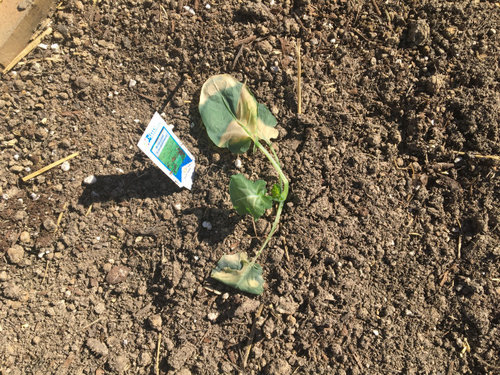
Hello all. I transplanted some peas, lettuce and broccoli yesterday afternoon. We did have temps dip below freezing overnight but today is sunny and in 60s. I noticed some transplant shock to my lil babes. Peas are barely noticeable, just some wilt. Lettuce is fine. But the broccoli, both those under cover and those not under cover look grim. Pictured below. Any advice on what to do and how to help future plants as well? Thanks!


Comments (8)

  • 5 years ago
    last modified: 5 years ago

    Judging by the tag next to your plant, they were purchased. How long did you give them to get acclimated at your garden?

    These baby plants come from a greenhouse, so they need to be introduced the elements -- gradually. It looks to me more like a case of sunburn than frostburn.

    If you don't have the time to baby them during the day (who does?), you may want to invest in a 50% shade cloth and keep them shaded for a week or so. The shade cloth also makes a nice windbreak.

    Once you have one, you'll want to use it all the time, e.g. to shade greens in the summer. I use mine all year round, but that's a different story 😎


  • 5 years ago

    Did you harden them off to sunlight before transplanting? It looks a bit like a combination of sunburn and cold burn in the above (although I'd need a closeup of the leaf for better ID).

    Broccoli really isn't cold tolerant below about 25 or so, if memory serves...a quick lookup says 26-31. So although a bit of a frost shouldn't have been overly bothersome, if it fell under that, it might have been a bit of a problem.

    So I'm surprised the covered ones reacted to the cold, and it may be sunlight if the hardening off wasn't long enough.


    Maybe try adjusting them a little slower?


    I notice (I mostly do flowers) my marigold and zinnia are bulletproof, but some have to be coddled a lot more. Eggplant are in the middle. Dahlia like to be coddled a tad. Melampodium like to take it slow.

  • 5 years ago
    last modified: 5 years ago

    As noted, we're not talking "transplant shock." As to the "what to do", for the burned leaves, nothing. They're dead. But the plant may have survived. I'd wait a week or two and see if new growth starts to come out. Brassicas tend to do that. My collards do that routinely. You can get a stem where all the leaves have fallen off, and start to get new growth sprouting from the stem. Also, "under cover" has a pretty flexible meaning. Something just draped loosely over them will allow air infiltration, and won't keep things much warmer than the outside air. A tight cover might be expected to protect somewhat better.


  • 5 years ago

    Oh, yeah sorry, what he said. :-) Not much you can do.


    Keep them moist, it'll aid recovery. Not wet, not soaked, just damp to moist; roots need oxygen, too. Remove the dead leaves when they're really dead, but don't go tugging at the plant more than you have to right now.

    If you feel you didn't adjust them long enough, shield them from sunlight with a tarp, covering, or other shield. If low temperatures are expected, cover them with non-plastic covering (plastic's ability to insulate is poor; paper's is quite good if it isn't wet). Multiple layers are better, where even plastic becomes effective.

    Remove the next morning as soon as the sun is up, or as soon as you can; sunlight on those can cook the plants if left until noon. :-)

  • 5 years ago

    The broccoli should recover if the damage wasn't too extreme but broc plants don't like stressful conditions so you may end up with a buttoned-up (smallish) head.

  • 5 years ago
    last modified: 5 years ago

    With regard to strategies to protect a seedling from cold, you just need to invert a bucket/bottle over the plant at night. Most of the protection is from trapped warm air from the ground. Heat that has accumulated in the daytime, and also heat from organic decomposition in the soil. Any bucket will do that. But some of the protection is from the insulating capability of the bucket. For a given thickness, plastic, wood, and paper are roughly similar in insulation capability. Glass is worse per unit thickness, but any glass cover is going to be a lot thicker. Metal is a factor of 10-100 worse. You won't find any thick paper or wooden buckets, and most any glass cover will be small (trapping less heat from the ground) so I'd do plastic.

    If you're trying to protect a whole bed, then a plastic tarp weighted down at the periphery is the way to go. I just did that en masse in our recent horrific Texas freeze.

    I find it amusing when people try to protect small fruit trees from a freeze by wrapping them in a tarp. That doesn't work at all. When you put a blanket around yourself, it keeps you warm because you generate heat, and the blanket keeps it in. Trees and plants don't generate any heat.

  • 5 years ago

    I tend to water before cold snaps; a humidity shield is one of the best as long as the evening is windstill. I can get two weeks out of the garden extra in fall just from that, sometimes.

  • 5 years ago

    Thanks y’all!!

Sponsored
J.Holderby - Renovations
Average rating: 5 out of 5 stars4 Reviews
Franklin County's Leading General Contractors - 2X Best of Houzz!