Software
Houzz Logo Print
westes

What is Your Experience With Pumice Dust for Rooting?

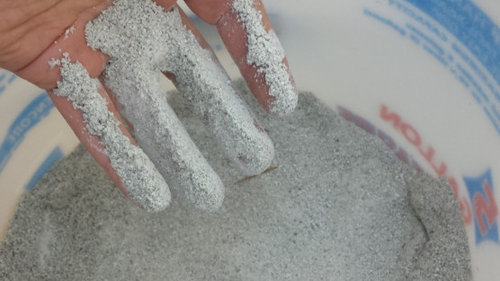
I have a lot of pumice dust leftover from filtering and washing pumice. It is more like ultra-fine sand than dust, although there is some dust mixed in. I am thinking that this might be the ultimate material for rooting plants, particularly succulents and cactus. I would need to keep it undercover and make sure it never gets wet because when it is waterlogged such small particles become a soup. But as a dry rooting mix, the advantage is that I can slip the plant in and out of the mix easily. The plant just glides in and easily pulls out. I can inspect every few weeks for root development and it is minimal trauma to the plant to be removed and reinserted. In addition, the roots will have no problems at all pushing through this soil. So it might actually optimize early root development. Obviously, this will only work for plants that like to be rooted in dry conditions. A plant that needs constant moisture is going to prefer another soil mix.

Has anyone else tried pumice dust for rooting, and how did that work out?


Comments (15)

  • 5 years ago

    My main concern is that maybe the pumice dust is so compacted by ultra-small particles that oxygen does not get to the roots even when the mix is dry. What is the minimum soil particle size that allows oxygen to freely travel into a container soil?

    @tapla (mid-Michigan, USDA z5b-6a) maybe you have something to say on this issue?

  • 5 years ago

    I’ve never tried straight pumice dust but I used to mix unsifted pumice into C&S mix for succulents. When I went to repot a year later I’d find a layer of near cement at the bottom of the pot from the compacted dust. Now I sift it. I’d guess you’re right that it’s too fine. One way to find out though. :)

    westes Zone 9b California SF Bay thanked Sara (9b SF Bay Area)
  • 5 years ago

    @Sara (9b SF Bay Area) I would never use unfiltered and unwashed pumice in a soil mix. Pumice products like "Dry Stall" are just garbage out of the bag and make a disgusting slurry.

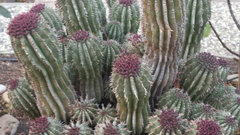
    If you take the time to wash it and filter it, pumice can make fantastic soil. My large euphorbia and cactus seem to love it. This one is planted in pure pumice.


  • 5 years ago

    @tapla (mid-Michigan, USDA z5b-6a) At least with cactus, and some euphorbia and succulents, the best procedure for rooting the plant after the callous develops is to stick it in the soil and avoid watering it at all for months. Usually, some roots have formed in that time, but I have plants that took nine to 12 months just sitting in a dry container to develop their first roots. Cactus in particular can be very tough customers. So when I talk about a "dry mix" I am talking about a special container - protected from both sun and rain - into which I would insert cactus and succulent cuttings and wait for them to root.

    If I watered pumice dust, I would get a lake on top of the soil that would take hours to clear. It would be ugly. So this is not a pot I would be watering at all. It is just a place for the roots of a cutting to begin to grow. That said, what is the point of not watering the soil to protect the roots from being deprived of oxygen, when the dry soil is also deprived of oxygen. Either way, the plant is not going to be in an optimal environment for root growth.

    For a soil mix that will be watered, 1/16th of an inch is about the smallest I have been able to make the particles and still avoid a significant perched water table. For a dry mix, I am suspecting that I could probably go to half that size, about 1/32 of an inch, and still get some oxygen to the roots. What do you think?

    I have a #20 mesh - about 1/30th of an inch - so I could try to filter the dust based on that size first and just do an experiment to see how that soil mix behaves.

    Does anyone make an oxygen sensor for soil that does not cost a fortune? I guess the easiest way to answer this question would be to just stick such a sensor down at the bottom of a pot filled with your target soil and see how the oxygen level develops there over the course of a few days.

  • 5 years ago

    I’ve only ever used pumice fines to cover seeds after sowing. Moist growing medium. Sprinkle seeds on top then “cover” very lightly with a thin layer of pumice fines and press down with the back of a metal spoon to ensure good contact.

    westes Zone 9b California SF Bay thanked SoCal Stewart (San Diego, Ca Zone 10A/10B)
  • 5 years ago

    I know someone who has a lot of experience with growing Mesembs from seed and surprisingly has told me it is very good for Mesemb seed germination and seedlings.

    westes Zone 9b California SF Bay thanked Polypompholyx
  • 5 years ago

    @SoCal Stewart (San Diego, Ca Zone 10A/10B) So in that application you are basically using pumice dust like a mulch on top of the soil, but for the early germination period you are using it as the main soil. Once they grow roots the plant quickly goes down into the soil and at that point, the small pumice layer is just a mulch.

    The problem I see with that approach is that one watering alone will just push all the pumice dust aside, and it won't stay in place as a mulch.

  • 5 years ago

    @Polypompholyx Did he happen to mention how he was preparing that soil, or what particle sizes he was using?

  • 5 years ago
    last modified: 5 years ago

    @westes Zone 9b California SF Bay, he didn't give an exact size but we both called it "fines" and I am familiar with the place that his pumice came from. I was surprised he even tried using it. When it gets wet it becomes like slush and I thought it would be terrible for anything cactus/succulent related. Perhaps it only works well for certain Mesembs. I'm not sure. Next time I get pumice I plan to get some fines just to try. I sent a private message to you.

    westes Zone 9b California SF Bay thanked Polypompholyx
  • 5 years ago

    At least with cactus, and some euphorbia and succulents, the best procedure for rooting the plant after the callous develops is to stick it in the soil and avoid watering it at all for months. Usually, some roots have formed in that time, but I have plants that took nine to 12 months just sitting in a dry container to develop their first roots. Cactus in particular can be very tough customers. So when I talk about a "dry mix" I am talking about a special container - protected from both sun and rain - into which I would insert cactus and succulent cuttings and wait for them to root. I'm not much of an authority on cacti or succulents, but I've grown and still grow a variety of succulents and have grown a dozen or so different cacti, all of which did well. My limited experience suggests that plants which need a dry period to root, will usually root if left on a dry paper towel on your work bench or by simply putting them on top of the soil you intend to grow them in. Is there a reason you want to use the pumice fines, like say perhaps you don't want to waste them?

    For a soil mix that will be watered, 1/16th of an inch is about the smallest I have been able to make the particles and still avoid a significant perched water table. For a dry mix, I am suspecting that I could probably go to half that size, about 1/32 of an inch, and still get some oxygen to the roots. What do you think? Anything larger than .100 won't support perched water. 1/16 is .062 and should support 2 or more inches of perched water unless the particles are rounded and fairly uniform in size. I don't think a lower size limit of 1/32 (.031) would be too restrictive of gas exchange as long as the medium stays dry. Not good though, if it does get wet. I don't know whether or not you use Turface in your media, but the fines that pass through an insect screen would be about perfect for what you're trying to achieve.


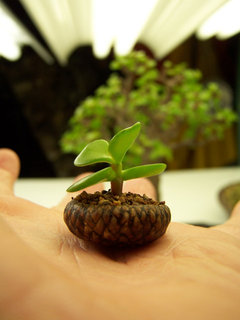
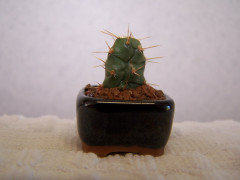
    Here's a closeup of what Turface fines look like. The pot is only the size of a thimble (note how large the nap on the terrycloth appears), and if I placed a nickel in front of the subject, all you would see is the very top of the cactus (hardy in MI). This plant is actually growing in them. It's interesting that Turface fines will supports several inches of perched water, but the gas exchange is so good, these small volumes of soil dry much to fast for the PWT to have an ill effect on the plants. They wouldn't work well for a plant which doesn't readily tolerate being dry for a bit between waterings.

    Another you've likely seen, growing in an acorn cap:

    I have a #20 mesh - about 1/30th of an inch - so I could try to filter the dust based on that size first and just do an experiment to see how that soil mix behaves. Do be careful while screening and use something you know will protect your lungs. Pumice is a glass pyroclast that can cause silicosis should it enter the lungs. Often, the damage doesn't appear until years later.

    Al

    westes Zone 9b California SF Bay thanked tapla (mid-Michigan, USDA z5b-6a)
  • 5 years ago
    last modified: 5 years ago

    @tapla (mid-Michigan, USDA z5b-6a) The reasons to use pumice fines: 1) I do not want to waste them and 2) I want to explore whether difficult-to-root cactus and succulents develop roots faster based on the particle sizes - and separately on the mass of the particles - when the soil remains dry.

    Regarding going down to 1/32nd of an inch as the minimum diameter of the pumice fines: I have to say that filtering pumice fines to different diameters, and then testing it with a watering, has been a perfect experiment for illustrating the effects of cohesion and adhesion with small particles. What I observed was that filtering with a mesh #20 sieve down to around 1`/32nd of an inch, if I watered a pot that contained only uniform pumice of that size then the water instantly disappeared from the top of the pot and drained out. For sure there was some residual water at the bottom of the pot, but that also dried out within a day.

    If instead, I created a pot with the leftovers of my filtering: particles all smaller than 1/32nd of an inch, then watered, I observe two things:

    1) The pot immediately forms a lake on the top and that lake of water does not go away for hours.

    2) Once the pot is drained and dry, the residual soil has formed an incredibly hard and compressed mass, hard to the touch and nearly impossible to break apart without mechanical assistance from a device like an ice pick.

    I do have Turface fines, but my feeling is that those particles have a lot more mass than pumice particles of the same size. I perceive that the succulent cuttings use a little more energy to push through particles with higher mass. I do not have enough experiments done to prove this yet. But I am going to add Turface fines to my experiment just to have some comparison.

    Regarding the risk of silicosis with pumice dust: that is a fair point, although the risk is really to someone who would be exposed to this every day for years. What kind of filter mask would even work against such particles? Would an N-95 even be sufficient, or would you need a heavier duty filter? How do I specify the type of filter in my search? I would use the generic 3M masks that take plug-in cartridges.

  • 5 years ago

    I wasn't clear re the fact we're discussing an experiment, which is why I was offering alternate strategies and even a bit of discouragement. I'm sorry about that.

    If instead, I created a pot with the leftovers of my filtering: particles all smaller than 1/32nd of an inch, then watered, I observe two things:

    1) The pot immediately forms a lake on the top and that lake of water does not go away for hours. Pumicite (ground/powdered pumice) isn't soluble, so water's surface tension/cohesion will not allow it to quickly move into the minuscule spaces between an agglomerate of particles. Water molecules are in a constant state of vibration and collision with each other. Based on the force and angle of collision, enough energy can be exchanged for a molecule near the surface to fly off into space as a gas, which is how evaporation works. With water resting on top of the pumice, some of those water molecules will be flying into the pores at the surface of the pumicite. This creates the potential for water molecules to gather as a droplet, which then creates an attraction between droplets or between a droplet and the main water mass, with gravity helping the main water mass to move downward to join with water molecules within the agglomerate itself. This is how the tendency toward hydrophobia due to particle size in agglomerates is reversed.

    Mask: I retired from a Glazing Contracting Corp and sold it about 18 months ago. Our shop workers and to a lesser degree our field glaziers were exposed daily to glass dust resultant of the dry grinding and fabrication of of items like glass tabletops, mirrors, sawdust, dust from drilling in ceramic, granite, cement, ..... We provided each worker his own mask which was similar in function and filtering ability to THIS MASK, primary differences being the part against the face was made of medical grade silicone and I'm guessing, based on price and never having used the one the link takes you to, the ones we used were more durable.

    Al

    westes Zone 9b California SF Bay thanked tapla (mid-Michigan, USDA z5b-6a)
  • 5 years ago
    last modified: 5 years ago

    @tapla That is an interesting discussion about pumice dust and how water moves through it. What I see matches that kind of physics.

    For the mask, I ended up getting a 3M 6500 (with the quick release latch) and a P100 filter that covers for particles and organic vapors. In the future, I will probably optimize that by buying separate particulate and organic vapor filters and using some 3M adapters to combine those separate filters together. Anyway, you are right to warn to use a mask, and better safe than sorry as the pumice dust really does create quite a cloud.

    I do not know how easily you can make your own pumice sand in really small sizes, but if you want some of the 1/32nd inch pumice fines to compare against your Turface fines, I would be glad to send you some. You could supply shipping information by PM here.

  • 5 years ago

    Thank you, but I haven't enough need for dry rooting anything to justify your kind offer, but I really do appreciate it ....... unless you discover something you think I should be aware of because it will help me or help me help others to get more reward for our efforts. Ain't that what being here is all about? Best wishes.

    Al

    westes Zone 9b California SF Bay thanked tapla (mid-Michigan, USDA z5b-6a)