Software
Houzz Logo Print
kishoris

Staying during a second floor addition

5 years ago

Am I crazy to think we can stay in our ranch house while we add a second floor? We have already renovated the main floor, so the only work to be done in our current living area would be when they add the stairs and open up a bedroom wall. Contractors say it’s a bad idea. We lived in our house while we renovated every room in it. I don’t understand why this would be so much worse. I do believe there would be times when we may have to leave for a week or 2 if there is no roof or no water. We also have a finished walk out basement with a full bath we can live in if it gets bad. The cost of renting in our area would make a huge difference in the budget. Has anyone lived through a second floor addition? Thank you!

Comments (24)

  • PRO
    5 years ago

    It depends on the scope of work. If the Contractors (who know the scope of work) say it’s a bad idea, it is probably a bad idea, therefore you are crazy.

  • PRO
    5 years ago

    Move. You're done the wrong order of operations here. All of that first floor remodeling you’ve done will suffer damage from adding a second floor. Water will rain down through after the roof gets ripped off, and you’ll have mud and dust everywhere. You’ll need all new flooring and repair for the drywall, at a minimum. And thsts with every stick of everything you own in storage.


    Which is why you remodel the first floor after you do a 200K+++ pop the top.

  • 5 years ago

    We are near the tail end of adding a primary suite above our living/dining room, plus renovating that space and the 2 existing bathrooms. Our contractor insisted that we could stay during the work - they offered to ziplock the back of the house where the work was going on and said that they did it all the time. We opted to move out instead, and once we saw the demo and dust we laughed so much about how insane it would have been to try to stay. To add even one room there's a ton of work on the existing house to integrate the plumbing, electrical, HVAC.

    We're back now, still waiting on some punch list stuff and a back porch to be finished, and it really is incredibly disruptive to try to work from home, with kids doing school at home, even just with some work outside. I truly can't imagine staying one night in a house where the roof is being ripped off and a second floor under construction. Seriously, whatever it costs to move out during the project, do it. For us it was about $25k for 6 months. Worth every penny.

  • 5 years ago

    I've lived in more than one house that was completely renovated while I lived in it. If you are adventuresome and don't mind dust, dirt and a little inconvenience, sure, go ahead.

  • 5 years ago

    After we moved into our new house, we had to pull down our living room ceiling because of the AC unit. They taped off the room, and our house is a U shaped house with the living room as the center part of the U so we never had to walk through the living room while they were doing the work. Even so, dust got into the kitchen, the hallways, etc. Don't do it.

  • 5 years ago

    We are adding an addition right now. Yes, we are doing more of a gut remodel, but even if it were just the expansion of the 2nd floor, my advice would remain the same. We haven't even reached the point of taking roof off yet due to rain. But I can't even fathom what life would have been like if we stayed. Our rental is close by and we visit the construction every day. The dust is everywhere. Our garage is full of lumber so no room for the cars. The driveway is full of construction trucks during the week. When I've stopped by during the day, I can barely hear the contractor over the noise. Moving out was the best decision we've made yet.


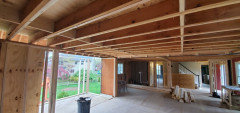
    This picture is the first floor family room, over which the new master suite is being built.


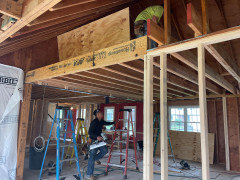
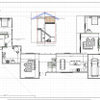
    Here they are reinforcing the floor joists upstairs.


    I'd recommend building housing into the budget. We don't regret it one bit!!!!!

  • 5 years ago

    Why not a compromise. Try living in your basement, only, and see how you like it. You'll need to set up a kitchen. Have a back-up plan. If the construction gets to be too much, move out.

  • 5 years ago

    @Moira L's photos look a lot like my house did in Sept/Oct. And she's spot on about the dust and noise and trucks etc. Our gas and water was turned off for weeks, maybe even months, at a time. (To our detriment - we came back and found a sewer pipe clogged with tree roots and a kitchen sink leaking because the plumber's putty dried out, both consequences of nonuse.) We also found a rental within walking distance and it was a regular reminder how lucky we were not to be trying to live through construction. We'd been in our house 17 yrs, my husband in particular is highly averse to change and to frivolous expenses, but we all agree this was the best money spent during the reno!

  • 5 years ago

    We have done it.....with kids, but not with homeschooling!it helps that my husband grew up in a house that his Dad built while they lived in it! If you do, move to the basement and pack up everything else...the dust gets in every crevice!

  • 5 years ago

    Thank you! I am thinking we package personals and cover furniture, maybe leave while there is no roof and then try the basement. We are lucky our kids go to in person school, but looking to do this next year anyway. Hoping that construction costs come back down somewhat!

  • 5 years ago

    Make sure there is an accessible exit other than the basement stairs if you sleep in the basement. Buy some extra smoke alarms, co detectors and a fire extinguisher. Think about renting a POD.

  • 5 years ago

    Another thought.... we had to move a LOT of stuff around in our basement to accommodate work down there. We needed an extra lolly column to support the beams. That involved jackhammering the foundation. (and despite putting up plastic we have dust everywhere in our basement now too.) We needed to move a lot of our storage to make room for the plumber to connect the new master en suite to the existing sewer lines. Our gas is turned off so we have no hot water. And the HVAC system is totally dismantled. Ask what access they will need to your basement because we got a day's notice to move some of our storage since the plumber was coming. The stuff has to go somewhere.


    Whatever you decide, good luck! Take tons of pictures. We are on week 4 here and it's been amazing to watch the progress.

  • 5 years ago

    That’s a good point about basement access and hot water! Did having to work on the foundation and support beams make a huge difference in cost? And did it cause damage to the pre existing parts of your house?

  • 5 years ago

    @Seabornman, the OP said it was a walkout basement in their first post.

  • 5 years ago

    We lived in the basement during our upper two floor major gut job. Saved money and it was tight quarters but totally doable. I also loved being so close to the house and it was awesome as I was asked a lot of questions as we hit the tail end of the renovation. We left all our furniture upstairs for the most part and just covered it in plastic. Zero regrets

  • 5 years ago

    @kishoris hard for me to tell the additional cost of the basement work as it was all baked in. I know there was a chance we had to do some foundation work for our addition if our concrete slab for the screened in porch didn't have proper footings. Thank God it did, so that saved us $6500! The basement work for us structural and plumbing. There's a lot of structural reinforcements needed to add a second story. The engineer will tell you what needs to be done. In our case we were removing 2 load bearing walls on the first floor and expanding our second story. Long story short - 1 steel beam, 4 microlams, sistering up all the 2x8's over the family room and a lolly column. My house is a fortress now I believe.

  • 5 years ago
    last modified: 5 years ago

    Having to have a contractor work a schedule around people living in a home will cost you as much in time and extra work as it would to move into a rental. The quickest and cheapest scenario is to turn the services off and rip apart everything that needs to be ripped apart. And leave most the services off for the duration.

    You cannot have any HVAC running while a job of this involvement happens. Water and electricity are intermittent, depending on construction needs. Water can be off for weeks at a time. Electrical usually has a breaker or two up to power the job equipment, but nothing else. Unless you’re adding a sub panel for the upper floor? Then you’ll have to up your service, and that’s usually done first, so the sub panel supplies the job power. But with the leaks that happen from no roof, the site power is usually shut off at the end of the day.

    There is no way that the existing home doesn’t sustain damage from a job like this. Sometimes quite a large amount of damage. Just one good rain, and you’ll have damaged drywall and flooring everywhere. All of that has to get ripped up and removed to dry out. It’s part of the risk you take to do this, so you might want to contact your insurance company about a builder’s risk policy. Just packing up a few things won’t do it. You need to pack everything up like you’re moving. You want nothing left behind. Vacant.

    You should explore an addition rather than a second floor. That, you can live through. With minimal damage to the original home.

  • 5 years ago

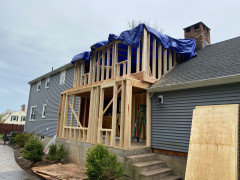
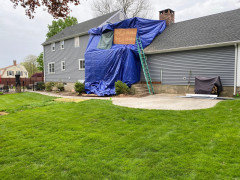
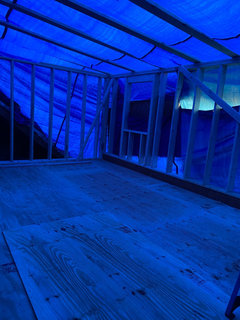
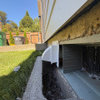
    A picture tells a thousand words. I wrote yesterday morning that my roof hadn’t come off yet. Well, part of it came off yesterday right after I posted. This is what it looks like with and without the tarp. We went inside and we had a funky blue hue.

  • 5 years ago

    My building partner and I were interviewed by a prospect who wanted a simultaneous reno and second floor addition. While we were there, he had words with a repairman who hadn't removed his shoes and tracked dust into the house.


    We turned him down.. He let us know that he had found someone who had never built a house before who said it was completely doable. A few months in, the owner moved out.


    So, no, not a good idea.


  • 5 years ago

    If you enjoy primitive camping in dirt, with no running water and electricity, stay. But you’d be better off to not do this at all. Adding a 2 story addition is one thing. Adding a second floor is completely something else.


    You’ll need to remodel the ground floor after, just from the ground in and watered in dust in everything. It makes this sticky white mud that’s impossible to get out of the grain or cracks in wood floors. You’ll have to clean and shellac prime the walls after. And hope the leak in the tarp doesn’t ruin the cabinets or other built ins.


    Because tarps leak. Any amount of wind causes movement, which creates friction and fraying. Then holes. Then it rains.

  • 5 years ago

    I am now worried from multiple comments that it would be a mistake to add a second floor to our fully renovated home. The architects and contractors we have met with have not said this would be an issue. We have been in this house for 8 years and did renovate everything when we first moved in. We would like more space, but not at the expense of all that we already put into the home. Has anyone successfully added a second floor without having to fully renuévate the first floor?

  • 5 years ago

    There are many considerations, including need for framing improvements to turn attic framing into floor framing, utility changes, complexity of second floor framing, availability of labor, weather, etc. Ask your architect and contractor. They are the ones who know your specific project.

  • PRO
    5 years ago

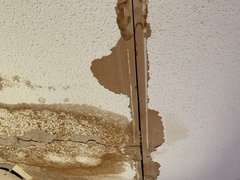
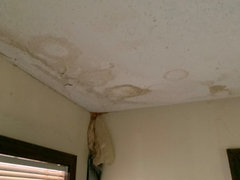
    If you want to see what leaks in a tarp can create, here’s some pics.


    We are doing a remodel on an large single level empty home in a sought after neighborhood. Raising the 8’ ceiling height. Some of the same challenges as adding a 2nd floor. Setback regulations prevent a teardown, or that would have been the plan. We refuse to do jobs like this (or 2nd floor additions) with homeowners in them. We also won’t do them for homeowners who do not realistically expect damage to happen and don’t want to make changes in the first floor.


    It rained last week. A lot of rain. Plus the heat. Quick mold growth. All of this ceiling is going away, but we didn’t want to have to redo the wall drywall unless we had to. We now have to on a couple of exterior spots. This is with it tarped. We always wear respirators when doing demolition, so it doesn’t add a lot to this job to deal with the mold. We’ll spray Concrobium as the last phase, before starting the interior rebuild.