Software
Houzz Logo Print
sugar__magnolia

Tomato & Pepper leaves yellowing and dying

5 years ago
last modified: 5 years ago
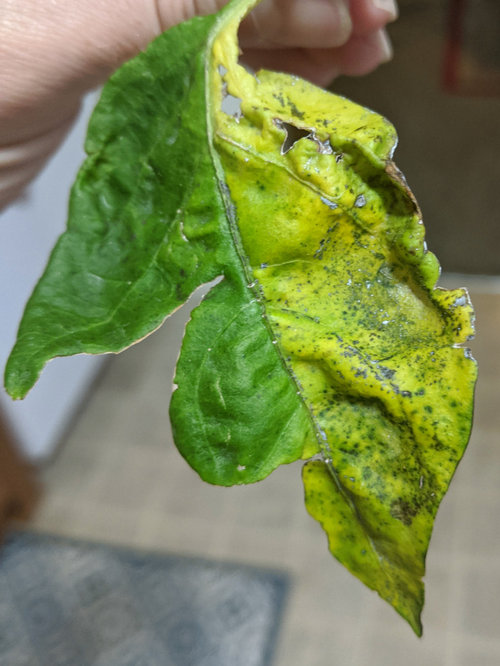
Hoping this is just a fertilizer or environmental issue and not bacterial spot or other disease.

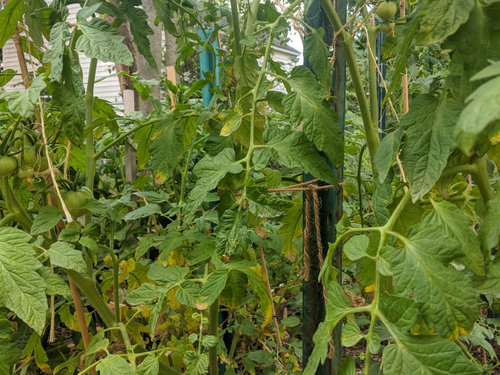
Zone 6, upstate NY. Temps between 80-90. I went out of town for ~36 hours and came home to my tomatoes' lower, older leaves and some pepper leaves looking like this, and I'm trying to figure out what is wrong:


- I spray the tomatoes every 7-10 days with Daconil and have been rotating some pesticides to try to get rid of leafhopper nymphs, oriental beetles, and aphids (castile soap, neem, acetamiprid, spinosad).

- Before I left on Friday I sprayed my tomatoes with Daconil and spinosad in a tank mix according to label rates. Peppers got spinosad only because for some reason chlorothalonil for home gardens is not registered for pepper plants.

- I watered them a bit at the beginning of the week, but we're supposed to get a lot of rain in the coming days so I didn't want to overdo it.

- I have removed as many of the lower leaves as I feel comfortable doing - as they get taller, I remove more leaves.

- The dead parts are crunchy.

- Both tomatoes in the soil and my tomatoes in grow bags are affected, though the ones in grow bags are less affected.

- The plants don't have any wilted parts.

- Both heirlooms with no resistances and hybrids with various resistances to V/F wilt, EB, LB are affected.


Any ideas about what the issue(s) could be? Thanks so much.

Comments (10)

  • 5 years ago
    last modified: 5 years ago
    Sounds like a sensible approach. Note that although chlorothalonil is not specifically listed for peppers, extension services don't seem to mind using it for them. See https://plantpathology.ces.ncsu.edu/wp-content/uploads/2017/02/2017-NCSU-Bell-Pepper-Fungicide-Spray-Guide.pdf Go figure.

    Now, of course, chlorothalonil is non-systemic, so if already infected by fungus, it won't help. I don't use spinosad, but I understand that it does have some systemic properties. Understand that commercially, fungus control is a major battle, and usually involves a whole suite of fungicides, because fungi can become resistant to a particular one.

    Fungal problems are usually most conspicuous on lower leaves.

    I assume you're confident that no one nearby has been spraying herbicide.

  • 5 years ago

    Hey Dan! That was actually what I was doing before I came back after 36 hours and my plants looked like this. I thought maybe it was phytotoxicity but the upper leaves look ok, and the lower ones are most affected. I am not sure what is wrong with them, but I'm concerned about bacterial spot. I'm not sure if they are underwatered (it's been hot - heat advisory in my area), if it's chemical or nutrient burn, or maybe some kind of specific nutrient toxicity or deficiency. I'm trying to figure out why this happened. They didn't look like this when I left. Even though Garden Tech says not to add anything, I find that I get way more even coverage when I add a small amount of spreader-sticker. So far I haven't had any problems with phytotoxicity with Daconil + spreader sticker + acetamiprid, but this is my first time adding spinosad/dead bug brew. Do you have any ideas about what it could be?


    Thanks for the info about chlorothalonil - it's registered for most other solanaceous veggie crops so I was confused about why not for peppers. It'd be way easier to spray them all with the same mixture.

  • 5 years ago
    last modified: 5 years ago
    That's smart to be aware of which crops things are registered for. I've been using Daconil on my tomatoes, and shooting the extra on my peppers, without ever considering that. But I guess I'm good to go after all.

    With regard to tank mixing fungicides and insecticides, be careful. I think the product label should have a "compatibility chart". Mixing things can suppress the performance of one or the other. For example, see http://www.tomatoville.com/showthread.php?t=7922. Also, Daconil breaks down under alkaline conditions.

  • 5 years ago

    Looking at the pictures I basically ruled out a nutrient issue, and the lack of water or excessive heat will wilt the plant before Necrosis sets in so it should be eliminated. Now I've been fooled by Herbicide damage in the past so wouldn't rule it out but there is something often mistaken as herbicide contamination and one to consider.

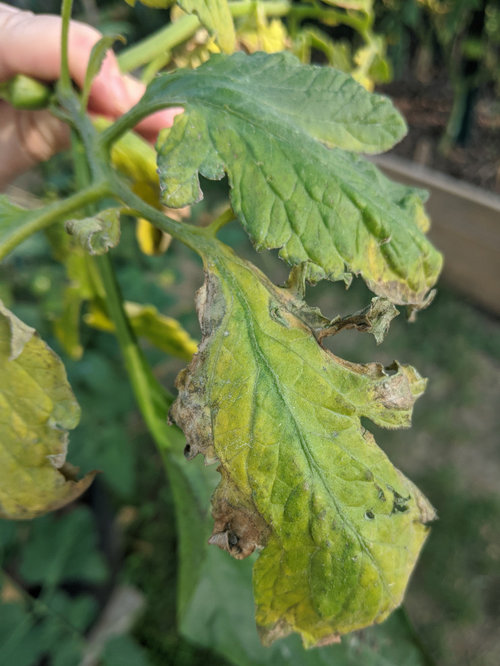
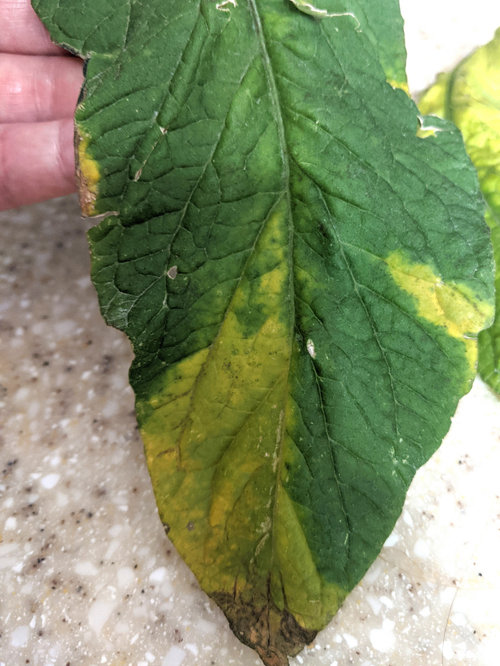
    Your pictures of the leaf damage is similar to Bacterial canker. Sorry but what I see may be bacterial canker, and as it progresses it will curl the leaves with wilting of the plant going forward making people think their plants were hit by roundup. It's just my opinion and even with your excellent details accompanying the problem (one of the best I've seen) I'm unwilling to confirm my diagnosis and present it only as a possibility

    Here's a link with some great pictures and details, along with treatment options for bacterial canker.

  • 5 years ago

    I looked at the link you sent me extensively and looked more into it, and I don't think it is - although at first I was convinced it was. But thank you so much, because it made me look really closely and critically at my plants to try to figure out if I should rip them out of the ground! Here's my reasoning for anyone who finds this post in the future or has similar concerns:


    First, it was really sudden. I sprayed in the evening, left the next morning, and came back late in the evening the following day - and all of my plants suddenly looked like this. Usually there's some kind of progression to disease, not 0-100 on every single plant in 36 hours. In my experience anyway.


    In the majority of the leaves, it's just where the spray would pool or be the last area that it would evaporate - for example, the inside cup of curled tips or the bottom margin of a horizontally-oriented leaf, or in between the thumb and mitten of the potato-leaved tomatoes, or the leaves of plants heavily shaded by other plants or on the east (shaded) side when I sprayed. This explains why the tops didn't get burned - not as much spray as it's hard for me to reach, and it evaporated much more quickly.


    There's also an absence of other canker symptoms besides just the leaves. There's no wilting, bacterial streaming from stems, brown streaking in the veins, etc, and it doesn't appear to be getting worse, and my plants are otherwise looking great. Growing like crazy and putting out more flowers.


    Plus, everything in my garden that got the spinosad has a little burn - but the daconil + spinosad was clearly a toxic combo and I won't do that again. In fact, I might not use the spinosad at all anymore. It burned my blueberries and peppers too - same symptoms. Bonide's DBB says it's compatible with most tank mixes. I did try to search this website, ag extensions, etc to see if it was an OK combo and didn't see anything glaring like mixing captan and azadirachtin.

  • 5 years ago

    Great, I wasn't sure without looking at the plants and actually thought about the combinations burning the leaves but also wasn't sure. They looked a lot like Canker damage and just wanted to bring it to your attention just in case.

  • 5 years ago
    last modified: 5 years ago
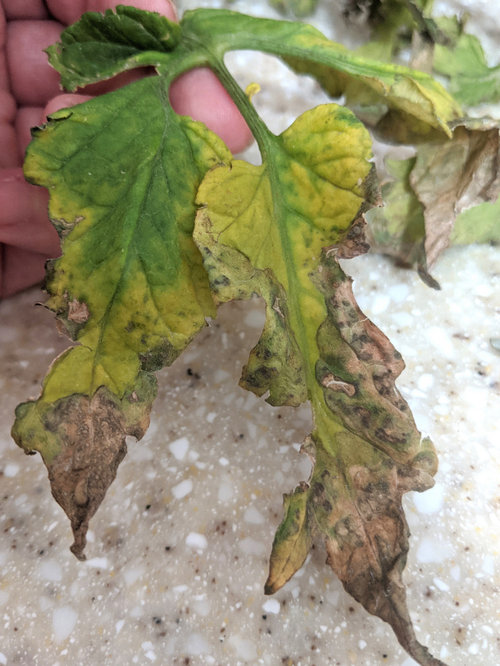
    So, it turned out to be bacterial wilt and bacterial spot - the two diseases both displaying symptoms was really confusing. I'm having mediocre success battling the spot, but all of a sudden my tomatoes began wilting and the stems began collapsing. They're completely hollow inside. Upper stalks remain green inside (but hollow), but at the bottom there is light brown discoloration in the vascular tissue. Bacterial streaming test was immediately positive, disgusting, and heartbreaking :(

  • 5 years ago

    Sorry Karl but it happens and happened to me twice over a few decades (bacterial wilt) and watched then die in a matter of days. I did my research like you did and dissected the stems to find what you found. I have enough land and rotated my tomatoes and also learned to pickup every bit of plant litter with an extensive fall clean up, which involves removing everything including the roots to basically keep nematode populations down. It sucks getting a bacterial or viral attack after putting so much work into raising the plants so I do my best and just hope for luck, and all we can do.

    I've had a lot of problems but never had bacterial spot and hope I never do, but Looking at your photos again I really don't see any signs of Bacterial spot so how did you find out your plants were infected with it?

  • 5 years ago
    last modified: 5 years ago
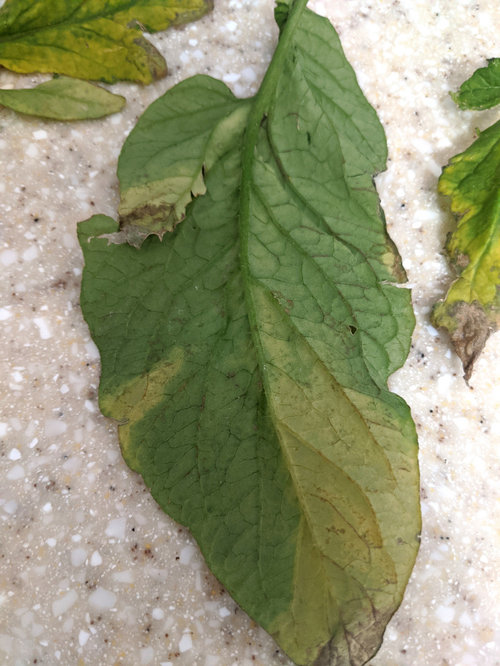
    @outpaientzero my stems were hollow like a straw but the "lining" of the hollow (not sure how else to put it) was purely white, no brown or discoloration except where it met the leader. Is that what yours looked like?

    I settled on bacterial spot due to the spots on my fruit (both tomatoes and peppers - apparently bacterial speck only infects tomatoes). I don't think it was canker because I don't have the same kind of spots on my fruit that canker causes.

Sponsored
More Discussions