Software
Houzz Logo Print
rose_pekelnicky

Filling canning jars.

5 years ago

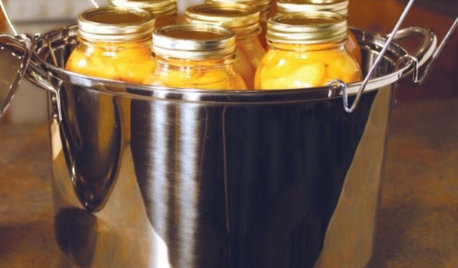
When I am canning something like a pot of spaghetti sauce, I wash my jars in the dishwasher and take them out hot when it is time to jar the food. I set the jars on a towel on my counter and fill each jar to the proper level. Then I wipe off the rims of all the jars and set a lid on each jar. As I screw a ring on a jar I place it in my pressure canner, which is next to me on the stove with hot water in it.I am 72 and don't make huge batches of anything at one time (7 - 9 jars). The jars and food are still quite hot when I'm done

I have been told this is wrong, that jars should be filled, capped and placed in the canner one at a time. I think that would take more time for me. Am I the only one who does it the way I do?

Comments (23)

  • 5 years ago

    As long as the lids are vacuum sealing completely as the jars cool, I think your doing fine. IIRC, my in-laws used to have a pot that did about 5 jars at a time.

    Rose Pekelnicky thanked Annie Deighnaugh
  • 5 years ago

    Rose I fill just the way you do (for one canner load).

    Rose Pekelnicky thanked lucillle
  • 5 years ago

    I assume you have been doing this for YEARS! Of course it is just fine.

    Rose Pekelnicky thanked arcy_gw
  • 5 years ago
    last modified: 5 years ago

    I don't know anything about canning but I wanted to comment about the above thought.

    When there's a better way to do something, or if a particular approach is wrong or dangerous, doing it repeatedly the wrong way doesn't change anything. If doing something an incorrect way hadn't previously produced an undesirable outcome, then that was lucky, not a validation that the wrong way isn't a wrong way.


    Many think repeated instances of doing something incorrectly but without yet any adverse consequences bestows "experience" or "knowledge". It doesn't.

  • 5 years ago

    For canning in particular here is a good reference: https://nchfp.uga.edu.

    Elmer is right, canning the wrong way (just because you've always done it or your grandmother did it that way) is a really unsafe choice.

    Rose Pekelnicky thanked lucillle
  • 5 years ago

    I've read a lot about canning since I acquired a plum tree several years ago. Everything I have read from the USDAgriculture and various state extension services always write about multiple jars in the canning bath. I can't imagine just one jar at a time. I would be concerned that I would not be able to keep the product hot enough in the final cans waiting to go into the bath

  • 5 years ago

    The only time I can one at a time is when I use my asparagus pot for jam and only have 1 to seal.

    Rose Pekelnicky thanked aziline
  • 5 years ago

    I always fill one jar, wipe, put the lid on, put it in the canner, then repeat until all jars are in the canner. That way the won't cool off any.

    Rose Pekelnicky thanked cookiemon5
  • 5 years ago

    Our canner can take up to 7 jars per load. The load doesn't matter as long as the timing and temperature are correct, plus the lids seal. There are some differences in methodology when canning fruits, veggies, and meats when using a regular steamer vs a pressure cooker. Also wise to occasionally check the lids for popping when in storage. For jar lids that don't "take" once canned then these are best stored in the fridge for first use.

    Rose Pekelnicky thanked vgkg Z-7 Va
  • 5 years ago
    last modified: 5 years ago

    Rose, if doing 7 jars I would be comfortable doing it like you describe. If I were doing 27, I'd approach each jar from start to finish before moving on to the next.

    No, wait ;0) My canner just holds 16, so I couldn't prep 27 of a hot product. I'm exaggerating and when it comes to canning, I'm precise.

    I raw pack tuna. Those jars will be cleaned, filled with fish, then salt added to each one, rims wiped on all, lids placed on each and lastly rings added. However, that's not a hot product where the temp of a sauce or the jars in general matters, bringing up to temp is included in the timing process.

    Rose Pekelnicky thanked morz8 - Washington Coast
  • 5 years ago

    Rose, I do exactly what you do when I'm working with a standard canner load.


    I do have an extra-large water bath canner that can hold 15-30 jars. If I'm making a mega batch and using that canner, I'll fill 3-5 jars at a time.

  • 5 years ago
    last modified: 5 years ago

    There is nothing wrong with the way you do it rose. I'm going to get attacked here but I put my clean jars in the oven at about 200 degrees and pull out enough for a load, then put them in the canner all at the same time.

    It's not about sterilization but preventing thermal shock cracking the glass when pouring boiling water into a cool glass. Sterilization comes when pressure canning and not from putting the jars in a dishwasher, boiling water bath or a heated oven.

    For an extreme example I could store my jars in swamp water, fill them with food and top the jars off with toilet water without fear of getting sick if I pressure canned them properly. I've read what you heard and there is no scientific logic behind the process and think it's a waste of time and energy.

    Now for another shocker, I have 15 pounds of 1/2 thick bacon in the freezer I'm going to can next week. But...But... yes I can can. just because the USDA has no study on canning bacon confirming a process doesn't mean I can't. The 1/2 thick bacon was for "bacon on a stick" at the Minnesota state fair last year but was canceled and all the bacon ended up in discount food stores. $3.50 a pound.

  • 5 years ago

    But...But... yes I can can. just because the USDA has no study on canning bacon confirming a process doesn't mean I can't.


    Of course not. It does mean that by using an unconfirmed process in canning, which can have fatal consequences if done improperly, you may be taking a chance with the health of yourself and others.

  • 5 years ago

    1/2" thick Bacon !!!!


  • 5 years ago

    It's called pork belly not bacon. I sure as heck wouldn't can it even if there were an approved method/recipe.

    Best used for smoked pork belly burnt ends IMO.

  • 5 years ago
    last modified: 5 years ago

    Jack, the bacon was cut for the State Fair booth for "Bacon on a stick" and is very popular at the fair. Very good suggestion and I may try a portion of the whatever on a trigger. BTW you mentioned dehydrating hash browns on another thread. Do you shred the potatoes first, or exactly how do you do it?

    Lucille, thanks for your concern but please tell me what the fatal consequences are when canning bacon when it's done the same as any other pork product would be canned. Thanks,

  • 5 years ago

    kevin

    I've been to the Minnesota state fair a few times but not in the last 40+ years. I was raised in Brooklyn Park until 8 years old. Give the burnt ends a try. They are always a big hit when I make them. A heart attack in every bite! The recipe calls for 1.5" cubed pork belly but I think 1/2" thick would work if you decrease the time on the smoker. There are several recipes on the interweb if you google.


    Yes, you shred the potatoes first and then blanch them before dehydrating. If you don't blanch the shreds they will turn an ugly grey when drying. The below is basically the recipe I use for dehydrating potatoes for hash browns. You can use the same method for making slices for scallop potatoes. I'll sometimes dehydrate them diced and then add dehydrated diced onions and peppers for country style hash browns. You have to rehydrate them before cooking.


    Dehydrating hash browns.

  • 5 years ago

    I completely disagree that pressure canning deals with any and every pathogen you put in your jar. The practice of cleaning everything and heating contents where possible is based on eliminating as many problems as possible. Because home pressure canners do not replicate the commercial process we are told to not tightly pack jars since bacteria can survive in such conditions. I cant imagine multiplying the possibilities.

  • 5 years ago

    For me, i fill the jars, cap them and move quickly to the other jars then put them in the canner. the contents are so hot going in the canner i cant touchh

  • 5 years ago

    Interesting comparison PAT but both the home and commercial canning process are identical and use heat to destroy pathogens. Home canning is preformed at 240 to 250 degrees for 20 to 100 minutes depending on the food, and commercial canneries use temperatures exceeding 270 degrees with super heated steam for a fraction of the time compared to home canning. The Time and temperature is the only difference because the higher the heat the less time is needed to kill pathogens which the canneries do, and commercial canneries also have a labs to test and ensure safety.

    In an emergency scenario I'm sure you've heard contaminated water must be boiled for a few minutes to be safe to drink. But the best you can do is 212 degrees without increasing the pressure so how can this be safe? Because all pathogens will die below 212 degrees and easy to kill with exception of botulism, but in oxygenated water it can't live so the water is safe to drink.

    Botulism is the only reason we must even use a pressure canner otherwise everything could be done in a water bath without lowering the acidity of any product. There is botulism toxin which causes the poisoning and easy to inactivate at 185 degrees for 10 minutes, even quicker at higher temperatures. Then you have the active, or vegetative form and the inactive form called spores. Boiling at 212 degrees will easily kill the active form of botulism but it's the inactive spores that require a higher and longer temperature and why we pressure can at 240 to 250 degrees for a 20 to 100 minutes.

    Because of the time an temperature relationship to kill pathogens even the spores can be destroyed if boiled at 212 degrees but for 5 to 10 HOURS! I'm sorry to say Pat but you've heard wrong and completely misled by people with little understanding of the subject.

    I can say with complete confidence and 100% certainty swamp and toilet water along with every pathogen put in a canning jar will be destroyed if processed at the right temperature for the right amount of time without exception.


  • 5 years ago

    Over the years in the canning forums I've been on there is a very small but steady stream of people who have reasons ready (no doubt stored and ready to be cut and pasted whenever the opportunity arises) to show that other procedures besides the tried and true are fine, so don;t worry, be happy.


    I'm not referencing anyone in particular, just sharing observations. And it's not that I have anything against new ideas or progress, but there are organizations that take time to test for safety, and I'm all for letting them do that first.


    I'll stick with the tried and true. I'd rather be a live Lucille than a dead lemming.

  • 5 years ago

    I can only tell you what I do. I raise the rack to rest above the pot. I take out one jar at a time, fill it, and put it back in the rack. Repeat until all jars are filled. Then I lower the rack back into the pot, bring back to a boil, and begin timing.