Software
Houzz Logo Print
webuser_774792562

Fiddle Leaf Fig - Dark Brown Patches

5 years ago
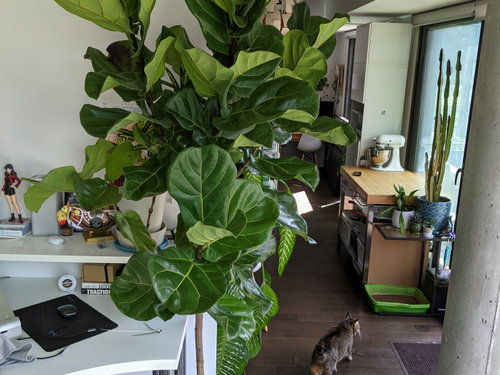
Hello and thank you in advance for any help!


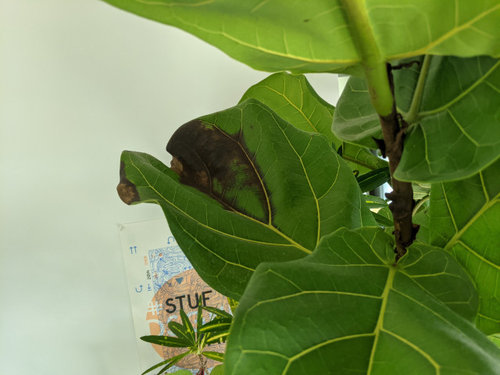
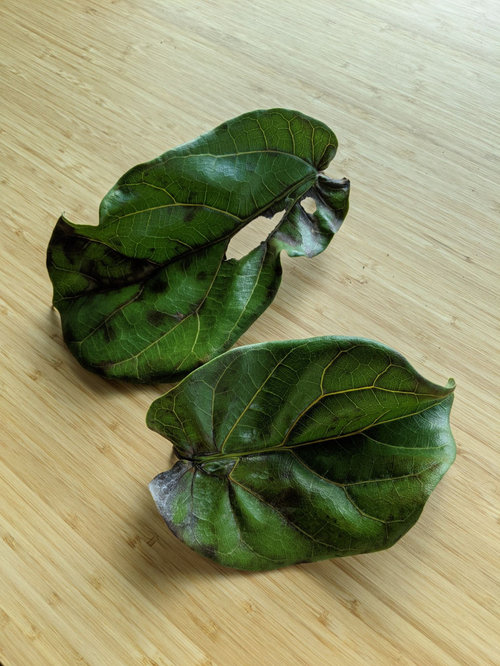
A friend of mine purchased this Fiddle Leaf Fig this past July. He started noticing dark brown patches and has since lost 16 leaves (mostly lower leaves), all with dark brown patches.


After a little research I assume the issue is root rot or bacterial infection, but if anyone knows better from the images of the leaves I have provided, I am all ears.


My friend has started checking the soil regularly for moister, and only waters the plant about 2 cups when it is dry.


The plant is also very root bound. When taking it out of its planter to check on the roots he noticed it was just a big ball of roots. Mentioning this incase this is contributing to the dark brown patches or if potting up is recommended? Though I know it's past potting season.


What are the next steps for this plant to ensure it has a happy future?


Comments (2)

  • 5 years ago

    A friend of mine purchased this Fiddle Leaf Fig this past July


    ==>> how did you.. or him.. rule out very slight shipping damage from grower.. to seller.. to him???


    it could take months .. if everything else proper ...


    dont go fixing anything before you insure there is something active going on ..


    i cant tell where those two leaves from a huge plant come from on the plant... but i would bet they were exposed on the edges.. those most likely to be abused ...


    also.. how did he come up with 2 cups of water being sufficient??? ... who knows if it is or isnt.. im just curious ..


    the plant looks otherwise very happy ... dont go applying goos.. or too much love and mess it up ...


    ken

  • 5 years ago

    Has the foliage been 'treated' with anything, like leaf shine, washed with dishsoap, sprayed with anything? Is the water the plant receives routed through an ionic exchange water softener (uses salt)? Has it been fertilized? If yes, with what product. Were any "tonics" or magic recipe elixirs from the internet been used? In short, what has been used on the plant other than tapwater? Is someone a habitual mister?

    After a little research I assume the issue is root rot or bacterial infection Root rot is a potentiality, but whatever the issue is it's not presenting like one would expect if it was a fungal root infection. Bacterial leaf spot diseases are initially wet and often/usually limited at first from expanding beyond leaf venation, making the lesions angular or irregular, while lesions associated with fungal infections are dry and uninhibited from expansion across venation.

    My friend has started checking the soil regularly for moister, and only waters the plant about 2 cups when it is dry. Watering in dribs and drabs ensures that all dissolved solids (salts) in tapwater and fertilizer solutions accumulate in the grow medium. If allowed, salts will accumulate to a level so high it prevents water from moving into plant cells (osmosis). Proper watering of FLFs consists of allowing the grow medium to become nearly dry at the bottom of the pot before watering. When watering, the entire soil mass should be fully saturated and at least 20% of the water applied should exit the drain hole, carrying any build-up of salts with it. The pot should never be allowed to sit in the effluent that exits the drain hole. It defeats the purpose of flushing the medium in the first place.

    Do not use the advice to "Water when the top inch or two of the grow medium feels dry". That is a recipe for over-watering unless your pot is 5" deep or less. If a pot is 10" deep and the top 2 inches feel dry, the bottom 6" can still be 100% saturated with water; and when it is, it's not a good idea to contribute additionally to the problem. Using a wooden tell to check moisture levels works better than your digital device (finger) or a cheap 'moisture meter' which measures electrical conductivity, not moisture levels. Let the "tell" tell you when it's time to water.

    The plant is also very root bound. When taking it out of its planter to check on the roots he noticed it was just a big ball of roots. Mentioning this incase this is contributing to the dark brown patches or if potting up is recommended? Root congestion can rob plants of an amazing amount of potential in terms of growth, vitality, and eye appeal. Still, I'd wait until next summer around the solstice or Fathers Day to repot as repotting a tree out of season can unnecessarily add months to the recovery period. You can pot-up at any time, but it's still best to pot up in summer, too. Potting up is a half measure that ensures the stress of root congestion in the center of the root mass remains indefinitely as a increasingly severe limitation. A full repot, which includes bare-rooting, root pruning, and a change of grow medium, completely alleviates all stress associated with root congestion until about the point in time when the root/soil mass can be lifted from the pot intact. Consider that the harbinger informing you it's time to repot.

    What are the next steps for this plant to ensure it has a happy future? When you think about it, a growers only job is to identify and eliminate cultural factors the limit the plant's potential. There isn't enough information to determine a probable reason for decline, but reading this piece re Care of Ficus in Containers should provide a basis for comparison. If you see suggestions in the piece that seem at the opposite end of the spectrum from what care is being offered, it might be worth considering a more in-depth discussion about your FLF's care. It's all pretty well laid out in the short piece I linked to.

    Al

Sponsored
Peabody Landscape Group
Average rating: 3.5 out of 5 stars8 Reviews
Franklin County's Reliable Landscape Design & Contracting