Software
Houzz Logo Print
webuser_917083989

Reducing spacing in vegetable garden

4 years ago

Right now, I've got two new 8x4 raised beds, plus some even smaller patches in native soil.


Can I get some real talk on how much spacing is actually ideal between plants for small gardens?


For small vegetables, I feel like even if I'm going on the minimum size of seed packets/transplant instructions, I've still got pretty big spaces between vegetables, and even bigger spaces between rows. There's tons of advice out there about how if you don't use optimal spacing, you'll get reduced yield due to competition.


But then I see people on the internets who have planted insanely closely, like square foot gardening, or even closer than that; and honestly, their vegetables look just fine. If the size of each plant is reduced (and I'm not even sure that's true), they're definitely getting it back in overall yield.


I don't get the theory either. If I'm fertilizing sufficiently, and keeping the soil moist, and plants are still getting full sun, what does it matter if there's competition?


Just as an example of what I'm talking about: Bonnie here recommends romaine lettuce be 10-18" apart. Presumably they're assuming rows of at least 12". If so, there's going to be a massive amount of space between each plant if you plant at 12" or over. 18" makes no sense at all to me. But I've seen people on the internets who look like they're cramming these into 6" spacing or even less, and like I said, it looks great.


What's the real deal here? I strongly suspect I can significantly increase planting density, but how much? How do I know?

Comments (10)

  • 4 years ago
    last modified: 4 years ago

    You can cram plants close together, and they'll be healthy, producing vegetables that look just fine, but the yield will go down. As planting density increases, yield decreases. Clearly, without adequate fertilization, it just makes the problem worse. Of course, once the plants start to shade each other, it also makes things worse.

  • 4 years ago

    There is also the lack of air circulation and more opportunities for disease and insect transmission if the plants are not spaced adequately.

  • 4 years ago

    try square foot gardening method.

  • 4 years ago

    I now plant my garlic a lot closer than is recommended. I saw an experienced gardener do this and it works. I use half the amount of space that I did before and the cloves are still nice and big.

    Linda

  • 4 years ago

    Linda, what spacing do you use for your garlic?

  • 4 years ago

    In my experience, tighter spacing works better in raised beds and containers than in the ground.


    In a raised bed or container, every square inch of soil is used for cultivation - there aren’t any walking paths. Since it’s never walked on, you can keep the soil light and fluffy. Since you are adding compost/manure/fertilizer to smaller areas, people often find it cost-effective to add more per square foot. So often the soil in raised beds or containers can affordably be made more fertile.


    However, there are limits and tradeoffs to denser growing.


    More difficulty in pest and disease control (especially in wet or humid conditions) has already been mentioned.


    There won’t be enough space between plants to hoe for weeds. You’ll have to get down there and weed by hand. (Taller raised beds or containers plus a garden seat make this easier.)


    Depending on the type and size of your raised beds, tillers and other power tools may be impractical. So a lot of people use no-till methods with raised beds.


    Raised beds and containers dry out faster, too. More diligent watering is needed. Using mulch where practical helps a lot. Drip irrigation is great, too.


    Individual plants and fruits are often smaller - dense planting is not the way to grow prizewinning veggies! But for some veggies there are “sweet spots” in terms of spacing where you get slightly smaller veggies but a LOT more of them.


    But if you push the crowding too far, the veggies will be severely stunted or not produce at all.


    Some veggies seem to tolerate crowding better. Generally leaf lettuces, greens, turnips, and small radishes don’t mind being tight. I’ve had poor results (tiny heads) crowding broccoli and cauliflower. I’ve had badly reduced yields from crowding tomatoes, eggplants, and peppers— in large part due to disease problems.


    Onions, lettuce, and many greens can be planted densely and thinned as they grow. Baby lettuces, baby greens, and scallions are treats, and give you early crops. (Beets would probably work for this, too too.) The space freed up by harvesting some of the young plants gives the rest room to reach full size.


    When planting densely, size matters - only plant similar height and vigor plants close together. Otherwise the bigger or faster-growing plants will crowd out the smaller ones.


    As for garlic specifically, in a raised bed with rich soil and attention to watering, 6” apart in all directions works fine.

  • 4 years ago

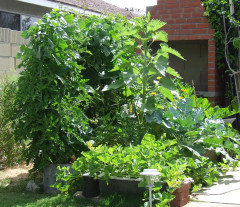
    This is my Square Foot Garden, which produced very well. No need for empty row space since you won't be walking between the plants. Taller plants to the north so they won't shade the lower plants.


  • 4 years ago

    Aaron, I just looked up the recommended spacing which was 6" between cloves and rows. I only give them 4" which isn't exactly half, but every little helps :).


    Linda

  • 4 years ago

    Thanks so much everyone; this is very helpful.


    My research over the past few days has also brought me to a method called "intensive gardening," which is very similar to square-foot gardening.


    I guess my summary is the traditional spacing is best when you're planting rows and rows in the ground; but in a smaller space like a raised bed, where we can optimize condition, a lot of veggies are amenable to being closer. But it sounds like something I have to research and test for each vegetable.


    I'm about to put in the garlic; I think I'll do it mostly with a closer spacing, but I'll hold back a part for traditional spacing, and try to compare.