Software
Houzz Logo Print
robinava

Best pots for indoor plants

4 years ago

Which are the best pots for indoor plants? Bottom drainage holes/saucers or those with openings to water from the bottom? Please explain why one is better than the other.

Many thanks

Comments (17)

  • 4 years ago

    Bottom drainage is best in my opinion. Seems to me pots with holes for watering from the bottom would be the same, with drainage. Supposedly watering from the top flushes out accumulated minerals and chemicals. I never water from the bottom. If a plant is excessively dry, I water thoroughly, wait a while and water again, let it drain thiroughly. I often set it on a stack of newspaper overnight. Never let a plant sit in water constantly.

    robinava thanked socks
  • 4 years ago
    last modified: 4 years ago

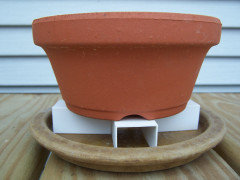
    When you view the question from the plant's perspective, the answer will almost always be a *top-watered *clay pot with a *drain hole through the bottom, with a *collection saucer underneath, and the *pot on blocks which elevate it above the effluent that collects in the saucer, ensuring there is no pathway by which the dissolved solids in the effluent can make way back into the soil solution.

    * Top watered - Water moving through the pot from top to bottom flushes accumulating dissolved solids (salts) from the soil. It also forces soil gasses from the grow medium and pulls a fresh supply of air/oxygen through the soil as it exits the pot.

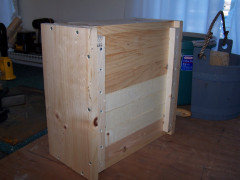
    * Clay pot - Clay pots have gas-permeable walls, so water vapor and soil gasses can move outward through the pot walls while fresh air/ oxygen can move into the grow medium and force soil gasses out. Other pots with gas permeable sides work very well. Wooden boxes,


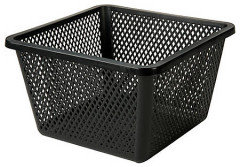
    pond baskets,


    and colanders work very well too, though you'll likely need to shop for a cache pot.

    * Collection saucer with a pot on blocks so effluent collecting in the saucer stays in the saucer and cannot make way back into the pot, which undoes all the good done by flushing the grow medium as you water.


    Bottom watering does not flush dissolved solids from the soil, so the level of dissolved solids (salts) in the soil solution continues to rise until the soil is finally flushed or the plant gives up. It also ensures that the ratio of nutrients in the soil becomes increasingly skewed. This is not as important when using fertilizers like FP 9-3-6 which closely mimics the ratio at which most plants actually use the nutrients, but it becomes critical when an uninformed grower thinks bloom-booster type fertilizers are a good idea for plants in pots, as though up to 13X more phosphorous than a plant can/will use can somehow be to the plant's advantage.

    Self watering pots are essentially closed systems which also ensure rising TDS levels and skewed fertilizer ratios. That's the view from the plant's perspective. Replies from growers' perspectives will vary considerably due to the fact there are so many things other than the plant's well being that enter into the equation, from color of pot, to weight of pot, to how much more often a clay pot needs water compared to a clay pot ...... ad infinitum.

    Al

    robinava thanked tapla (mid-Michigan, USDA z5b-6a)
  • 4 years ago

    Al, thanks for your input - educational, as usual.

    Does anyone sell blocks/spacers to keep the pot above the saucer? Or, better yet, pots (preferably clay) made such that they have built in blocks?

    robinava thanked Vladimir (Zone 5b Massachusetts)
  • 4 years ago

    "Does anyone sell blocks/spacers to keep the pot above the saucer?"

    Take a look at these: https://www.google.com/search?client=opera&q=pot+feet+rubber&sourceid=opera&ie=UTF-8&oe=UTF-8


    robinava thanked gardengal48 (PNW Z8/9)
  • 4 years ago

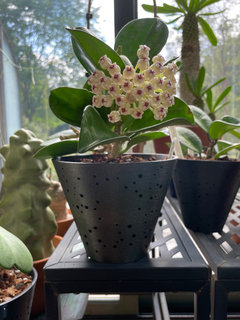
    I always water from the top and use terra cotta pots or pots with little holes in the sides that I print on a 3d printer (my plants really seem to like these). I don't use saucers (except for a couple of large plants); I keep my plants on plant stands and trivets and move them to the kitchen sink to water them (except for the ones in the greenhouse which just get hosed down). I sit them on an old baking rack to let them drain.

    You can also get terra cotta feet to put under pots.


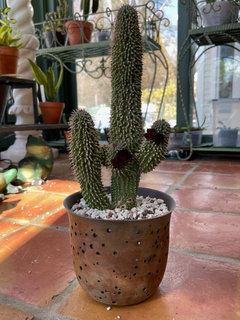
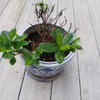
    here are pics of a couple of my printed pots, showing the holes


    robinava thanked stupidlazydog CT zone 5b/6a
  • 4 years ago
    last modified: 4 years ago

    Search also: Pot Feet


    Edited to say: I REALLY like the pots, SLD, especially the one with the earth tones.

    Al

    robinava thanked tapla (mid-Michigan, USDA z5b-6a)
  • 4 years ago

    Thanks, Al! The earth tones one was printed with an iron filled filament; the iron in it that's exposed to air then rusts and ends up looking like this. The filament is kind of pricey so I haven't printed too many pots in that.

    robinava thanked stupidlazydog CT zone 5b/6a
  • 4 years ago

    Those pots are fantastic, SLD!!


    Plastic bottle caps make great risers for pots, if you're dealing with a limited budget. Raising pots allows more water to collect in a drip tray, so there's less risk of overflowing the tray.


    The best pot is one in which the plant can survive when meshed with your style of care and schedule. This is not the same for everyone. If you suspect you're a hovering overwater-er, unglazed clay pots can help save the day. If you're one who forgets to water and loses plants to drying up, a plastic pot is probably going to yield better results.


    "Self-watering" pots require using a type of soil that can wick water upward. Not all types of soil can do that, so keep that in mind if you want to try these pots. I've never been able to keep a plant alive in one of these unless I've removed the water reservoir and then used it like any other pot. If you do want to try one, I would encourage you to use rain water or distilled water to avoid tap water substances from building-up in the soil.


    robinava thanked Tiffany, purpleinopp Z8b Opp, AL
  • 4 years ago

    ...scrolled back up for another look at SLD's pots and notice the "lumpy thing" behind the blooming Hoya. Is that a plant?!?

    robinava thanked Tiffany, purpleinopp Z8b Opp, AL
  • 4 years ago

    Thanks, Tiffany :-)

    robinava thanked stupidlazydog CT zone 5b/6a
  • 4 years ago

    Truly my pleasure!

    robinava thanked Tiffany, purpleinopp Z8b Opp, AL
  • 4 years ago

    I use 2 bricks underneath my large pots outside..no saucers..

    Tiffany..I never thought of bottle caps as pot feet!..clever and economical..

    robinava thanked nicholsworth Z6 Indianapolis
  • 4 years ago

    Thank you everyone, have several new and not returnable pots all of which have openings on the side for watering. Have removed the bottom pieces from each one and today will drill 1/2 inch holes on the bottoms. Very helpful information and thank you again.


  • 4 years ago

    Actually, a hole in the side AT the bottom is more useful than a hole in the center of the bottom. IOW, if the hole is low enough that the bottom of the hole is tangent to (touches) the bottom of the pot, it is more useful than a hole at the center of the bottom. Only one hole in an appropriate position is needed.

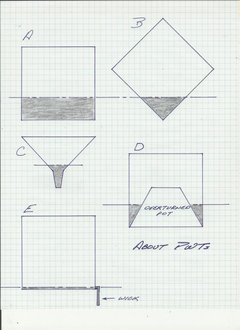
    Compare figure B to A. Tipping your pot at a 45* angle can remove a considerable amount of excess water from a planting and would be a useful strategy to employ habitually. If the drain hole in pot B was at the center it would limit the pots ability to drain only until the water table was even with the lowest part of the drain hole; whereas, if the hole was in the bottom at the side or in the side at the bottom, you can be sure that ALL water would drain until the water table was at its natural level for that particular medium.

    Figure E has the potential to drain more water than B by virtue of the fact the hole would be at the lowest point if the pot was tipped 45* right, and it has a wick to help it drain even more excess water.

    Al

  • 4 years ago
    last modified: 4 years ago

    I obviously agree with @tapla (mid-Michigan, USDA z5b-6a) and the others here about what is best from the plant's perspective. If you are always home, or have someone who can water while you're away, that's ideal.

    I travel a lot for work and the person who waters my garden while I 'm away doesn't have the keys to go indoors, so I had to find a compromise for my indoor plants.

    I use self-watering Lechuza pots. When I am home, I remove the insert which holds the plant and elevate the insert on feet above a tray (if the insert doesn't have built in feet, which most models do), as recommended by the posters here. When I have to travel, I place the insert back in the outer pot/water reserve, which allows the plant to stay watered while I am away.

    You could also achieve the same thing by just using a normal pot and simply putting a prepared upside down water bottle in the pot while away. But I like that the Lechuza system uses wicks through the bottom. These work both ways: they bring water up when in self watering mode, and help with drainage the rest of the time.

    Just my two cents, in case this might help someone. Self-watering doesn't have to be a permanent state.

  • 4 years ago

    For the sake of accuracy, all the pots in the line drawings provided have drain holes. If they didn't, there would be no way to diminish the volume of water depicted in figure A via the methods shown. Additionally:

    1. Plants with drainage holes don't prevent an accumulation of soluble salts ("nutrient build-up") unless the planting's care giver waters correctly. Even with a drain hole, watering in small sips ensures an accumulation of soluble salts in the soil and soil solution.

    2. Certainly plants with drain holes are less likely to provide environments amenable to primarily fungal infections, but it is the combination of (first) medium choice and (second) watering habits that hold the greatest sway over whether or not the pot and what it's filled with will provide a morass in a container or a combination that offers high potential for healthy root systems.

    3. Pots with drainage holes ensure only that any perched water table (PWT) supported by the grower's choice of grow medium will be able to return to the maximum 'natural' ht of the PWT at container capacity. This means when using a medium that supports 4" of perched water (PW) in a 4" deep (or less) pot, the grow medium will still be 100% saturated at container capacity, regardless if it has a drain hole or not. The 'drain hole' does not "ensure" the grow medium will drain. Pots only drain when the pull of capillarity (the sum of the forces of adhesion and cohesion/ the force that causes water to adhere to soil particles and pot surfaces, and cohesion - the force that holds water together in a cohesive mass such as a droplet or a puddle on a flat surface) are less than the force of gravity. The point at which the opposing forces of gravity and capillarity are equal is what determines the ht of a PWT. Depending on primarily the size of the particles in the soil, a medium might not support a PWT at all (very rare in actual use); or, unsuspecting growers might bite on the advertising and end up with a grow medium that supports so much PW that using the medium is little more than setting the table for disease pathogens.

    Al