Software
Houzz Logo Print
webuser_852347616

New Master Shower with leaking pan ... Advice !

4 years ago
I am having a new house built. Unfortunately, a pressure regulator wasn’t placed and we had a massive leak that required us to have sheetrock removed two weeks before moving in. While the studs are now exposed, I asked the builder to test the drain pan for our upstairs large master shower as this would be the best time to expose any leaks.

The builder did the test and it leaked in several places. One at the Schluter custom length drain, and another at two holes under the plywood. They believe the later leaks are coming from the U channels the glass sits surrounding the shower. They are currently putting silicone on the tile where it meets the glass and trying to find leaks on the surface of the tile. How can silicone on the surface substitute for a solid drain pan ? Silicone on glass and tile as a fix for a new home ?

For a new shower, I don’t believe this should happen. I remember them putting red guard but not that blue stuff. Can you please share any advice?

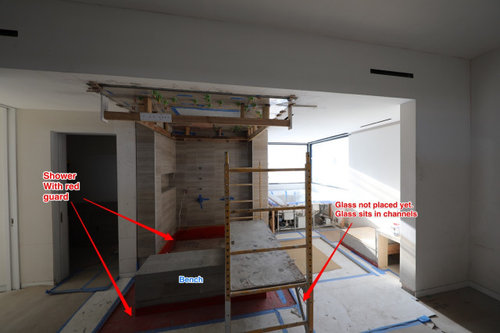
I’m sharing a pic before the tile went down. The glass is not in but it is in the channels surrounding the almost square shower. I can send a completed pic if that helps.

Thanks
Doof

Comments (16)

  • 4 years ago

    Another reason I hate shower glass is that after all the effort to waterproof things someone drills holes into the curb for the shower glass mounting hardware. When they do this the holes are usually filled with silicone, there's a rubber gasket of some sort around the screw and then where the hardware and the curb meets gets a bead of silicone. But water always hits the glass and ends up on the curb and that's where leaks occur.


    The leak at the drain just means it was not installed correctly and that should be redone. The use of Redgard is worrying as that's more of a home DIYer product/method and if they have a Schluter drain why not use Schluter through out.

  • PRO
    4 years ago

    No, the best time to test for any leaks was right after the waterproofing was completed. The person who failed to do this at that time needs to redo the shower now. Silicone dabs are not an approved or appropriate repair.

  • 4 years ago

    @Dragonfly Tile & Stone Works, Inc.: thank you for sharing all the invaluable information you do in this forum. (Your work is spectacular. Makes me wish I lived in your area and could afford to hire you.)

  • 4 years ago
    last modified: 4 years ago

    "another at two holes under the plywood"

    Plywood? No you do not use "blue stuff" and Redguard, only one waterproofing material. Sounds like a bit if a mess there. Is this a custom home or a tract build, that will depend on the level of repair they make. However, topical silicone does nothing for the long term and is not a proper repair. In fact this may not be able to even be repaired but again the level of repair will be based on the construction type. If they built it incorrectly the first time, I do not hold out much hope that anyone there will have the knowledge to execute the fix.

  • 4 years ago

    Bandaid ”fixes” are never an appropriate response to an incorrect build. A rebuild is the correct response. Always.


  • 4 years ago

    Do you have a layout view of this? (it's confusing for the picture) . Is the structure on the ceiling temporary to brace the tiles up there?


    I have a large shower in the new build but this looks massive, with a bench outside the water flow? are those 2 showerheads back in the alcove side by side and then the shower "area" extends out into the room past the bench that is into the floor like a monolith?


    If so that's a H-U-G-E pan area and now was it not flood tested before? I had to build up something to contain 3" of water to test my zero entry pan in order to pass inspection.


    This looks like a hugely complicated shower and caulk / silicone isn't the right answer. (and also it the water source is WAY back there - and the pan is sloped correctly - the water shouldn't be out anywhere near the bench or the floor to ceiling glass.

  • 4 years ago

    We had a slow leak when we remodeled a shower and it looked like it was the drain or shower pan. The builder tested all components and the leak was on the copper pipe between the thermostatic valve and the main showerhead. There was a mirror they hung on the backside of the shower and they hit the pipe when installing it. All that to say that water travels in mysterious ways and the source of the leaks aren't always the obvious ones.

  • 4 years ago

    Hi everyone - Thank you so much for your insight into this problem. Just_Janni - yes this is a huge shower with a monolithic bench covered in quartz. The glass does dive into channels but it seems you are correct in that as the water enters into the glass channels, it penetrates through screws that were placed into those channels. I don’t know if those were sealed at all. I don’t think so. The builder is basically is now adding silicone around the glass where it meets the tile and I’m worried this will only be temporary. So, should he remove the glass and reseal those screws? How does he build a a waterproof pan where the tile and glass meet when the glass is buried in this U channel? He suggested removing the tile in this area and adding an element to prevent water from entering into the channel. I’ll need to check the leak at the drain. I agree if it leaks there then that’s a completely separate issue. The builder did add silicone around the Schluter drain where the tile and drain meet and that was concerning. There was Schluter membrane put down and then red guard on top - two coats (I believe). I’ll post a picture of the finished shower as it is today and you can see for yourself the scope.

  • PRO
    4 years ago

    The only proper way to repair is to remove the glass, fix the waterproofing, and reinstall the glass *without* screws through the waterproofing.


    That said, your report of the builder putting silicone around the Schluter drain and redgard over Kerdi(?) membrane indicates a fundamental misunderstanding about how this system works. :(

  • 4 years ago

    I could be wrong about the red guard over the Schluter membrane ...
    But yes he did apply silicone around the long custom Schluter drains between where the tile meets the morter and whatever is under it.

  • 4 years ago

    Can I ask..if the channels were screwed in as I suspect, if the glass is removed and the channels replaced - how are the channels supposed to be secured to whatever is under it if screws can’t be used? Is there some type of U channel holding clamp?

  • PRO
    4 years ago

    It depends somewhat on which channel is used - some will be siliconed to the top of the stone/tile. Some (like Schluter) are set along with the tile - they have a flange that mortar is keyed into. I know some people like to use epoxy, but I've not seen that myself.

  • 4 years ago

    I remembet the channel was just a simple metal U channel with no flanges. I believe it was simply screwed through at its base at the bottom of the channel. So they should have used some epoxy in this case?

  • 4 years ago

    For the channel silicone should go into the screw holes and then a bead of silicone goes between the channel and the tile/curb. I think its slightly silly to spend all that time waterproofing

    and then drill holes through it and fall back on a single layer of silicone.


    For the Schluder the drain should be installed with thinset and maybe Kerdiseal, NOT silicone. The fact that you have Schluder and Redgard combined will void any warranties and it is worrying that the shower people are using Redgard at all as that points to them not being very "professional" as its more of a DIY solution.

  • 4 years ago

    I am beginning to learn a little more about how this shower was constructed. There was plywood, then some mortar like substance that dries rock hard to v]create the slope, then some paper?, then red guard. There was NO pan liner that went from inside of the shower under the U channels of the glass to the outside. Also, I don’t believe the screws were treated that went into the U channel. The builder is saying the shower is fine with the silicone fixes.