Software
Houzz Logo Print
blueberrybundtcake

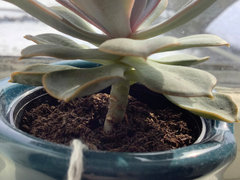
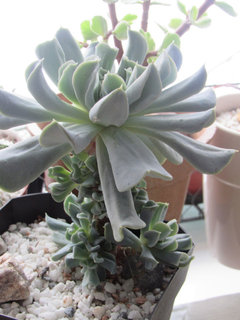
Echeveria developing a trunk, not etoliated

Hello,

I've had this little echeveria for a little while (I've asked questions regarding it before), and it seems to be doing well, but as it sometimes loses lower leaves, it it starting to have a bit of a trunk. It leans when I don't rotate it soon enough, but it doesn't stretch; the stem is only revealed where I took off dead/dying leaves. The lowest site seems to have grown some roots into the dirt. Show I be repotting it to bury this trunk? Or is it okay as it is? It's certainly easier to water this way, haha. Is it normal for it to have lost these leaves? Or am I underwatering it? (I'm definitely not overwatering it ...)


About the plant: it lives on an east facing window sill and it gets watered when the dirt has dried so much that it's pulling away from the sides of the pot. The plastic pot does seat into a ceramic pot on the window sill, but it gets watered over the sink, not in its cache pot.


Thanks!

Comments (12)

  • 4 years ago
    last modified: 4 years ago

    Here it is:


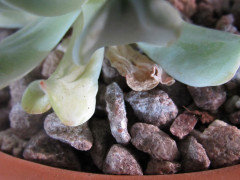
    Watered a couple days ago ... I think ... you can see where the leaves used to attach. This is a 2" pot in its cache pot, taken on its window sill.

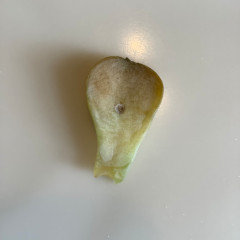
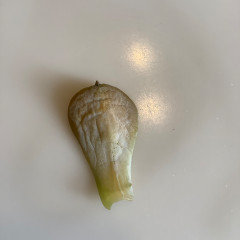
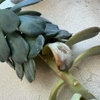
    I fished one of the recently removed leaf out of the trash ... so you all can seewhat I'm removing:


  • 4 years ago
    last modified: 4 years ago

    Re your concerns, what you describe is a normal part of the plant's morphology. As the stem extends, the older/ proximal leaves are shed. Typically, the plant grows a singular stem with a few branches eventually appearing here and there, with a rosette at the branch tips

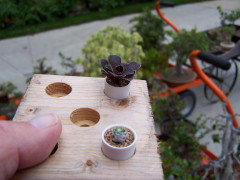
    If you don't like the stem, sever the plant anywhere below the rosette (cluster of leaves), leaving a stub below the leaves long enough to cover with soil, but allow the cutting to callus for a week or so before sticking it (in the soil).


    (Planted in a cap from a tube of Chapstick ^^^)

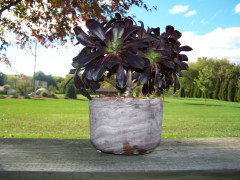
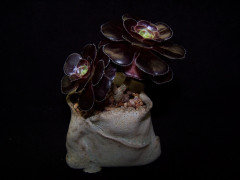
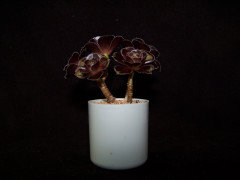
    If you want to grow something like the Aeoniums above, you can follow this procedure:

    * Sever the fleshy stem with a very sharp tool. I use a #11 scalpel, but a fresh single edge razor blade or utility knife blade will work nearly as well.

    * After severing, wait until the rooted stub stops oozing. When it has, dry the wound and carefully paint on waterproof wood glue, covering only the wound's surface and being careful not to allow any glue to get on the stem. The glue seals the wood and prevents the stem from dying back and creating a much larger and unsightly wound.

    * Allow the already rooted stub to do its thing. You will get many new branches forming on the stub, so instead of the plant growing with a singular rosette at the end of a longish stem, you'll eventually end up with a cluster of rosettes much like the first image I posted (allowing for the fact we're comparing 2 different genera). IOW, the reaction of the plant is predictable and will be very similar to what the images I posted illustrate.

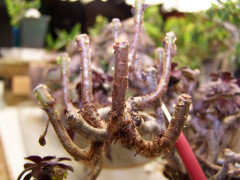
    This ^^^ is one of the plants I use for cuttings. Even though the image isn't all that clear, you can see the dozens of new branches erupting from immediately above leaf/ bundle scars (points where leaves were formerly attached), where exists a row of latent buds which are stimulated to grow when the growing tip of the branch/stem was removed. Simply rub off any branches that occur in places where they are not wanted. So, keep what you want and remove the rest.

    * The unrooted part of the cutting will root easily. Make sure it stays stable in the pot, and resist trying to see if it has roots. Breaking the first new roots represents a setback; not one the plant can't recover from, but a setback all the same.

    So, if you feel the stem is unsightly, you can keep your plant squat by creating a short-stemmed cutting whenever you like; and, now you can up your game by trying different ways to manipulate the plant.

    BTW - the grow medium you're using looks very water-retentive.

    Al

  • 4 years ago
    last modified: 4 years ago

    BlueberryBundtcake

    Oldest leaves eventually start drying up and detach themselves (or could be taken off - it looks like you are taking them off minute they start shrivelling?). Leaf here and there dying is normal; just think about ppl shedding some hair daily...Obviously if too many at the same time; and they are soft - there could be a problem. Over- & underwatering are typical problems & they are easy to fix.

    Many succulents will develop a 'naked' trunk/stem as they grow older. You can let it grow that way - some will grow many offsets from the 'naked' trunk (see photo; great if you want more plants); or decapitate/behead it. There are few threads showing different plants being decapitated. Search by looking for "Beheading plants"


    JMO, but burrying trunk is not the best idea.

    Also, watering ..."when the dirt has dried so much that it's pulling away from the sides of the pot" may be watering too seldom. While succulents usualy recover from under-watering easier, letting plant to dessicate regularly could cause problems too. Check soil for good drainage too - if it starts pulling away from the side of the pot, it could be too full of peat. If peaty soil is not watered properly, it becomes hydrophobic & plant doesn't get any water when watered.

    BlueberryBundtcake - 6a/5b MA thanked rina_Ontario,Canada 5a
  • 4 years ago

    Okay. I will not bury the trunk. I only asked because I noticed roots growing from the lowest former leaf site. I don't mind the trunk, just wanted to make sure it wasn't something that needed tending. The offsets are really neat looking ... I will hope for mine to do that eventually.


    Is there a benefit to leaving the leaf on until it falls off on its own? They're often more dessicated than that when I remove them, but I do usually take them off rather than letting them fall off by themselves.

  • 4 years ago

    BlueberryBundtcake

    Many plants will grow air roots, and for few different reasons. Sometimes it is because plant is thirsty, so it will get some moisture from the air. From what you said, it seems to me that you are keeping it quite dry - that is ok if it is kept quite cool. But typical house temps are warmer, so maybe that is the reason. Obviously, I am just guessing - reading between the lines & could be wrong.

    Photo I posted is different plant & yours may or may not grow so many pups. Either way, they often do grow at least some.

    I mentioned that oldest leaves drying off is normal. I think that you should figure out why they are falling off -there could be a different reason. I pick off dry leaves, but leave them on bit longer since they may be feeding/supply moisture to the plant. Overall, it should not be a problem even if you remove occasional leaf early. Some plants just look better without them. And they are usually much easier to remove when dry, lol. Here is one that will be removed soon - and one left of it is starting to get old but it will take a while before it dries up.


  • 4 years ago

    They're not air roots ... they're regular roots ...


  • 4 years ago
    last modified: 4 years ago

    Rina is correct BbBc. Whenever we find roots growing from any organ other than the base of a plant or a root of a lower order, they are technically adventitious roots. 'Aerial root' is a term that came into being as a way to denote where the adventitious root is growing on a plant. It's not 'in the ground', but 'in the air', thus the term aerial root. Once an aerial root contacts the soil, it's growth rate increases. The outermost layer of the root periderm (skin), exposed to light and air movement, dies, turns brown, develops a corky outer covering, and eventually develops cracks and furrows as the thickening root begins to split its outer-covering. As Rina noted, there are several types of adventitious roots that serve the plant in different ways, and as I noted, the term 'aerial root' delineates the type of roots attached to your plant from other types of adventitious roots.

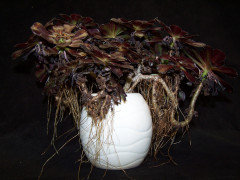
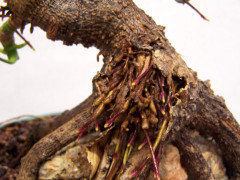
    A parent plant I use for cuttings, sporting a bushy beard of aerial/ adventitious roots:


    The adventitious/aerial roots emanating from the trunk of this schefflera, which is growing over a rock, are located above a dead root.

    BTW, roots that form on cuttings are adventitious roots, but they will perform the same function as a root system which emanates from the root radicle (taproot), the first point of growth to erupt from a seed.

    Al

  • 4 years ago

    Huh ... I guess I never thought of cutting roots as being adventitious roots ... so I guess my army of jade plants all just have adventitious roots, since they just get stuck in dirt whenever a new one is created (by breaking or cutting).


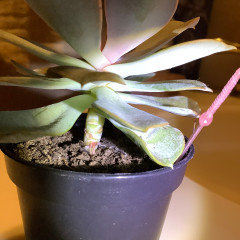
    I will say, I don't actually know if the roots are coming from a site I took a leaf off of or if it was already removed when I bought the plant ... and who knows what conditions it experienced at the grocery store. Do these seem like new roots or old roots?

  • 4 years ago

    They look fairly young.

  • 4 years ago
    last modified: 4 years ago

    They might for all intents/purposes be the same age as the roots below the soil line - no way to tell w/o lifting the plant from the pot to inspect the roots. It is not obligate that you keep the roots emanating from plant parts above the soil line if you don't care for their appearance. They definitely don't enhance the plant's eye appeal.

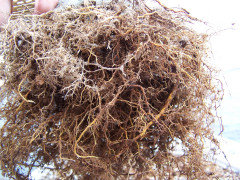
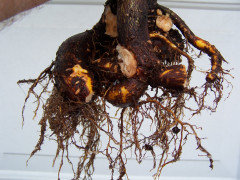
    Simply cut them off flush to the trunk. I would remove the single/larger root first, then wait a month or so to remove the trio below. The wounds left by the root's removal will callus and heal within a year or so. While the following images illustrate a rather radical root pruning, it gives you a sense of how large roots can be, relative to the size of the trunk/stem, and still be removed w/o a conspicuous penalty.


    Al

  • 4 years ago

    ...I would seriously consider what tapla said...he really knows about the roots (and plants) a lot; he is an expert...those roots are not a problem & could be pruned/cut off as he said. Or left if you want...Even jades will grow them & I already said many plant do. For different reasons...