Software
Houzz Logo Print
violetlife

Perennials/self-seeding blue, purple, or orange flowers?

4 years ago

I am working on a color-themed bed with three colors in northern Massachusetts. The bed for my neighbor should be basically permanently no-maintenance except for harvesting. A little seeding or planting every few years per flower type would be okay. With these constraints, what flowers would be possible? I am thinking seal-heal, bergamot, echinacea, aster, lungwort for purple; nasturtium, wild poppies, and marigold for orange; snow glories and heavenly blue morning glories for blue. Will all of these flowers really take care of themselves, though? How will they interact if planted together?


Are there more good blue flowers?


What herbs and medicinal plants would either be all green or fit the parameters?


Much respect,


- F.

Comments (25)

  • 4 years ago

    Platycodon - Balloon flowers are a really good blue.

  • 4 years ago

    Fair warning, I grew Grandpa Ott's Morning Glory 3 years ago and I'm still pulling out seedlings. Don't know if all MGs are like that but I will never plant one again.


    My friend has self-heal coming out of the woodwork--another voracious spreader.

  • 4 years ago

    Agastache Honeybee Blue and Golden Jubilee spread politely. Both are very long blooming.

    I found blue columbine seeds at Home Depot this spring.

    Orange - add asclepias tuberosa. Monarchs need all the help they can get.

    Another "nay" vote on the morning glories.

  • 4 years ago

    Ooh, voracious spreaders are exactly what i'm looking for. A polite spreader might be better, but flowers that will return consistently are the goal. There will be paths between beds to prevent any bloom from totally taking over.


    Feeding the monarchs sounds wonderful.

  • 4 years ago
    last modified: 4 years ago

    Well if you are looking for voracious spreaders then Lobelia siphilitica - Great Blue Lobelia is right up your alley.

  • 4 years ago
    last modified: 4 years ago

    If you want a voracious spreader then at least make it native and ecologically useful.


    ETA: unless you have the time needed to manage a voracious spreader, you should be more careful in your selections.

  • 4 years ago

    Voracious spreaders will overtake everything in its way, especially if there is no maintenence, and you will be left with a huge bed of one thing, which may not be what you want.

  • 4 years ago

    If you plant a native garden, then do NOT cut it down in the winter as many native invertebrates use the standing stems and accompanying leaf litter as hibernaculum.


    You can tailor your planting to what garden activities you are willing/able to do based on time and physical restrictions. It will require lots of research, speaking to professionals, reading. You may consider hiring a local garden designer to develop a plan that you and your neighbors can implement over time.

  • 4 years ago
    last modified: 4 years ago

    I would agree. And even non-natives provide shelter and food. Not to mention winter structure.

  • 4 years ago
    last modified: 4 years ago

    I agree with the premise that no garden is completely maintenance free. But, to answer your question, I find nigella to be a nice reseeder, and it comes in shades of blue. Pretty and delicate foliage as well. And blue/purple larkspur and lupines. Also, I personally love dill in a garden. I think it's a beautiful plant!

    : )

    Dee

  • 4 years ago

    Yes, we are looking for mostly native plants and ecologically useful ones which would grow as they would in the wild (thus the goal of no maintenance seems naturally achievable). Some planting and watering may be necessary, as well as occasional reseeding or removal of plants that escape the bed; otherwise, a native plant bed should go through changes but otherwise be a lovable space without much labor, just as a meadow or forest would. Grazing animals will provide a decent amount of "labor" for free. ;) this may seem optimistic but is working in my yard. Bergamot is the plant we lost; echinacea also eventually died out. By now we have a lovely area of ferns, though.

    Removing the trees once they reach a useful size may be the most taxing operation, although picking any herbs and medicinal plants will also be fine.


  • 4 years ago

    A natives only garden left to fend for itself most of the time is hardly what most suburban gardeners want unless they have plenty of acreage and no neighbors or HOA's to complain about the unkempt appearance :-) And be careful in your selection of "native" plants. Native to the US does not necessarily mean they are native to ALL parts of the US and unless you provide very similar growing conditions to their natural range, they will struggle and fail to thrive. Very likely the reason why your open prairieland natives did not succeed in MA.

  • 4 years ago

    She lives in the woods ^__^


  • 4 years ago

    So is this proposed planting in sun or shade? I'm so confused. It sounded like you were proposing a meadow garden. Scratch my plant recommendations given above.

  • 4 years ago

    It would be partial shade. She's removing some trees.

  • 4 years ago

    Right now, she has a little lungwort and columbine along with endemic partridgeberry and wintergreen.

  • 4 years ago

    You could add sedge, ferns, wild ginger, tiarella, mayapples and spring bulbs. If she doesn't weedwhack, I don't see how she can prevent the woodies (ie maple seedlings) from filling in.

  • 4 years ago

    As Cecily and madgallica mentioned, in an area surrounded by trees, many of the unwanted plants will be tree seedlngs. So whoever will be doing the maintenance (your neighbor?) will need to recognize the common woody (tree and shrub) seedlings in your area and pull them by hand if tiny or with pliers if a bit larger. You don’t want to let them go for even a year or the chore may become overwhelming. If the house is surrounded by trees you are likely in an area where nature wants to turn everything into a forest, so open areas need to be maintained by mowing or fire or hand pulling.

    In part shade, hay-scented ferns are a lovely dense groundcover but spread vigorously and will overwhelm most other plants.

  • 4 years ago

    I realize that you want to purchase seeds to fill a large space quickly and inexpensively but I've been scratching my head and I can't think of any shade plants except columbines which are commonly available by seed. Maybe lobelia. Native plant nurseries often sell plugs (little baby plants). Check Prairie Moon nursery.

  • 4 years ago

    Nasturtiums should be planted in full sun. There aren't many deer resistant "shade" flowers available as seed.

  • 4 years ago

    I've grown 'heavenly blue' for years and never had it reseed. I grew 'Grandpa Ott' years ago and still occasionally get seedlings.


    I agree strongly (from experience) that a no-maintenance or very low maintenance bed sounds possible but in reality is impossible with reseeders. The only places I have very low maintenance in part shade is where I have huge hostas and swaths of rodgersia. Weeds will still find a way, but they're more limited. Also, as mentioned, tree seedlings need to be handled annually or get to be a major chore.

  • 4 years ago

    Amsonia Taebermontana is native, pretty and blue. Should be okay with some shade

  • 4 years ago

    Mertensia virginica. Also native, blue and some shade tolerant. (Under deciduous trees).

  • 4 years ago
    last modified: 4 years ago

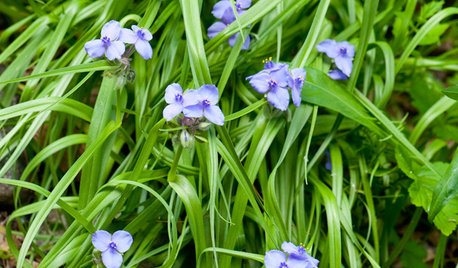
    Since we’re listing shade plants, i have a shade garden under my deck which gets no direct sun at all. i would call it a bright shade in the morning, and that’s being generous. The plants in that part are: Epimediums, Alchemilla mollis, Tradescantia virginiiana, Mertensia virginica, Spigelia marilandica, Lamium. Another shaded area has ferns and a wild geranium whose name escapes me, as well as pulmonaria.