Software
Houzz Logo Print
hominamad

Fertilizer tips for my row of arborvitae

4 years ago
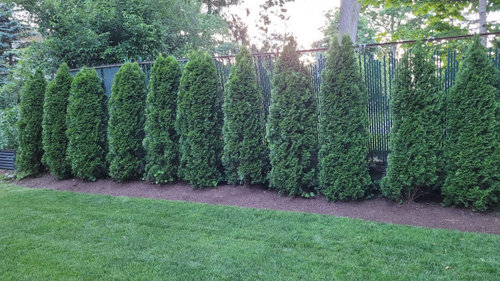
Hi - I picked up some Jobe's evergreen fertilizer spikes recently for this row of trees I planted a few years back. I read that the spikes should be spaced around 3 feet apart, but I wasn't sure if I should put a row in front of the trees and another behind them? Or is that going to be too much? Don't want to do anything to risk hurting these trees! I didn't think they were going to make it after the first year or two, but they seem to be pulling through. Thanks!


Comments (17)

  • 4 years ago

    First, fertilize spikes are one of the most inefficient ways to fertilize a plant one could imagine! Why in the world would you think concentrating all the necessary nutrients to just a single location in the root zone (or even 2 or 3 locations) would be a sound practice? Do you dump all your lawn fertilizer in a singe pile in the middle of the lawn? Fertilizer spikes were developed to be a quick and easy convenience to the gardener without much regard for the benefit of the plants they are supposed to be supporting. If you already have them, grind them up and apply as a granular broadcast around the dripline and then water in well. If you haven't bought them already, opt instead for a standard dry/granular all purpose fert and do the same.

    Second, why do you think there is a need for your arbs to be fertilized? They look reasonably lush and healthy. Have you had a soil test done to confirm there is a need?

    As one of our longtime members here is fond of saying, trees never need fertilizing. I wouldn't go that far (never say never :-)) but it is very seldom that any trees require much supplementation and pretty darn close to never if planted close to a fertilized lawn!

    btw, in all my years of gardening both personally and professionally, the only trees I have ever fertilized are those grown in a container rather than in the ground.

  • 4 years ago

    Yeah, I pretty much got them because they had great reviews and people have recommended them to me for this purpose. Whether or not they NEED fertilizing is another question. I never had the soil tested, but I thought that it was just sort of a good practice to fertilize regularly to encourage faster and fuller growth.

  • 4 years ago

    The only time you need to fertilize is if there is a determined nutrient deficiency. Fertilizing is not intended to promote faster or fuller growth - only to replace any nutrient that might be missing in your native soil. And only the nutrient that is missing or deficient is necessary to be applied. A complete fertilizer - like the spikes or a granular all purpose - is unnecessarily providing more than is required. And that can be just as harmful as not fertilizing if needed.

    As to the efficacy of using spikes as opposed to a broadcast granular fertilizer, it only takes a basic understanding of tree anatomy to see how inefficient they are. Tree roots spread out long distances from the base of the tree. And it is the fine feeder roots that emanate from the bigger that are able to access and draw up the necessary nutrients from the soil. A fertilizer spike or two implanted here or there is going to provide minimal benefit and only to the roots closest to them. Many arboriculturists consider them to provide next to nothing. They are more expensive and their popularity is based on their simplicity and ease of application.

    btw, not all tree fertilizer spikes are slow release and not all lawn fertilizers are fast release.

  • 4 years ago

    ETA: it seems our cloning twins are up their usual hit and run mischief and deleting their misinformed comments as they go. Makes for very choppy reading.....sorry :-)

  • 4 years ago

    I don't understand - why are so many of the comments being deleted here?

  • 4 years ago

    A number of the gardening forums have been recently infiltrated by a troll - or possibly trolls - with multiple accounts and multiple screennames. They respond to a thread with enough nonsense to stir things up, then either delete their own off the wall comments or the Houzz mods delete them. Makes for choppy reading and disjointed threads.

  • 4 years ago

    the trees roots are as long as th4 tree is tall .. ergo.. its roots are under the heavily fertilized lawn.. and need NOTHING else ..


    besides.. your tees look perfect.. why ....exactly do you think there is something to fix ..


    frankly.. odds are.. you can only screw it up by loving them to death ..


    they are not children ... they do not .. ever.. need to be fed.. ..... educated.. clothed ... etc ..


    just take a loss on the spikes ... or grind them up and figure out how to use them on something that might actually need fert ...


    ken

  • 4 years ago

    With an NPK of 11-3-4, I'd hardly call them "highly concentrated"! I use Osmocote Plus on all my containerized tree and shrubs and that has an NPK of 15-9-12 so theoretically a higher strength/more concentrated formulation yet it doesn't damaged the plants at all.

    Being treated to be slow release does not concentrate nutrients. It only makes them less immediately water soluble.

  • 4 years ago

    "Therefore they - along with other slow release fertilizers - are much more concentrated in form than a broadcast fertilizer and liquid fertilizer."

    No, they are not more concentrated!! It is still the same proportion of nutrients contained in the product regardless of whether or not it has been treated to become slow release. That process has absolutely nothing to do with concentration! Nor solubility.

    This primer from the International Fertilizer Industry Association might explain things in more detail. https://www.fertilizer.org/images/Library_Downloads/2010_Trenkel_slow%20release%20book.pdf

    You can dish it out in as much BS prose as you like but it does not change the underlying concept!! Concentration has nothing to do with a slow release produce versus one that is not.

    And the question still boils down to whether any fertilization is needed at all.

  • 4 years ago

    Sorry, bubba. Not even close 😕 And a pathetically weak counterargument!

  • 4 years ago

    Oh lordy!! Did you even take a science class? The percentage of active ingredients remains the same per pound if treated to be slow release or not. Are you saying that organic fertilizers - by definition slow release - are more concentrated than any similar formulation of a fast acting or immediately available synthetic?

    The ONLY time concentration enters the picture is if the fertilize product is overapplied!!

  • 4 years ago

    I assume the fertilizer needs to be dissolved in water to take effect. And crushing it will increase the surface area of the fertilizer, so while the NPK numbers don't change by crushing it, the liquid produced in the ground by dissolving in water will likely have higher NPK numbers if the fertilizer is crushed.

  • 4 years ago

    I don't think they need fertilizer. I never directly fertilize my arborvitae. They may get some from the lawn fertilizer, but not much. But it probably won't hurt to fertilize them and may help. If you already have the fertilizer, I say go ahead and use it according to the directions. Maybe you'll see an improvement.

  • 4 years ago
    last modified: 4 years ago

    Whatever they happen to get from fertilization of the lawn is good enough .

  • 4 years ago

    Thanks for this!

  • 4 years ago
    last modified: 4 years ago


    I go to the site below frequently for information:

    https://extension.umn.edu/trees-and-shrubs/fertilizing-evergreens

    I will say that fertilizers that use Muriate of potash (potassium chloride) is not a good choice for evergreens, especially Hemlocks. It contains a high amount of salts and chlorine.


    Edited 9:55 pm 6-28-22 After troll remarks disappeared.

  • 4 years ago

    Fertilizing only a few trees in the hedge seems like a ridiculously bad idea: the OP doesn't WANT one end to grow faster, they want a uniform habit.