Software
Houzz Logo Print
acg8971

Concrete slab or paver walkway

4 years ago
last modified: 4 years ago
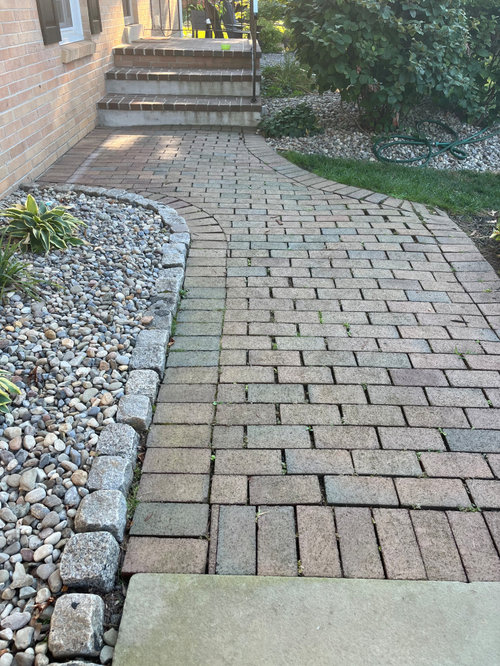
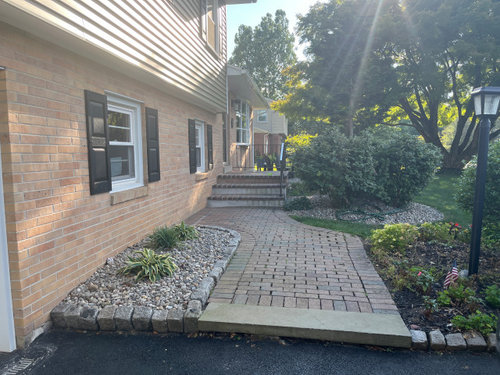
Hi, our paver walkway is dated and separating. should we replace with some modern pavers and a darker gray edge paver or opt for clean concrete? Also, do i keep the curvy shape or opt for more right angles. should i get rid of the small stone garden next to the house and make the whole thing one large slab?

also, i have tired brick steps that need to stay, but I would like to match the risers to all brick or parge all three risers.


Im open to ideas and suggestions. thanks.

Comments (24)

  • 4 years ago

    the brick walkway is lovely. also, i think curves have better chi than angles.

    acg8971 thanked hbeing
  • 4 years ago

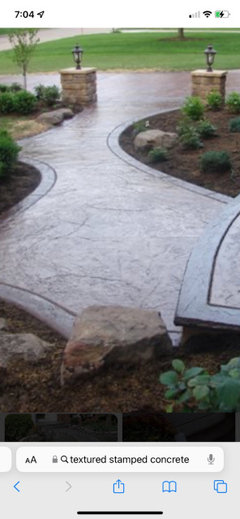
    Stamped concrete. Have friends who have pavers and weeds, lifting etc. happened

    acg8971 thanked Lisa Dipiro
  • 4 years ago

    Keep the curves

    acg8971 thanked Lisa Dipiro
  • 4 years ago

    Like this. Textured but without all
    The cuts to look like brown or
    Pavers. I have something like this I didn’t want it to look dirty all the time with the cuts.

    acg8971 thanked Lisa Dipiro
  • 4 years ago

    Stamped concrete to keep the beautiful texture of pavers.

    Keep the curves

    I personally love the small stone area between the sidewalk and the house but if you are tired of weeds coming through you could definitely fill it in and get some sort of patio set or bench to put there to keep it from looking too wide!

    acg8971 thanked Michelle H
  • 4 years ago

    I like the look of the brick, not a fan of the textured concrete but maybe there’s a stamp they can use. Like the stone. Maybe get some more interesting plants next to the house.

    acg8971 thanked sherry52
  • 4 years ago

    Concrete always cracks. Love the curve and the cobblestones. Check out new pavers, I think they’ve come a long way.

    acg8971 thanked Stacey
  • 4 years ago

    See if you like travertine pavers

    acg8971 thanked Stacey
  • 4 years ago

    Pavers are prettier than concrete.

    acg8971 thanked RedRyder
  • 4 years ago

    Pavers are easier to repair and slightly more environmentally friendly. I agree with other posters that concrete always cracks. And I like the curves.

    acg8971 thanked S Mil
  • 4 years ago

    Those are cheap brick clay pavers. They were not installed properly. You can easily set them aside, install a proper base and bedding, and relay them with edging. The existing layout is generally fine in that it conforms to the driveway step, so I wouldn't expand it towards the house giving unusable space. I may, however, soften the curve a bit and even make it skinnier at the stoop so you don't knock your head on the house.

    I would probably stick with reusing these bricks, unless you wanted to expand the scope, cost, and difficulty of the project by redoing the stoop brick overlay to work with a new walkway product (concrete interlocking pavers, tile, or concrete), and reevaluate using the soldier edging, the landscape bed layout, and plantings to work with whatever new product you would choose for the walkway.

  • PRO
    4 years ago

    I need to see the house ti understand the curve versus no curve and also why the brick needs to stay since it does not match the brick anyhwere else that I can see

  • PRO
    4 years ago

    I vote for pavers and curve.

  • 4 years ago

    Pavers are better than concrete, always!

    Pavers can always be pulled up and re-laid to fix any tree roots, ground settling or broken irrigation pipes. Cracked concrete would need to be jack-hammered and the new patch will never match the old concrete.

  • 4 years ago
    last modified: 4 years ago
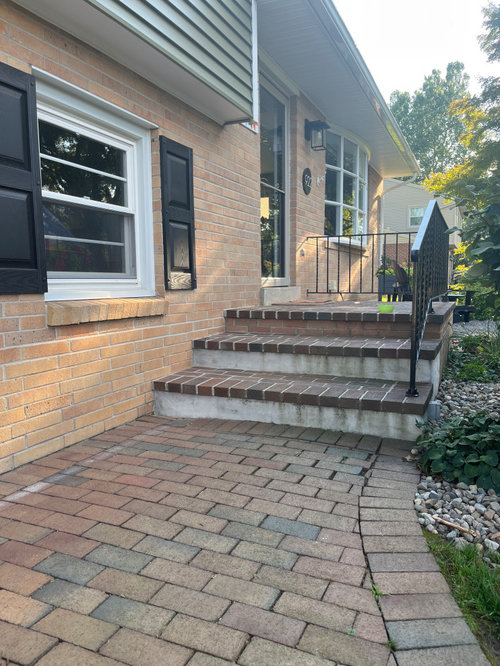
    Curves are more welcoming and inviting. If you want to 'up date' I would purchase new pavers a color to your liking and replace them one for one. Easy peasy and as mentioned above finish off with polymeric sand. Concrete will never look as rich. It does appear you have at least three different colors of bricks. That seems excessive.

  • 4 years ago

    I like the flower beds, so I'd keep those.

    The brick has a really nice slope, also maintain that.

    don't know if those bricks are worth saving. Cobble pavers would be nice. In a chacoal/black color.

    right now your have 3 different bricks w/3 diff colors all next to each other.

  • 4 years ago

    Stamped concrete is beautiful when it’s new but over time it cracks, has to be resealed, is slippery when wet and looses its color. Trying to decided how fix my 8 year old stamped concrete driveway.

  • 4 years ago

    I love what you have, with the curves. Concrete cracks...pavers are prettier! I'd pick up those bricks, rework the dirt base...relay them.

  • 4 years ago

    I agree with Beth. Black or charcoal gray cobblestones would look awesome. I didn’t know they made them. Plus it goes with the light gray ones in the planter. Beth is pretty awesome!

  • 4 years ago

    I think it looks great. Is that permeable pavers? The separations have to be refreshed every so often with granite chips or cherry pits from feed stores—every 3 or 4 years. Concrete cracks with weather changes and does not allow for water to seep into the ground. I have permeable pavers because our lake is low and concrete wasn’t allowed for walkways to and from the house.

  • 4 years ago

    It depends. Are you in snow country? Pavers don't stay put long due to our freeze/thaw spring/fall rains and use of salt/calcium chloride. They aways heave or sink. Pavers are slippy and are harder to remove snow from.

  • 4 years ago

    I have pavers and a large area. I live in an area that gets a lot of snow and cold. I don’t find snow removal difficult or no slipperier than concrete. I would do what was suggested remove the pavers and have them reinstalled. There is a product on the market called wet and forget that cleans the pavers. You spray it on the area needed and forget it. The rain and snow over time removes the grime, moss, etc.

  • 4 years ago

    You were only asking for design advice for the walk, but as I read many comments I feel it is necessary to offer some advice from a more technical viewpoint.

    The individual clay brick paver units look to be in very good, clean, condition. This product is very porous and has that texture you see - you do not want to apply a sealer to them, and they require to be installed with a small gap filled with sand to maintain a solid, uniform surface. This gap should be 1/8" (3mm) - only if you used large pavers/patio blocks (say maybe >12x12) could you utilize big enough gaps that would fit crushed granite, stone chips, or fruit pits yet maintain a uniform surface.

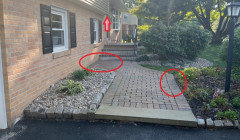
    Your walk should be redone just from the evidence of settling in the circled areas alone. Especially by the stoop, you do not want water running towards the house pooling against the wall. These areas are a sign that there wasn't a proper base installed. As often happens with this kind of paver, the bricks were probably installed right over the soil, or only a thin sand bed, rather than having a solid, 4" minimum, compacted gravel base with a topping of 1" bedding. So no matter if you reuse these bricks, go with new concrete interlocking pavers of a different color, or change over to poured concrete, the base needs addressed.

    The other reason to redo is you can see an area by the stoop where the brick pavers are still holding tightly together as original, but the remainder has inconsistent, growing gaps and many units have shifted. These separations and migrations is because there is no edging/wrong edging/edging not fastened into solid base and the outer bricks moved, in combination with the settling.

    Also illustrating my first comment earlier in the thread, I marked an arrow showing the upper floor cantilever that someone could knock their head on.

    And FWIW your house brick wall should have weep holes at the bottom where the brick meets the concrete foundation. Those should not be covered, nor should you ever want to have soil and landscaping touching brick. Brick is porous, and will retain moisture. If your wall construction does not have the proper flashing/weeps or internal moisture barrier, that moisture will migrate to the interior.


    ___________________________

    And just to address the flip side of the technical aspects listed above, you could choose to install brick pavers with wide, varieted gaps and undulating alignment. Performance-wise having settling or bricks moving in the vertical plane, as long as water pooling doesn't affect anything nearby, could be acceptable. This method and genre would have a certain "feel" and "look" to it.

    However, I would say in this instance, because the walk is located against the house, the house has a very formal brick wall, the house is a split level of a certain era, the style of ornamentation on the house, and the brick pavers having concise, cut edges, that a genre just described would not fit well here.