Software
Houzz Logo Print
nejohnson

SDHV ducting in old house

3 years ago

We are buying a house built in 1910. Interior space issues are all complicated by duct runs — too low, too many, odd placement. Has anyone installed Unico or other small diameter, high velocity (SDHV) ductwork in an older structure? What is your experience?

Comments (29)

  • 3 years ago

    Good point!

  • PRO
    3 years ago

    There are a number of threads here on houzz.com that discuss high velocity systems such as Unico and Spacepak. Just do a search in "discussions" and you should find a number of them.

    Before committing to any forced-air system, be sure to explore ductless mini-split heat pumps as an option. The are well suited for retrofit applications, have high efficiencies, good turndown and eliminate a number of problems that come with pushing air around a home.

  • 3 years ago
    last modified: 3 years ago

    This is the Spacepak I’d look at. Hydronic distribution for heating, air-conditioning, zoning and domestic hot water - with fewer or no ducts!

    Spacepak


    If you'd like another brand, here's one from Taco:


    Taco System M


    IMPO

    SR

  • 3 years ago

    fsq, do you want to know where this house is located and its size before recommending HVAC equipment?

  • PRO
    3 years ago

    If you'd like another brand, here's one from Taco:


    I prefer the BURR-ito. ha, ha, ha.


    Seriously the high velocity space is rather small, it's a specialty market much like mini splits.


    The problem with mini splits is ugly contraptions hanging on the wall in every room or nearly every room in the house. Maintenace, repair and replace. After so long you're playing maintenance & repair whackamole.


    So they make a cassette that you can hide away in a ceiling if you have the room. Then when it breaks it's harder to work on, repair etc.


    I think I would be more in the spacepak high velocity duct realm if I had a lot of these kinds of jobs. Older prebuilt structures have a good number of challenges to pull this off.


    the walls are likely plaster and lath. Not my idea of fun to cut into that, even just to poke a 2 inch duct thru it.

  • PRO
    3 years ago
    last modified: 3 years ago

    "it's a specialty market much like mini splits."

    If it's a "specialty market" then it's a big one: The global market for ductless systems (including residential, commercial, and industrial) was estimated to be $98.4 billion in 2021 and is expected to grow at 8.1% compound annual growth rate through 2026. Residential applications make up the biggest share of the ductless market.

    Integration of ductless systems into smart homes is easier, retrofitting the systems in existing homes is easier, they are at the high end of the efficiency scale and they offer health benefits compared with forced air systems (think not circulating molds and viruses throughout a structure via a central ducted system.)

    Ductless systems are inverter-driven so you can keep beating that drum, Ray.

  • PRO
    3 years ago

    We had a 1905 house at the beginning it had an really old huge furnace forced air and huge piping going to spaces . We did a high efficiancy furnace moved it from the center of the basement and ran all new ducting much smaller in a soffit around the exterior wall of the low ceiling basement it was a huge job but so worth it the heat so much better all the spaces including the 1/2 story upper floor heated nicely and we put a sofa in our media room under the soffit . Get some reallly good advice before doing this . I like heat pumps but I hate mini splits so was not an option for us.

  • PRO
    3 years ago

    There's always some degree of tension between form and function. If we're going to derive the benefits of mini-split heat pumps in the U.S. we're going to have to learn to deal with the indoor cassettes like the rest of the world already has.

  • 3 years ago

    No Elmer, he didn’t say where they live so he’ll have to decide for himself if this is for them or not. It’s a great system if you’re somewhere where you need heating and/or air-conditioning and hot water, particularly in a heritage home where the installation of ductwork is difficult and zoning complicated and comfort in all areas near impossible.

    Anyone considering mini-splits as a solution in a larger home to satisfy zoning, ducting and comfort issues should at least know about these technologies to rule them in or out.

    Where they live is irreverent to me or this technology; it works everywhere.

    Just like the automotive industry is moving towards electrification so too is HVAC moving towards Hydronic heat pumps and hydronic distribution as it requires less refrigerant, it’s delivered completely refrigerant charged, it’s more efficient to move water than air and it presents more options for zoning solutions and comfort. You can even heat, air-condition and produce full capacity hot water all at the same time. You can have snowmelt and heating zones as small as 1-hydronic towel rack in a closet sized bathroom - without short cycling.

    Electrification is the ‘Buzz’ word in HVAC today and Hydronics are the new breed of residential ‘Cold Climate’ heat pumps that will replace oil and gas boilers and their forced-air furnaces.

    You’ll notice that I did not recommend geothermal that is another fine option.

    BTW: I have seen home installations designed, built, up and running that have Hydronic distribution and full domestic hot water (DHW) production using both Air-to-Water and Geothermal heat pumps for backup, redundancy and further energy enhancement, as when the outdoor air temperature rises above the average local annual ground temperature and heating is still required, the Air-to-Water heat pump can be more efficient than the Geothermal! The energy spreadsheets that now go back a couple of years are quite impressive even when compared to their design expectations and predictions.

    Air-to-Water Heat Pumps are probably the only air-sourceheat pumps that can have a defrost mode - without having to introduce ‘air-conditioning’ into the home!

    IMPO

    SR

  • 3 years ago

    "Where they live is irreverent to me"

    This says it all. Capable advisers understand that there are few "one size fits all" situations. Just as an example, you mention the equipment is useful for snow melt. That's relevant to a very small portion of the US. But, as you say, the location doesn't matter to you. It's hard to take your recommendations seriously.


  • 3 years ago

    Re: Elmer J Putz

    "Where they live is irreverent to me”

    At least use the entire quote, “Where they live is irreverent to me or this technology; it works everywhere.”

    You are a nasty idiot - And I say that with the utmost of all due respect to someone living in an echo chamber that likes to hear their own voice who brings no new knowledge to the conversation.

    IMPO

    SR

  • 3 years ago
    last modified: 3 years ago

    No reason for a personal insult. I don't consider your advice to be informed or thoughtful, everyone is entitled to an opinion. It's funny you mention an echo chamber, because your comments could come from one - always the same, no matter what the situation and without regard to any individual's circumstances, needs or requirements. Not unlike the "pro" active in this forum.

  • 3 years ago

    We’re in Lexington, KY. We have trained Unico contractors in town, but the closest Spacepak is somewhere in Ohio. Absolutely do not want a mini-split — I do not like the exterior nor interior appearance and have not heard good reviews from those using. The exterior of the home has been carefully renovated. Odd is that both the electric and gas are split into 1st floor and 2nd floor bills and it was always a single family home. Nearly 3800 sf including basement and 3rd floor. Kitchen needs attention. Basement ceiling restricts use. The HVAC is relatively new (2015) and the Unico may be able to accommodate an existing furnace/AC. Five gas-converted fireplaces in a 1910 Historic District neighborhood.

  • PRO
    3 years ago

    The performance of any HVAC system depends not only on the equipment and controls, but the competencies of the installer and the degree of care exercised during the installation. Since you have Unico contractors in your area, I suggest you ask them for a list of customer references. That way you can inquire about folk's experience with the system as well as the various contractors you are considering.

  • PRO
    3 years ago

    Ductless systems are inverter-driven so you can keep beating that drum, Ray.


    The Bosch BOVA 2.0 is inverter-driven Charles and uses traditional duct work, not requiring some ugly box hanging on the wall of every room of the house.


    While they also make Cassettes, these have their own challenges for pre-built existing home.


    The common challenge with mini splits from the OP themselves...


    Absolutely do not want a mini-split — I do not like the exterior nor interior appearance and have not heard good reviews from those using. The exterior of the home has been carefully renovated.


    ----------- We're gonna have to learn? -----------

    • If we're going to derive the benefits of mini-split heat pumps in the U.S. we're going to have to learn to deal with the indoor cassettes like the rest of the world already has.

    The benefits as I ( a HVAC repairman sees them)


    More maintenance. People can't change the 1 air filter they have now?

    More equipment = more repairs, more air filters to clean. People complain of 1 broken unit cost, imagine the cost of repairing 5 or more "inverter" equipment heads + condensing units?


    Clicking noises? common complaint when things go wrong. You'll lose some sleep, just learn to deal with it. (Check this board for clicking noises if you don't believe me)


    Ugly. You got some box hanging on the wall that you'll be left to dust off then look at and regret.


    You are gonna have to "learn" to deal with it? You have no choice from the dictator home builder in VA. You will own nothing, and you will be happy. (sound familiar?)


  • 3 years ago
    last modified: 3 years ago

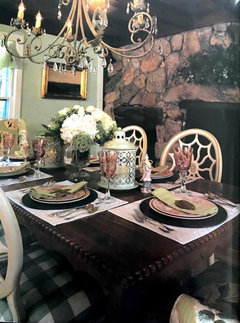
    Our home, built 1810, and there was no way to get duct work for the house. We did two min-splits. One was on the wall in the dining room. I'd hoped there was a photo of how it looked, but I only have pictures of the room. The mini is to the left of the window. Ugly? I had to chuckle on that comment. Painted it the color of the walls, and with everything else going on in the room, no one noticed it. How do I feel about splits? I love them. Much easier to control than a whole house system, which I have had in three homes. My daughter has one in her cottage basement that heats and cools. Perfect for the location. As for the condenser, ours was on the side of the house and camouflaged by a trellis.


  • PRO
    3 years ago

    2 units versus a whole house filled with them. Not a really good comparison to what I am talking about.


    No two climates are exactly alike. Some areas all you have to do is crack a window at night.

  • PRO
    3 years ago

    I rented a beach house in NC that was conditioned exclusively by mini-splits. There were three units that took care of the entire home. I'd guess it was about the same size as your 1,900 SF home, Ray. So that's a whole house filled with them.

  • PRO
    3 years ago

    rental vs something you live in full time. That explains everything Charles.


  • PRO
    3 years ago

    I was delighted when we arrived to find the home had mini-splits because I wanted to be able to evaluate them in whole-house application. It was a split-level with 3 BRs and 3 Baths. Temperatures throughout were very uniform and comfortable over the course of a week.

  • 3 years ago

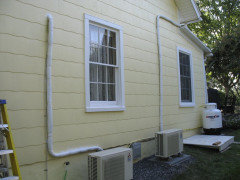
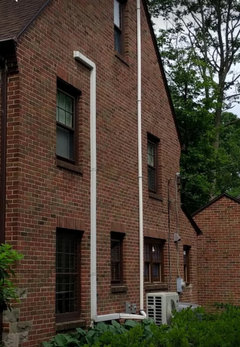
    The mini-splits I’ve seen have all had ugly outside “ducting” of some sort — what is that?

  • 3 years ago
    last modified: 3 years ago

    Hard to know what you've seen but with both conventional split and mini-split systems, there are pipes that run from the outside units to the inside units that the refrigerant flows through.

    Sometimes there's a plastic cover over them, intended to make them less unsightly.

    You see them on the outside of a building when the install is a retrofit to an existing structure. When put in at construction time, they can be concealed in walls.


    I too have experienced mini-splits many times, when travelling abroad. They work great, very quiet, very energy efficient. Both the kind with the wall hanging units, and the "ducted" kind that have small air handlers distributed around in ceilings that have small ducts running out from them.

  • PRO
    3 years ago

    Ductless mini split heat pumps are available with either wall-mounted, floor-mounted or ceiling mounted cassettes. They are an elegant solution for residential HVAC in engineering terms, but less so with regard to aesthetics.

  • 3 years ago

    A plastic cover does NOT make this less unsightly. Yuck. I can’t image saying these abominations are “less elegant”. Why would anyone do this?

  • PRO
    3 years ago

    As Elmer notes above, the refrigerant lines can be installed inside framed walls where they are not visible. That's relatively easy to do in new construction but not so easy in existing construction.

    What makes ductless mini-splits "elegant" in engineering terms is their efficiency and the options for independent zone control they provide right out of the box. They eliminate many of the drawbacks of distributing air from a central system. The main objection to ductless mini splits is that some folks don't care for the look of the indoor cassette units.

  • 3 years ago

    That’s why I was asking about the SDHV ducting in a 1910 home. I was hoping someone in the Houzz commenters had some experience in installing or having it installed in an old house. I have a Unico HVAC contractor coming Monday and I’ll ask for references (which will likely be positive, can’t imagine they’d offer me to call dissatisfied customers even if they are out there.)

  • 3 years ago

    We are in a Historic District, and I am absolutely sure the Board would never approve of the installations pictured in the photos above.

  • 3 years ago
    last modified: 3 years ago

    I agree the photos are bad. The brick one should have used dark brown (to match the gutters) line set cover. This would make it go a long way toward disappearing.

    The yellow house should have white line set cover. Matching the line set cover to the gutter color goes a long way toward integrating the look. Search line set cover on amazon to see all the options.