

Has anyone solved the problem of leaking minisplits?
I have LG minisplits, a multi-head system with 4 heads. They were installed in 2017 and every one of them have leaked numerous times. the installer has been out dozens of times, but I think had finally given up (or I've given up on him). Before I fix all the drywall and floor damage, I'd like to see whether anyone has a solution? the only suggestion I've received is to pour clorox or vinegar down the drain every month. This sounds easier than it is, since one requires a full ladder to reach, and taking the cover off isn't easy. Not really the maintenance I thought I was buying in to. I know (now) that leaking is a well-known problem with these systems, but I really don't know how they can continue to be sold when they cause so much damage, completely unpredictably and without warning.
Comments (39)
 3 years agolast modified: 3 years ago
So, its not the refrigerant that's leaking out, but rather the condensate from the AC.
"I know (now) that leaking is a well-known problem with these systems,"
Not really. The condensate drain from a mini-split should be fairly basic, although it depends on how the system is set up, especially with multi-head or ceiling cassettes. Can you post picture of the setup?

susan
Original Author3 years agoGood morning and happy New Year. I'm not sure what kind of photos you need? I could post pictures of the heads on the wall, but that looks pretty normal. Everything else is in the wall. Is there something in particular that would be helpful?
Related Professionals
Butte General Contractors · La Grande General Contractors · Sebring Home Remodeling · Lake Charles Home Remodeling · Rolla Home Remodeling · Lufkin Home Remodeling · Cedar Rapids Home Remodeling · Ottawa Bathroom Remodelers · Middlesboro General Contractors · Hartford General Contractors · Lewiston General Contractors · Marquette General Contractors · Amherst Basement Remodeling · Bend Basement Remodeling · McAllen Bathroom Remodelers- 3 years ago
Just a picture of the wall/ceiling indoor units. So the condensate drains are hidden in the walls? If they are completely enclosed, then I would have no idea what the problem is.
 PRO3 years ago
Mini-split heat pumps produce condensate the same way a central air conditioner does. The difference is that the evaporators (in a multi-head system) are distributed throughout a home so routine maintenance of a single condensate line is multiplied by the number of heads. Condensate lines can get clogged at their entrance (dust, mold) and at exit points (spider webs, etc.) An easy way to keep the line open is to use a shop vac at the exit point. Some mini-split manufacturers recommend condensate line maintenance every 4 months. You may need more or less frequent maintenance, but it's a reasonable interval to start with.
susan thanked Charles Ross Homes- 3 years ago
I feel your pain Sue but based on the snippet of information you furnished I can't give you a recipe for correcting your problem. What I can tell you is that mixing Clorox and vinegar results in poison gas DON"T DO IT. Are you looking for instructions to diy or do you want to tell a service tech what to do? Do you have documentation of the installer's attempts to rectify the leaks? Did you pay the installer for those failed attempts? Are all 4 heads equally problematic or is 1 or 2 causing most problems?
susan thanked klem1 susan
Original Author3 years agoThanks, all. The heads are all on interior walls. There is one downstairs that cools the whole (small, open) downstairs and drains to the powder room under the stairs. Upstairs are one in each of 2 bedrooms backing to a bathroom, so the idea was that they would drain into the bathroom. The one that is high up in the upstairs rec room backs to the upstairs laundry room and drains to the washer overflow drain. This drain point can be accessed with a shop vac -- in fact, the installer used that trick the last time he was out. I guess I will have to invest in a shop vac and haul it upstairs every month or so (no room for it in the very small laundry). The other three that drain to the bathrooms -- I'm not sure where or if they can be accessed.
They have all leaked at one time or another. I think it is somewhat correlated with how humid it is outside, which makes sense, but I wonder if the drain just gets overwhelmed. (A surefire way to make it leak is to run it on power mode when the room is hot). But even running them all the time still results in leaks -- there is no real way that I've found to predict it and if I'm not home or not in the room it isn't good. I could consider moving them to exterior walls, but probably would have to get another unit since that would put two of them a long way from the condenser, and would be quite a bit of repair work. If I have to replace the whole system, any suggestions for a better system that doesn't require ducts? I took out a perfectly good central air system to get rid of 7 ft ceilings created by the duct furdowns ... space looks great now, except for the falling drywall and warped floors ...
- PRO3 years ago
There are a variety of after-market condensate overflow switches designed for use with mini-splits. The switches can be integrated with controls to shut off the indoor unit in the event of an overflow. You might want to check with your installer to see if any of them are right for your application.
susan thanked Charles Ross Homes - 3 years ago
"There is one downstairs that cools the whole (small, open) downstairs and drains to the powder room under the stairs. Upstairs are one in each of 2 bedrooms backing to a bathroom, so the idea was that they would drain into the bathroom. The one that is high up in the upstairs rec room backs to the upstairs laundry room and drains to the washer overflow drain."
This sounds like all of the drains violate building codes and may well be the cause of your problems (for example, draining into a washer drain will most certainly cause issues if its before the trap and will allow sewer gases into the house if draining after the trap). Unfortunately, without more detail as to the specifics of the setup, its pretty much impossible to help.
susan thanked sktn77a susan
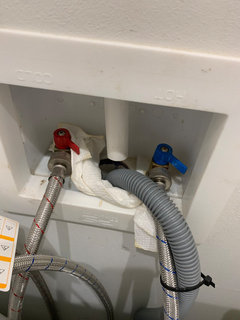
Original Author3 years agoThe problem is somewhere between the head and this drain. When it's working right, you can see the condensate draining here from the white pipe. When it's not working right, you can see the condensate pouring down the wall from the head on the other side of this wall!
- 3 years ago
sktn77a "There is one downstairs that cools the whole (small, open) downstairs and drains to the powder room under the stairs. Upstairs are one in each of 2 bedrooms backing to a bathroom, so the idea was that they would drain into the bathroom. The one that is high up in the upstairs rec room backs to the upstairs laundry room and drains to the washer overflow drain."
This sounds like all of the drains violate building codes and may well be the cause of your problems (for example, draining into a washer drain will most certainly cause issues if its before the trap
What issues is that certain to cause and how would it cause them?  PRO3 years ago
Susan,
The installing them (mini split heads) on interior walls is problematic for this reason. Tying the condensate drains into a plumbing system drain complicates things further. These kinds of appliances really arent designed to have traps -- they are designed to be drained outdoors from an exterior wall. There are ways to do this, but it's far easier to install them the way for which they were meant to be installed. That said it sounds like (looks like to me) that the problem is between the head and to where it drains to. The proverbial drain tube.
I don't see a code problem with draining the system into where the washing machine drains. There is a trap to that inside the wall. You noted well as to what happens when the unit leaks so my suspicion is a poor installation made worse by where they installed these (on an interior wall).
I don't think this is something you should attempt yourself as it would require removing the head from the wall enough to see the drain pipe arrangement. The point at which the drain tube enters the wall may be where the problem lies.
Another problem might be unit itself being unlevel. As you also noted the ability to make it leak would be to run it in a power mode setting which would create more condensate. The condensate reservoir for these machines isn't what I would call big or expansive so any issues with the draining system and problems like these come out of the wood work.
It might be something as simple as the drain tube being elevated slightly as it goes into the wall and maybe a combination of the head itself not being level.
How often do you clean the filters on these? That is another problem too, because the filters really hold next to nothing, as they load up smaller particulate makes it's way thru that eventually works it's way to the drain. So it's often times a stack of things that just compound on top of one another.
If it was installed on exterior wall you could just go outside prop a ladder and pop the cover off the line set cover to gain access to the drain tube right as it exits the unit. This also makes it far easier to install it to make sure the drain tube is positioned for success. (it will still clog, but because you got better access it would make it far easier to deal with.)- PRO3 years ago
"The installing them (mini split heads) on interior walls is problematic for this reason" I don't know how many mini-split heat pumps you've installed, Ray, but we've used them in dozens of remodeling projects--many of which were on interior walls. There is no reason that mini-split cassettes can't be installed on interior walls and function just the same as cassettes installed on exterior walls. Wherever they are installed, they need to be installed by a qualified professional installer and maintained according to the manufacturer's instructions.
- PRO3 years ago
There is no reason that mini-split cassettes can't be installed on interior walls and function just the same as cassettes installed on exterior walls.
It's not about functioning Charles. It has to do with maintenance... you know the one thing you don't do as a builder / remodeler. You do your work and leave, maybe come back once or twice to blow a few cigs of smoke to cover up your infallacies of any warranty you might provide.
Cassette style mini splits are those that are flush mounted into the ceiling, that style has a condensate pump to pump the waste water out.
You like to talk about those who can't understand the written language need to use pictures and hear I am correcting you about how you write and understand the things you write not even 24 hours later. Why is that Charles?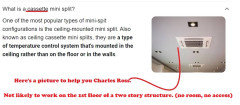
Now if you compare the picture I posted to what the OP posted you'll realize these configs are not the same for very important reasons.
The maintenance debacle I have repeatedly talked about as to why these kinds of things are poor choices when it comes to HVAC. The structure (what ever it is) has it's limitations but the more equipment you have the more maintenance you have, the more breakage you will have.
In order to sell something --- what has to happen? In order for you to be happy with the purchase so much so that you'd do it again the same way -- how much time passage is required for that to occur?
For me it's about repeatable business. If I sold you some product that you were not happy with how likely is it that you would use my services again?
The new build / remodel market isn't like that currently. There are signs that things could be on the cusp of getting a little rough for the remodel & build markets.
You can pick whatever you want. If your structure has imposed limits on you to go the mini split and / or the ceiling mount cassette these are products that have "clear" limitations. Those limitations aren't spelled out by those selling them... because if they were spelled out -- you probably wouldn't choose them?
Quote from the OP: Not really the maintenance I thought I was buying in to. I know (now) that leaking is a well-known problem with these systems, but I really don't know how they can continue to be sold when they cause so much damage, completely unpredictably and without warning.susan thanked Austin Air Companie - PRO3 years ago
Yes, Ray, most people do limit the term "cassette" to ceiling-mounted units. We prefer the term "cassettes" to "heads" and we use it to describe indoor units in any configuration, please forgive us that. The difference in vernacular aside, there is nothing in your posts on which to base your claim that installation on an interior wall is problematic. Condensate drains need to be properly installed and maintained and have the same potential to cause problems regardless of where they are installed.
Any routine maintenance requirements which affect the selection of one system or one brand over another should be communicated by the trade contractor or retailer the OP is working with during the design/selection process not learned after the fact.
susan
Original Author3 years agoReally appreciate all the comments. A couple of points: I am probably not as good as I could be at the monthly filter cleaning (but they are rarely dirty when I check and that doesn't seem to correlate with the leaking). But even if I am remiss, the consequences should not be so dire. I've lived with central air, and with window units, and skipping changing/cleaning the filters regularly only means you lose efficiency, not your drywall and floors. In any case, my parents clean their Daikin minisplits regularly (they have a grandson for this purpose) and theirs also leak. Luckily, they live in a barndominium with metal walls and concrete floors, so they just have to be careful about what they put under the units. Second point about leveling: houses shift. Even if the unit was perfectly level when installed, one can't expect it to stay that way. Again, if normal, expected use is going to create a very costly problem, that is a major design flaw. What would be the harm in making them with a more pronounced slope to the tray, a larger drain, and an auto cut-off water sensor? Or, barring that, perhaps a shelf that would attach underneath and hold a houseplant.
- PRO3 years ago
Susan,
There is no reason why your home should continue to be at risk of damage due to a mini-split condensate drain overflow. If the indoor unit is installed correctly and the overflow problem can't be addressed by routine preventive maintenance, an overflow detection switch can be installed which will shut the unit down upon activation. In case your HVAC contractor is clueless, here's a link to a video showing how to install an overflow detection switch on a retrofit basis:
https://cematraining.com/video-rectorseal-97622-safe-t-switch-ss610e-dls-condensate-shutoff-switch/
susan thanked Charles Ross Homes - 3 years ago
" What issues is that certain to cause and how would it cause them? "
Back pressure from double traps. But now that we can see the way the drain is set up, the "air gap" between the minisplit drain and the washer drain, this is not the likely explanation.It still violates all building codes I'm aware of!
- PRO3 years ago
Whether the use of the washing machine drain as a condensate receptor is a code violation would depend on the local code currently in effect and the judgement of the code official. The 2021 International Mechanical Code includes standpipes in the list of approved condensate receptors (2021 IMC section 307.2.1.1 )
- PRO3 years ago
Yes, Ray, most people do limit the term "cassette" to ceiling-mounted units. We prefer the term "cassettes" to "heads" and we use it to describe indoor units in any configuration.
But if I say something improper or use some improper term to describe something that's not OK?
You like to make rules only to break them yourself, Charles. That's a problem in 2023 for you Charles.
The difference in vernacular aside, there is nothing in your posts on which to base your claim that installation on an interior wall is problematic.
If it was my perception only, not based on any facts that this thread provides? Here we have a thread started by someone who by your standards Charles doesn't truly have a problem? I question that logic.
Are you trying to make this all about you Charles? This is the common theme you like to put on me circa 2022. So unwittingly you've created a new problem for yourself Charles in 2023.
-------installing the water sensor switch.
The switch Charles posted is robust with options meaning it will reset itself when the condition (full pan) rectifies itself. It has an amber led along with green and red leds to give the tech clues on where to look.
However, Susan has told us already (in this thread) that putting the machine into a power position creates plenty of condensate that tends to over flow the pan. If the machine is constantly going into and out of a water fault condition that continually shuts the machine off how are you going to over come that limitation when cooling is needed most?
Maintenance problems not likely to go away with the introduction of a water sensor. - PRO3 years agolast modified: 3 years ago
"However, Susan has told us already (in this thread) that putting the machine into a power position creates plenty of condensate that tends to over flow the pan." There's an obvious issue with condensate drainage. In the "power position" operating mode (I believe LG calls it "Jet Mode") the unit is programmed to rapidly cool the space. In that mode, it appears to be able to generate condensate faster than it can be drained--at least under certain conditions. But, it's a user-selected operating mode. Until the condensate drainage issue is remedied, the OP would be well advised to not use that particular operating mode, but rather, to try to maintain steady state conditions.
"Maintenance problems not likely to go away with the introduction of a water sensor." On that point we can agree. The overflow switch is intended to protect against property damage-- not as a regular operating control for the mini-split. The alternative is to take the units out of service or only operate them when a person is in the room and can monitor them. That's for the OP to decide.
While the OP has a condensate issue, Ray, I don't believe its due to mounting the indoor unit on an interior wall. Your haven't produced any credible evidence to back up your claim that installation on interior walls is problematic. If it were, manufacturers would limit the options for installing indoor units to exterior walls only. As much as you've bashed mini-split heat pumps in these forums over the years, I think it's a reasonable assumption that you've never installed one and have no experience base from which to offer advice. If that's not the case, please share the number of mini-split heat pumps you've installed and also help houzzers understand how they differ from the Bosch inverter-driven heat pumps you promote (spoiler alert: they don't.)
- PRO3 years ago
While the OP has a condensate issue, Ray, I don't believe its due to mounting the indoor unit on an interior wall. Your haven't produced any credible evidence to back up your claim that installation on interior walls is problematic.
The only reason it's problematic is the difficulty it presents in the installation making sure that drain tube is positioned properly. As well as the serviceablity (maintenance) of the system. Does this mean you might have less clogs if the unit was installed on an exterior wall?
Not necessarily... only that it would be easier to deal with due to much easier access and being able to see the drain tube isn't kinked or not positioned well or clogged with dirt, grime, algae or whatever.
On an interior wall once it's mounted on that wall you can't see what is happening behind the wall it's placed upon.
These kinds of systems (mini splits) multi heads or cassettes in the ceiling in a home will ALWAYS need more maintenance than a single ducted HVAC system. That is and will always be the con of this type of HVAC system. Some homes don't have any better options, so it is what it is for some structures.
So does this mean a traditional ducted HVAC system won't have condensate clogs? No. Just far less and if it's installed with serviceability in mind it's far more comfortable to deal with the maintenance end of it. (It's a comfort machine, there's more to comfort than just warm or cool.. the utility bill every month, the maintenance like filters and such, how often it breaks down.) - PRO3 years ago
Ray,
A condensate drain is no more or less serviceable if the unit it serves is on an interior wall. The connection to the pan is equally accessible and the pipe or hose needs to be installed with the same pitch and the same level of care in either case. Systems with multiple interior units will require maintenance of each unit, but they offer a number of benefits over centralized systems--ductless systems in particular. It's up to the homeowner to decide which best fits their needs. Hopefully their mechanical contractor will have real-world experience with mini-split heat pumps and can help them to make an informed choice based on experience and not conjecture.
- PRO3 years ago
Ray,
A condensate drain is no more or less serviceable if the unit it serves is on an interior wall.
So much so that the OP has wasted our time here asking us if anyone has solved the problem of leaking mini splits? Charles wants us to forget all of that?
The OP even included a video to show you how accessible the problem is. (forget this too)
The OP's original first post: They were installed in 2017 and every one of them have leaked numerous times. the installer has been out dozens of times, but I think had finally given up (or I've given up on him).
It's so easy yet the installer has been out dozens of times according to the OP.
---------What does the OP say about how these units are installed?
Thanks, all. The heads are all on interior walls.
---------- dozens of times -- all on interior walls -- yet the builder still trying to pass this off as "no big deal". That's a problem in 2023.
The proof is this thread. Dismissing it? How is that "helping" Charles? (another problem for Charles in 2023.) - PRO3 years ago
Ray,
Without seeing the OP's installation "on site, up close and personal" you asserted that indoor units installed on interior walls were "more problematic." You've routinely bashed mini-split heat pumps here on houzz.com for years. I suspect you've never installed one. My company has a 15+/- year experience base with both ductless and ducted mini-split heat pumps installed on dozens of remodeling projects--both on interior and exterior walls. There is no reason the indoor units can't be installed on interior walls and function reliably if properly installed and maintained.
What is clear in this thread is that the OP's mini split condensate drainage issue has been a recurring problem since the original installation and that the installation contractor is unable to remedy the problem. It's long past time to bring in another (hopefully more capable) contractor.
susan
Original Author3 years agoI think the fact that someone developed an after-market kill switch speaks for itself. If leaking were not a wide-spread, hard to remedy problem, there would be no need for such a device.
- 3 years ago
My suggestion is to hire an HVAC company to due annual cleaning and maintenance of your mini splits. Here is a video I found showing how to do it properly:
susan thanked mike_home - PRO3 years ago
Problems with condensate drains are not new and certainly not limited to mini-split heat pumps. If you have a conventional central air conditioner or heat pump, your system likely has an overflow switch, and depending on the consequences of an overflow, an emergency overflow pan, too. The systems in my home have an overflow switch, an emergency overflow pan, and an overflow switch on the emergency overflow pan. If you have a ductless mini-split, you don't have the option to install an emergency overflow pan, but you do have the option to add the protection of an overflow detection switch. Keeping the entrance to the condensate line clear is a good way to minimize potential problems. Check your manufacturer's operating and maintenance instructions for specific guidance on how often and how to maintain the drain line.
susan
Original Author3 years agoYes, that is my point. Conventional systems are designed with an overflow switch and pan. why are the switches not standard on mini-splits? Also, to go back to my original point: if I had known that the drain line needed to be maintained by pouring bleach or vinegar down it monthly (which, again, means getting on a ladder and removing the cover -- not easy - for 4 heads, AT THE RISK OF CATASTROPHIC WATER DAMAGE if I am delinquent, and WITH NO GUARANTEE that I won't have damage even if I do this, since one bit of dust getting sucked in can apparently clog the drain and since just running it on high can overwhelm the drain, I would have not considered this as a viable option.
- 3 years ago
Convential HVAC systems do not come with condensate safety switches. The switch is installed as part of the installation. We often get posts of homeowners with water damaged ceilings because the HVAC contractor did not install a safety switch on equipment installed in an attic.
Here is a vide demonstarting how the switch is installed:
Mini split safety switch installation
Here is the safety switch installed in the video:
Rectorseal SS610E safety switch
I don't think you have to pour bleach or vinegar on a monthly basis. Once is year should be good assuming the condensate line was initially installed properly. I do agree it is difficult for a homeowner to do the preventative maintenance. I am not sure if it is easier on some models versus others.
susan thanked mike_home - PRO3 years agolast modified: 3 years ago
You've routinely bashed mini-split heat pumps here on houzz.com for years. I suspect you've never installed one.
I've worked on mitsubishi slims line for other companies I've worked for. Usually number 1 problem on those was low on freon type problems. The number of them out there has been growing in recent years but at best might make up 5% of the overall HVAC market in my area. It's a numbers game at the end of the day.
I know what can happen to a normal ducted system... like a furdown system as a prime example. There's no emergency condensate drain on those either, so the practice was to install them over a tub in a bathroom.
Can't tell you how many times I had to bloody my knuckles trying to get those to drain properly so they weren't spitting condensate into the tub. How many times I got called back because they continued to drip under certain events. To this point now? (They call it wisdom - ha, ha) The opposite is to just sell you a new mouse trap proclaiming this or that -- much of which is noise.
My HVAC market (Katy, Texas) is primarily homes built within the past 40 years (circa 1980). During that time HVAC ducted has ruled the roost here.
If you think a random flush with bleach is going to solve this --- I have my doubts with that too. This picture below is merely to show you the possibilities.
Traditional HVAC system drain back up -- The booger!
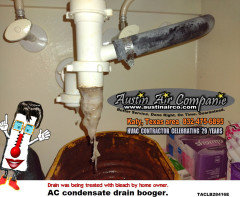
With the potential of causing freon leaks many major manufacturers don't want us cleaning evap coils any more with nothing but water. Bleach is highly corrosive and will eventually eat the metals that make up your indoor coil.You will always have maintenance issues. I haven't found a unit yet that doesn't break for one reason or another. (The more equipment you have (heads on the wall) the worse it will be. Because that too is a numbers game.)
Oh Ray you've made this thread all about you... no your comments Charles has lead us to this point. (That's another problem for Charles in 2023.)
- PRO3 years agolast modified: 3 years ago
I don't think a photo of a clogged condensate drain serving a conventional air handler is all that relevant to a discussion about a condensate drain serving a ductless mini-split heat pump except to confirm that condensate drain problems aren't limited to ductless mini splits. All HVAC condensate drains require routine inspection and maintenance. Manufacturers will usually recommend a maintenance interval. Whether mechanical cleaning, chemical cleaning or a combination of both is appropriate is a judgement call that's best made by a qualified technician on site.
A properly installed and properly maintained mini-split heat pump indoor unit installed on an interior wall is no more or less subject to problems than one on an exterior wall. Either will give you problems if not installed or maintained properly.
- 3 years ago
Humping the football isn't getting it fixed and certainly isn't making anyone look like a mastermind. OP simply hired a hack that made a mistake installing equipment and can't see their mistake to fix it. The finest technician in the business can't diagnose it long distance and even if they could and told op EXACTLY what the problem is,op couldn't fix it themselves. The solution is the same as 99% of problems showing up on houzzz,hire a reputable contractor to straighten it out and sue the hack in small claims in hopes of recovering some of costs.
susan
Original Author3 years agoI would prefer to sue LG for marketing an inherently defective product with clog-prone, too small plastic drain lines and no overflow cut-off switch.
- 3 years ago
If LG brand is as bad you say,you should prevail. During my experience in the field poor installation caused vastly more problems than product deficiencies in all brands. I'd like to look at information which convinced you the product is inferior and not installation error if you furnish the source.
- PRO3 years agolast modified: 3 years ago
I would prefer to sue LG for marketing an inherently defective product with clog-prone, too small plastic drain lines and no overflow cut-off switch.
Susan I hate to be the bearer of bad news, but I am often put into these situations by those who talk you into products that are lacking one way or another. You see the builder and a home owner defending these sorts of products. The builder even going out saying there is nothing stoping you from placing these heads on an interior wall. That is true to an extent until you start having these sorts of problems.
Susan you said these were installed in 2017 / 2018 time period I believe. How long after that did you start having the drain problems?
Limitations to the LG warranty: (click to enlarge)
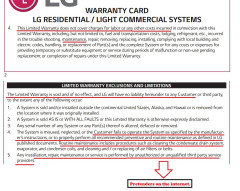
The above snippet of LG's warranty provided hereYou can search that document above to see if it includes your particular model. Even if your model is different it's not likely the documents will vary much from what I posted above.
I was told by the builder that I probably don't install these kinds of products all I know to do is to bash them.
FULL CIRCLE: Now you know why I do what I do.
Routine maintenance (or the failure to perform it) isn't going to win you any cool prizes. Sorry, it's in the warranty limitations. They even specify cleaning the condensate drain system with in the documents. (I even underlined them for you)










Austin Air Companie