Software
Houzz Logo Print
mxk3

Best wood for doors

3 years ago

DH is going to build a couple closet doors. Should be pretty straightforward. He's pretty good at building stuff, but not staining, and not very knowledge about characteristics of different woods (nor am I). So the question is -- which wood would be the best choice for the closet doors in terms of minimal warping and ease of staining?


I've ruled out birch and poplar. Oak is easy to find, but we're going to a specialty place tomorrow that carries a wide variety of lumber not available at the run-of-the-mill lumber yards. Here are the choices:


* Oak

* Ash

* Walnut

* Chestnut

* Elm


I'm not sure if they carry the chestnut or elm, but I'd consider them if they have them. I love hickory but we're going with a mid to dark stain (along the lines of Provincial), and that kinda defeats the purpose of buying hickory, plus I've heard it's tough to stain -- but is that really true?


Any input on any of the above wood is appreciated.


(cross-posting in Kitchens to tap all the knowledgeable folks on there)

Comments (13)

  • 3 years ago

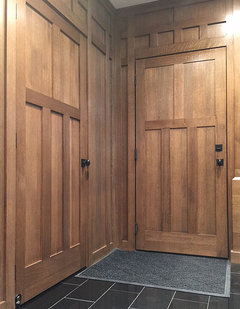
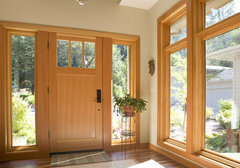
    white oak or douglas fir and keep the stain medium

    Craftsman Doors - 5-panel Riftsawn White Oak · More Info


    Douglas Fir Interior · More Info

    m

    porkchop_z5b_MI thanked herbflavor
  • 3 years ago
    last modified: 3 years ago

    "You can not make closet doors for what it costs to buy them premade and prehung, so any vanity project like this hinges on both having good wood knowledge and good finishing abilities. You say that he is lacking in both, so this is not a good project to take on."


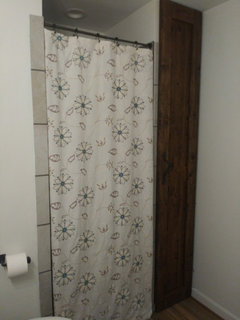
    IDK about that. He's made some doors before that came out just fine, for me anyway, I'm not looking for perfection, just something that looks nice enough for the bedrooms. Here's one he made for the bathroom pantry, I suppose a pro would pick it apart but I'm happy with it:


    Pre-hung and pre-finished doors aren't cheap -- will cost way less to DIY.

  • 3 years ago

    Those are beautiful doors, herflavor. I think this place carries white oak, I'll see when we go. We're going with a darker stain because that's what we've got going on in the rest of the house, trying to keep it cohesive, even for the private spaces

  • porkchop_z5b_MI thanked Crepe Myrtle
  • 3 years ago

    I would not select nice wood doors if there was no other wood around, and if there was other wood around, that is the wood I would use.


    (Walnut is nice wood, but a waste if it's going to be stained because stain hides its lovely grain too much.)


    As far as making your own doors, cool! Ask the people at the lumberyard for advice once you look at the actual stock they have.


    porkchop_z5b_MI thanked Iri
  • 3 years ago

    What are the natural tones of Ash, Elm, and Chestnut? (green, red, yellow - ?)

  • 3 years ago

    White Ash tends to be light brown and/or beige, Black Ash is a medium brown and/or beige.

    American Elm tends to have some red tones but they are not overpowering like Cherry. Chestnut starts with slight red tones but reddens significantly over time.

    ---

    Having said that, you can correct any tones in the wood with stain. Just grab the color wheel and go the opposite side. So to get rid of the red tones you mix some green tint in with your stain, if the wood reads yellow mix in some purple tint, etc. Correcting tone issues only becomes difficult when you are trying to maintain a clearcoat look, if you are adding some color it just isn't a problem. You want a wood that doesn't change too much over time so Chestnut might be problematic, but I actually like the depth that the red tones add to chocolate stains over time, in fact, cherry stained espresso is one of my favorite wood and stain combinations.

    porkchop_z5b_MI thanked bry911
  • 3 years ago

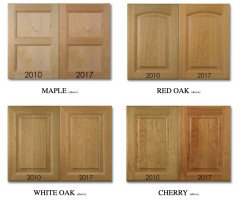
    Scherr's shows the colors for various wood species.

    https://www.scherrs.com/contents/en-us/d18_ReflectingNaturesBeauty.html


    Keep in mind that wood can shift in color over time.


    https://www.scherrs.com/contents/en-us/d53_ColorShift.html


    porkchop_z5b_MI thanked Mary Iverson
  • 3 years ago

    https://www.wood-database.com is a great tool for understanding workability, tone and color change of woods. I use it every time I am considering buying a wood that I haven't used before.

    porkchop_z5b_MI thanked bry911
  • 3 years ago
    last modified: 3 years ago

    We went to the lumbar yard this morning. Were bowled over by the beauty of walnut, we both wanted. Like right now, no question. BUT -- then we saw sample boards on display and the walnut looked yellowish. Thought maybe that was due to the clear coat they used, so stopped in and talked to the local paint pro, and he showed me a walnut board that also looked yellowish -- we had a sample of the walnut that looked very different (brown) from the two sample boards we saw. He said the only way to get it to stay brown like the raw piece of wood I had in my hand is to stain it.

    At that price -- forget it. If DH were an expert stainer, maybe -- but he's not, and red oak is 1/3 the price, as is ash. So it will be one of those. I can't go wrong with the red oak because my floors are red oak, so tonally they will end up pretty much the same. I'm not sure about Ash, though -- ash was slightly more expensive than the red oak but insignificantly so. Any input on which I should go with? Will probably stain Provencial or something of a similar ilk.


    ETA: If you look at the Scherr's link above, you'll see exactly what I'm talking about with the walnut.

  • 3 years ago

    I am happy to give an opinion on how I would select the wood, but I have a couple of questions about the project first.

    Are you looking at rough sawn, S2S, S3S, or S4S boards. Rough sawn means that none of the surfaces are smooth, S2S means that the boards have been run through a planer and the faces are smooth(ish) and parallel, S3S adds a straight cut to one edge (so the width can be trimmed on a table saw), and S4S means that all surfaces are smooth(ish) and parallel.

    There are really three ways to build a door... which one are you opting for?

    1. Stacked 4/4 lumber. The rails and stiles are made by gluing together 4/4 lumber to get a final dimension of 1.5". This is the cheapest method and can be done with the fewest (cheapest) tools (a track saw and a router), but some elitist would frown on it. Since it is for a closet, I wouldn't get too worked up about that.

    2. 8/4 lumber and resawing. You purchase 8/4 lumber and resaw the boards for the panel in half. This is the method I would prefer because I have a great bandsaw (although it could be done on a good table saw just as easily), however, 8/4 lumber is more expensive and it requires more and better tools.

    3. Buy a mix of 8/4 and 4/4 lumber. This can work great if the 8/4 lumber available matches the 4/4 pretty well. You don't have to resaw to get this one done and all you really need is a good table saw and a dado blade kit. You also don't have the extra step of gluing the rails and stiles together.

    porkchop_z5b_MI thanked bry911
  • 3 years ago

    I can't answer the question as to the how -- I can't build a house of cards let alone a door. I believe the lumbar we looked at today S2S.