Software
Houzz Logo Print
hebs820

Commercial hood design / spec advice

3 years ago

Hi folks!

We are designing a custom hood (or liner; tbd still) for our new kitchen and while I’ve spent a lot of time digging into all of the input and feedback here (incl the green heck guide, many of the great threads, etc), I’d love to get input from the experts here if what we’re thinking will be sufficient.

Here are the details - would love any input or feedback folks have!

Range: It’ll be a Lacanche cluny 1400. It’s 55” wide, and the front of the stove will sit 28 5/8” from the wall. The front burner starts about 1.5” from the edge that is 28 5/8” off of the wall.

I was looking at a modern aire setup with:

Custom hood or liner that is 68” wide and 33” deep. It will sit 38” above the range. I would do 30” deep, but the light bar that sits in the front looks about 3” so I figured 33” would give me an opening of 30”. Based on advice from this forum, that depth seems perhaps a little shallow but when I talked to one of the ModernAire reps locally, they said they had never built a hood that deep. Thoughts on this size and in particular, the depth?

In line silencer. The exhaust will run straight up about 5-6’ to the roof.

External blower. I was looking at both the ModernAire 1400cfm external blower and the Abbaka 1400cfm blower. They look identical but are about 20% different in cost. Anyone know whether they’re the same blower but rebranded, or whether there are any differences?

Make up air system still to be designed.

Thanks in advance for any advice folks here have to share!!!!!

Comments (29)

  • 3 years ago

    @opaone is your go-to source here for commercial in the home. In case you missed it, here is one of his reports: https://bamasotan.us/range-exhaust-hood-faq/.

    68 x 30 is about 14 sq. ft. calling for an actual full power flow rate of 1260 CFM to achieve 90 ft/min across the entire opening. However, this is for residential hoods with baffles near their entry opening. A true commercial hood, such as opaone uses, will have a lot of hood volume (reservoir) below the baffles and can get away with less.

    1260 actual CFM calls for about 1900 rated CFM, and this will require a larger motor/fan blower than a 1400. Hence, details of the hood guts are needed to determine whether this is a capture and contain immediately residential style hood or an average across the baffle space commercial style hood -- or something in between.

    Be sure that a hood that overlaps the cook is high enough to clear the tallest cook.

    Size duct for 1000 - 2000 ft/min at max actual CFM.

    There is also a forum FAQ, and I think a follow-on FAQ II. I can't search for them at the moment.

  • 3 years ago

    Thanks Kaseki- those are the helpful posts that gave me the info to come to these specs for my hood. I appreciate your input on those and others.

    The modern aire hoods do have some angle to them but not as much as, say, a captive aire hood so that’s why I am wondering if it’s big enough.

    With regards to your Cfm discount calculation, does it matter that it’s straight up and only about 5 feet to the roof? I thought this would mean that while there is some degradation it would be minimal. And more practically, what do people do if they want 1900cfm? The largest blowers I’ve found that aren’t horribly huge and large are 1400cfm. Thanks!!!

  • 3 years ago

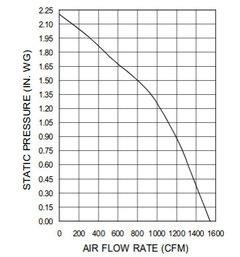
    LIFO. Wolf provides a Broan blower rated at 1500 CFM at zero static pressure. Fantech makes a series of in-line blowers up to fairly high CFM for residential use. Commercial blowers (up-blast style usually) can be spec'd to whatever one wants. Larger ones operating at low blade tip speed can be very quiet.

    The scaling from actual 90 CFM/sq. ft. to rated 135 CFM/sq. ft. assumes some typical set of pressure losses, including that of the MUA system and in particular that of the baffles. Duct length is a factor, but likely tertiary at 1000 ft/min or so.

    If you can get the baffle/(rest of hood) pressure loss vs. CFM from ModernAire, the duct loss from WWW calculators, and decide, on the basis of potential combustion appliances what your MUA will be and hence what its pressure defect will be of house vs. exterior, then you can go into candidate blowers' fan curves and find the actual CFM from the pressure loss of your systems.

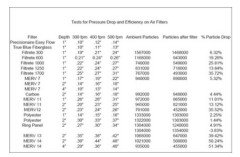
    For the case of no combustion appliances taking common air from the kitchen, passive MUA may suffice, and the MUA filter loss vs CFM may be (perhaps) dominant. Water heat exchanger pressure loss would add, but electric coil heating might have negligible effect.

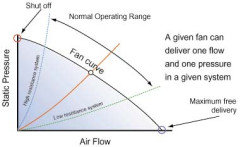
    Generic fan curve; click to expand:


    Broan 1500 CFM fan curve (not necessarily the one supplied to Wolf):


    Example DIY MUA filter pressure losses (divide actual ft/min by square feet of filter area to get chart fpm)

    MUA pressure losses can be mostly overcome with an MUA blower, but the control system may be complex.

  • 3 years ago

    Another way to look at it, given vigorous cooking: Let the plume upward rate be 4 ft/s (240 ft/min). Let the plume area at the baffles be 2 ft x 2 ft (equivalent), the the volumetric plume flow from one burner/pan will be 16 cu ft/s or 960 CFM. (This calculation is deliberately extreme; the plume velocity profile over the capture area needs to be used for a more accurate analysis.) And this plume mostly has to go through the section of baffles it impinges, so the rest of the baffle area needs a similar air velocity, adding to the required hood CFM. Volume under the baffles helps hold transient cooking plumes, spreading under the baffles in the volume helps with averaging, but generally, the design of residential systems does not provide much averaging and this helps drive up the required CFM.

    I seem to be OK with 90 - 100 ft/min in my Wolf Pro Island hood, but YMMV.

  • 3 years ago

    Note that the Modernaire hoods are not in any way commercial but just basic consumer hoods. They lack the containment volume that is critical to why commercial hoods perform so well.


  • 3 years ago

    Thanks @billy_g. Do you mind me asking what type of commercial hood you went with? I am investigating some commercial hoods with more capture area and debating between brands.

  • 3 years ago

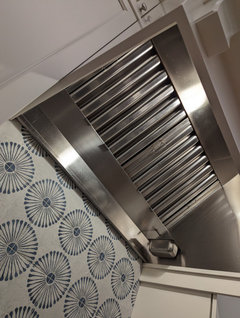
    @John H I contacted Accurex but they told me their minimum hood depth is 39 inches, which was too deep for my kitchen. So I designed a hood with commercial features and filters, using a few calculations for containment volume based on my desired capture area as well as airflow across the filters, and had it made by a sheet metal guy who works with stainless steel and has built "miles" (in his words) of commercial hoods. I posted comments and drawings in this thread:


    https://www.houzz.com/discussions/6099827/exhaust-hood-faq-ii

  • 3 years ago
    last modified: 3 years ago

    Hint: Start looking for it at about 70% of the way down the Hood FAQ II page.

    P.S. @billy_g Did you ever answer the question of what baffles you used?

  • 3 years ago

    @kaseki I used two Captive-Aire HRSS2020, and I like the fact they have built-in hooks that hold the filters in the opening and hold them above the grease trough under the filters. The baffles are specified in the drawings I posted. :-)


    https://www.amazon.com/Captive-Aire-HRSS2020-Baffle-Filter-Stainless/dp/B076C3NDPY


  • 3 years ago

    Thanks for all of this billyg! I was looking into the abbaka blower (ModernAire has the same fan but in a different box as well), and like the idea of a custom fabricated option.


    I did have a few questions if you don't mind:

    - Was one light enough for you?

    - Who installed the lighting / electrical on the hood? Did you do this yourself, or did the folks who made the hood?

    - Did you have any issues with permits in your remodel because of this? I am not an expert, but was wondering if hoods need any certain type of certification (eg UL) to be used, or if there's anything special you needed to do for this custom hood.


    Thanks in advance - I really like your approach and am thinking about doing this myself now. I wish I would have caught it in that other thread sooner! (but appreciate you sharing it!)

  • 3 years ago

    Hi John,

    I used the 1400 CFM Abbaka blower... I think they were bought by Bluestar.


    One light is enough but I might use two with a wider hood.


    The hood fabricator did the light cutout for the hood and mounted the electrical box. Electricians did the wiring at installation.


    No issues with the permits... when the hood is turned on the makeup air system is turned on -- you may need makeup air in your jurisdiction. The hood itself doesn't contain the fan or switches so there's probably nothing for UL to list... :-)


    The switches for the hood light and fan are mounted on the backsplash to the left of the cooktop.


    It's amazing how well the hood works and how quiet it is.


    Billy

  • 3 years ago

    Thanks Billy! Total long shot but you don't happen to be in the San Francisco Bay Area, do you? (that's where we're located and if you were, was curious who you used to manufacture your hood to see if they can do another, just a little wider :-) )


    Thanks again for all of the input!!! I will post details about what I end up with as well so others in similar boats might also benefit like I'm doing with your solution!

  • 3 years ago

    Hi John,

    Oops, I saw your question and apparently didn't answer it.


    I'm not in the Bay area - I live in DC. The sheet metal guy was recommended by my kitchen designer because sometimes they build custom hoods (wooden, stucco, etc) and need reliable suppliers to fabricate the sheet metal inserts. I would start there.


    My guy lives out in Virginia... and he does stainless steel work at the White House! He built a ton of stainless hoods for the restaurant industry so there should be people around you who do this for a living.


    My last hood was custom built by ModernAire in Los Angeles. I visited their factory and I'm sure they could do it, but I think you'll be better off with someone local.


    Billy

  • 3 years ago

    Thanks Billy! I am sure there are folks by me that do this so I will look around.

  • 2 years ago

    @billy_g Thanks for all of your advice and sharing your spec sheets on here. I am getting close to having someone fabricate our custom hood, but had a question on your build / install. How did you end up mounting the hood to your wall? Did you need to add holes to screw it in and/or mounts on the top for chains / support in any way? I didn't see these in your drawings so was curious how you managed this. Any advice would be welcome!

  • 2 years ago

    @John H, no chains or hanging support. They drilled holes for screws on the back of the hood, behind the filters where they would not be seen. The cabinet guys also added a wood spacer to hide any possible ripples in the sheet metal, and hide any gap between the sheet metal and wood hood. The wood spacer might provide some support, but it's the screws through the back that hold it up.

  • 2 years ago

    @John H, no chains or hanging support. They drilled holes for screws on the back of the hood, behind the filters where they would not be seen. The cabinet guys also added a wood spacer to hide any possible ripples in the sheet metal, and hide any gap between the sheet metal and wood hood. The wood spacer might provide some support, but it's the screws through the back that hold it up.

  • 2 years ago

    I can say that Wolf canopy hoods are attached at the top to their matching chimney structure which attaches to the ceiling joists and cross members. Specifically I have a island hood, so wall hoods may also provide holes for fixing the rear sheet metal to the wall. With a 7-foot ceiling, the chimney wouldn't be used. I think these heavy hoods are best hung from above no matter what the ceiling height is, rather than hanging from a wall. I'm sure that even the one on the bottom of the page at this link is hung.

    http://www.handcraftedmetal.com/

  • 2 years ago

    Sorry for the double post. Somehow my photos weren't uploaded.

  • 2 years ago

    Thanks! Did you have the fabricator pre drill holes or did you just do this upon installation? I am thinking the latter is far easier but just wondering if there is any downside to doing it

  • 2 years ago

    Kaseki- why do you think they are better hung than mounted? Wouldn’t either be fine provided the right mounting into wood?

  • 2 years ago

    Hoods are generally hung with chains or perf strap to provide sound/vibration isolation from the structure.

  • 2 years ago

    They can drill the holes onsite to match the stud spacing.

    No need to hang the hood - the structure with the triangles is stable. Straps or chains would be a pain to get aligned.

    There is no fan weight in the hood - the fan is mounted on the roof and we placed a muffler in the duct run to keep everything quiet.

    Billy

  • 2 years ago

    They can drill the holes onsite to match the stud spacing.

    No need to hang the hood - the structure with the triangles is stable. Straps or chains would be a pain to get aligned.

    There is no fan weight in the hood - the fan is mounted on the roof and we placed a muffler in the duct run to keep everything quiet.

    Billy

  • 2 years ago

    My thought was that a heavy wall hood, even without a blower in it, could distort hung from the rear unless this was taken into account by the design. I suppose it could also distort hung from the top unless properly designed. So its designed mounting approach should be followed per its installation guide.

    A search for an example wall hood led to these instructions for Wolf. This wall hood is hung from a metal strip that is attached near the top of the hood rear sheet metal and bolted to the wall studs. Note that the installation calls for blocking between the studs. Also note that this 48-inch hood weighs almost 100 lbs.

    https://www.subzero-wolf.com/-/media/files/united-states/product-downloads/sub-zero-wolf/installation-guides/wolf/pro-wall-chimney-hoods-ig.pdf

  • 2 years ago

    @kaseki, an important factor that needs to be considered is whether the hood is unenclosed and freestanding (as with the Wolf hoods covered by the instruction manual) or is installed as a hood insert in a structural cabinet, as is the case with the insert in my drawings. In addition, the Wolf hoods have a heavy light bar (I think) at the front of the hood whereas in my hood and in commercial hoods the light source is mounted at the top of the hood. All considerations...

    Billy

  • 2 years ago
    last modified: 2 years ago

    "My thought was that a heavy wall hood, even without a blower in it, could distort hung from the rear unless this was taken into account by the design."

    Yes, it must be designed properly but that is quite simple. Even an extremely heavy hood should be able to be hung from a wall without much difficulty. For example, there are thousands of cantilevered pull up bars in gyms that have to support multiple times the force of any hood (body weight + live weight = a huge amount of force).

    The issue with hoods is vibration xmission to the structure that then becomes a giant loudspeaker. So the hood, ducting, silencer and blower should all be mechanically isolated from the structure to prevent this as much as possible. Our blower is balanced (IIRC there was a 0.1g weight in one place) and blower+motor isolated within the housing but they still recommend always hanging the blower using chains without any other structural contact. My guess is that this is partially since grease/dirt will unbalance the blower over time.

    Interestinglly, while I've had to clean our baffles numerous times over the past few years, the blower blades have remained totally clean. The baffles seem to be working well!

Sponsored
AIS Renovations
Average rating: 4.5 out of 5 stars15 Reviews
Custom Craftsmanship & Construction Solutions in Franklin County, Ohio