Software
Houzz Logo Print
webuser_708737691

How can I replace seal on washing machine drain that is on wall?

3 years ago
last modified: 3 years ago

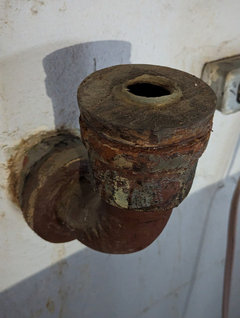
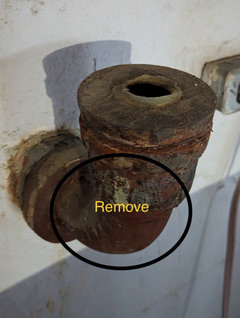
I live in an old house and was preparing to paint basement when I moved the washing machine and drain hose came out of wall drain. The seal had been caulked to the drain and hose to the seal. The seal came off and I can't find replacement. I don't know how to fix this.
I have pictures.

Comments (22)

  • 3 years ago

    Drain hose isn't normally sealed in drain,just insert deep enough it doesn't push it self back out, tie hose to one of the faucets or do as I do by running drain hose beneath hot or cold hose to hold it in place.

    Patti thanked klem1
  • 3 years ago

    Patti, post the pictures. Visuals are always helpful.

    Washer drain hoses normally should not be sealed air-tight to the standpipe so as to prevent siphoning of water from the machine.

    Patti thanked dadoes
  • 3 years ago


    It's hard to tell, but the top, which feels like wood, was sealed on pipe with glue or caulking. The small hole on top is where the washer hose went in. Mess to clean

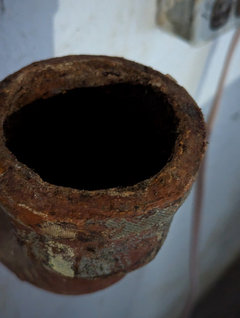
    This is drain without top

  • 3 years ago

    If I stick washer hose in the top of drain it won't stay in because top just sits on drain

  • 3 years ago

    Hum... Well yes I suppose according to newer homes this is unconventional, but this house is 85 years old and I've already put way too much money in it. I was hoping since I have used this drain without any problems for over 20 ;years I could find a way to make it look better. So I guess the fastest and cheapest way is to clean top up and re-caulk it in place.

    I have been remodeling my basement for over 2 years. Everytime I hire someone they don't listen to me on how something needs to be done and after I pay them I end up doing it over. For some reason they think a 67 year old female can't do anything, but I studied, listened to and learned from people like you. So thank you

  • 3 years ago

    Oh and yes I read that hose should not be airtight and I'm thinking the guy who hooked it up did it with glue or caulking. I'll clean it up and hose should be fine, I hope.

  • 3 years ago
    last modified: 3 years ago

    Have you looked into Fernco flexible coupling adapters? They may make one that would fit over (and clamp around) the top flange of that cast iron elbow at the end of your washer drain. If you can find a coupling adapter that fits, you could slide a piece of 2" Sch. 40 pvc pipe down through the adapter into the elbow and then clamp it place with a ring clamp around the top of the Fernco. That could give you enough of a PVC riser to properly hold your washer's drain hose.

    There may be other brands of adapters. Fernco just happens to be the one that my town's hardware store carries.

    Patti thanked jwvideo
  • 3 years ago

    This sanitary waste elbow looks to not have a P-trap, so the top must be sealed to prevent sewer gas from rising up the pipe. Your washer drain hose must have an air gap and a standpipe to drain into. So these items as exist currently conflict with both functioning properly and being safe.

    It may have been jerry rigged for 20 years and been lucky, but with Murphy's law I wouldn't bet in the future that some caulk holding a gyrating drain hose or it completely sealing sewer gas will continue.

    Patti thanked 3onthetree
  • 3 years ago

    Well, it is not a waste elbow and does not need a pea trap. It's the drain to my washing machine and I cannot have a standpipe unless I want to spend a lot of money tearing up basement floor. There is only one floor drain and it is on other side of basement. I believe it has lasted this long because it is sturdy and hose fit good until I moved it.

  • 3 years ago
    last modified: 3 years ago

    Also, I do not think it was jerry rigged. It seems that all the old houses around here or at least on my street look like this. I am constantly amazed at well this house was built and the material used. The craftsmanship is so much better than anything I have seen around here lately.


    jwvideo - yes Home Depot sells the Fernco adapters and I am going to try it. The top of drain is 4" diameter so do you think I should go with a 5" coupling?

  • 3 years ago
    last modified: 3 years ago

    You want the coupling-adapter that has the same interior diameter as the outer diameter of your existing drain's fitting. If the outer diameter of your pipe's fitting is 4", then you you would want a Fernco 4x2 (4" end clamps over the top of the fitting with 2" on the other end to hold the PVC riser.) Fernco does make a 5x2 if that is what it takes to fit over the top of that elbow.

    Could you clarify your response to 3onthetree about not needing a P-trap? Did you mean that a P-trap is not needed because there already is one elsewhere in the drain line in the wall so you do not need to add one at the elbow? Or, did you mean that you think washer standpipes don't need P-traps? I'm hoping it's not the latter.

  • 3 years ago

    ∆∆∆∆∆∆


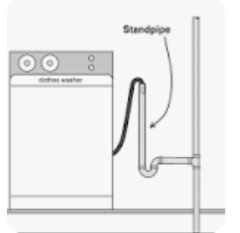
    P Trap on a washer standpipe.


    If there's no odour, the P-Trap is somewhere in the wall.

  • 3 years ago

    There may also be an “S” trap behind the wall or in the floor. My old house, which is only 68 years old has no “P” traps, only “S” traps everywhere. And there is no laundry standpipe. The washing machine empties into a large sink which is actually an old double kitchen sink with legs on it (well over 100 years old and repurposed by the original owner.) Despite the common knowledge that “S” traps are no longer allowed because they don’t work as well as “P” traps, everything in this old house still works fine. I second the idea of using a Fernco fitting to try to create a standpipe. The existing pipe looks like it’s pretty high up on the wall. If it was lower, I would suggest trying to add a laundry sink and emptying the washer into the laundry sink. That is allowed by code.

  • 3 years ago

    Upon further review of the photos, it looks like a previous owner may have added this pipe to an existing clean-out in the plumbing system and there may not be a trap. Then they sealed it up to prevent sewer gases from entering the house. If you live in the city and are connected to public sewers, the seal also prevents things such as cockroaches from entering. So I strongly suggest that you try to seal it back up, or try to add some kind of proper trap to prevent a bigger problem (infestation.) They do make laundry sinks with a pump underneath so that they can be pumped uphill into a drain. You might try looking into something like that, but I’m not sure if the pumps can handle laundry lint.

    Patti thanked A
  • 3 years ago
    last modified: 3 years ago

    Oh boy I think I'm in trouble...

    Jwvideo - I have no clue what I have. I made a mistake assuming I didn't need a p-trap. I figured the drain on the wall took care of everything.

    Worthy - I wish my hook up looked like that, but drain is on wall. Although, there is no odor and never has been.

    A - yes the drain is high up on wall. As a matter of fact the top of drain is over washer. I'm not sure what a clean out is and I definitely don't want bugs. Wha

  • 3 years ago
    last modified: 3 years ago

    Sorry..

    Whatever they did was more than likely done by original owners years ago. I never had any problems until I moved the stupid thing! I have a handyman coming over tomorrow and I'm not sure he knows anything about plumbing, but I'll ask him to look at this thread. I know for sure I don't want to add a sink. Maybe I'd be better off calling plumber.

  • 3 years ago
    last modified: 3 years ago

    Jwvideo I just got to thinking and took another picture

    of drain looking at it from the top. I can stick drain hose into the narrow opening that goes into elbow, but not sure if that's ok. I believe it would hose would be a snug fit which means no breathing room. I really don't want to call a plumber. This basement remodel has been expensive. Before I took up tile floor or tore down ceiling I had it checked out and it was asbestos. Only certain people can remove it and they're not cheap.


  • 3 years ago

    A - I'm sorry to sound stupid, but if my drain is high on wall how can I use the Fernco fitting to create a standpipe? Also, now you have me worried about roaches....

  • 3 years ago
    last modified: 3 years ago

    >>>" if my drain is high on wall how can I use the Fernco fitting to create a standpipe?"<<<

    This is going to be a long response.

    What you do with a Fernco adapter is clamp the wide end around the top of the elbow and slip a foot or so of 2" PVC down through the narrow top of the Fernco to bottom out on the top of the curve in the elbow. A ring clamp around the narrow top of the Fernco will hold the riser in place. That gives you a standpipe type connection.

    The question is: how high can that substitute standpipe be and still work with your washer.? You said the elbow in the wall is "above the washer." So that is maybe 45 inches above the floor? More? Less?

    Here's the thing: Some washers have drain pumps that can handle standpipes as high as 96 inches. Others have less reach. Still others' pumps are rated for as little as 40 inches above floor level. The installation instructions for your washer will tell you its maximum allowable height for a standpipe. If you do not have your manuals/owners guides, you can probably find one online by searching on your washer's model number.

    If your washer's drain pump can't go another foot higher, then the Fernco idea won't work. Unless you buy a new washer rated for tall standpipes.

    Might be worth your while to have a plumber check out the drain line to see if it has any kind of trap inside the wall.

    If the drain line in the wall does not have a p-trap and your washer is one that can drain high enough (or, if you are willing to buy a replacement washer that can reach high enough), it may be possible to DIY plumb a P-trap above the elbow and strap the components onto the wall above the iron elbow. PVC components will be cheap. The P-trap will need a standpipe above it of at least 18 inches and will need to have a horizontal run from the P trap to the elbow to avoid creating an "S trap," It would be a good idea to add an air admittance valve to vent the assembly. Where I live, we are allowed to use air admittance valves (sometimes called "Studor vents") but you need to find out if your jurisdiction allows them. Again, this is where a licensed local plumber can help.

    On concerns about asbestos --- having it turn up in the ceiling (80-year old fiber soft or accoustic tiles?) and on the floor (commercial asbestos cement floor tiles?) does not tell you about asbestos risks in the walls. Are the basement walls concrete foundation walls? Might have asbestos in them, but probably not. Block wall construction -- a lot more likely. If the basement walls are sheathed in 85-year old cement-board panels, the chances of finding asbestos go up. Did the earlier testing of the tile and ceiling also include tests of the walls?

    Given that array of possible problems, I also liked A's idea of a laundry sink with a laundry lift pump although that will be a lot more expensive than adding a PVC P-trap and standpipe on top of the elbow (unless you have to buy a new washer.) Saniflo is the brand I have in my old house basement. They are expensive -- last time I checked, Saniflos for laundry sinks cost around $450 plus whatever you have to pay for a laundry sink. A laundry sink (with a drain screen to catch lint) would avoid the problem of drain height for the washer, would provide the p-trap, and the lift pump won't need its own trap so its drainpipe could be sealed onto the elbow (with a Fernco adapter),

    But there is a catch. What a pump will need is ready access to a drain waste vent (DWV) to the outside. Is there a DWV nearby that could be tapped into? (If so, that's probably something you want a plumber to do for you.) For a vent from the pump itself, maybe you can DIY the installation? You would run PVC pipe from the pump out a basement wall or window and up to where the end is away from opening windows. That's what I was able to do with the lift pump in my old house basement. But, I didn't have to worry about asbestos in the walls. So, very much a YMMV thing.

    With your basement's constraints, it may be worth your while to pay a plumber to check out what you have and what you might do to navigate the constraints.

    ETA - just checked my Saniflo's manual and found it only needs 1½" PVC for venting rather than the 2 or 3 inch that I mentioned

    ETA: Also, if you do not know what A and I meant by an "S" trap, the easiest way to visualize it may be to think of a P-trap as a letter "J." Turn one J upside down and put its end over the end of the other J. That's an "S" trap. Here is a random link that explains them. I mention this because, if your washer drain line has a trap, it may very well be an S trap. Codes allowed them when your house was built 85 years ago and they were often used. When I bought my century-plus old house, all the sinks as well as the washer drain had S traps. Today's codes ban S traps in new construction but they do not require you to rip out old ones that still function. However, this is just theoretical. That cast iron drain might not have a trap of any kind.

    ETA: But, here's an additional worry about cutting into the basement walls to get at that existing cast iron drain. The walls are painted. If they've been painted for a long time, the original layers may have been lead paint. Not a problem until you need to cut into the wall. (In my century-and-something old house, I was lucky -- the basement walls had never been painted.)

    Patti thanked jwvideo
  • 3 years ago

    The size of the cast iron looks around 3" (estimated from the washer hose hole), so there will not be a Ptrap on that size. Also, with the surface mounted receptacle and what looks like a parge coat (1930s either on CMU or maybe just poured), probably no Ptrap within the wall or behind there.

    The money spent on getting the basics right, like plumbing, electrical, and HVAC, should take precedence over finishes. You can always go back and redo finishes later once your savings has recovered. A plumber's hourly fee would set you up with the proper information that we aren't going to get over the internet, so at least you can make decisions. I would consider that moving the washer and knocking the hose out was a blessing in disguise.

    Patti thanked 3onthetree
  • 3 years ago
    last modified: 3 years ago

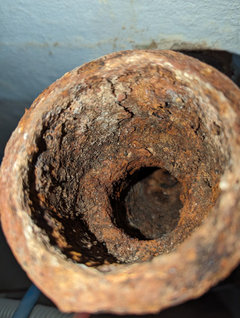
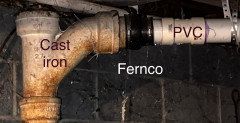
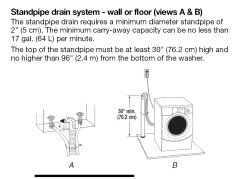
    I think you may be in over your head on this one, and you should probably hire a licensed plumber who can evaluate what is existing and suggest the lowest cost solution to bring everything up to code. I actually don’t think it will cost that much to get it done correctly. I think jwvideo has a good suggestion with the air admittance valve, if allowed in your jurisdiction. If I was doing this, I would probably completely remove the elbow back to the larger pipe coming out of the wall. Then add a proper p-trap and AAV. This is probably the best way to get a p-trap, assuming there are no other traps in this wall (is this an outside wall?) Without the AAV, you would have an s-trap. A licensed plumber can guide you on what is allowed in your jurisdiction when doing a renovation. My town inspector told me that when making modifications, everything must be brought up to current code. But since you’re making a repair and not a modification, they may work with you. Jwvideo is also correct about looking up the installation manual for your washing machine and seeing how high it can pump. Mine can pump up to 96” but you want to make sure before adding a high-on-the-wall standpipe and then finding that your washer won’t drain. The photo is from my old house, when the plumber removed all of the galvanized pipe under our bathroom and replaced it with PVC 25 years ago. The screenshot is from the owner’s manual of my Whirlpool washing machine.