Software
Houzz Logo Print

Comments (18)

  • 2 years ago

    I had read that article, but thanks for posting. There are taller white pines, but girth is what stands out. We are planning a trip to upstae NY next August/SepSeptembe, and we should be reasonably close it. I’ve got the general area where it stands bookmarked, but finding it will be a difficult.

    bengz6westmd thanked maackia
  • 2 years ago


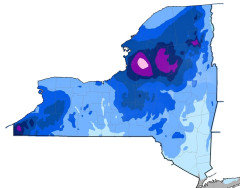
    Interesting that it's in a very high snowfall area.


    bengz6westmd thanked UpperBayGardener (zone 7)
  • 2 years ago

    Yeah, David, I wondered about that too. Could be it's cold enough there that the snowfall is relatively dry and not so sticky as places like we're at.

  • 2 years ago

    IME:

    Winters with heavy snowfall. protecting roots from subzero temperatures, gives most plants less stress to deal with the following spring.


    My understanding from the article is that these larger trees reside in 'hollows' between ridges. And it's an area east off the great lakes known for lake effect snows.

    I can imagine there are unbelievable snow depth in that area.


    Could have something to do with the longevity of these trees.


    bengz6westmd thanked BillMN-z4a
  • 2 years ago
    last modified: 2 years ago

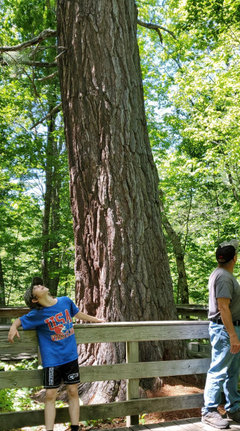
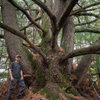
    Article says it's 16 ft in circumference, which is alittle over 5 ft diameter. The pic seems to me to show that it's more than that considering the person standing there. The standard technique is to measure at breast height, but where would that be? Where would one stand to get the exact breast height considering the size and expanse of that root crown?

  • 2 years ago

    I thought about that too. On such uneven ground, where's bottom?

    Mabey find the happy medium?

    I think 'breast height' has been standardized now to 4.5 ft. but still.


    bengz6westmd thanked BillMN-z4a
  • 2 years ago

    “Interesting that it's in a very high snowfall area.”

    That’s a bit confusing to me. Isn’t the natural range of P. strobus primarily in areas of regular and heavy snow? Besides the Adirondacks, it grows throughout the Great Lakes region, which has heavy snow load just about every year and produces some monster pines. This would also be true of southern Canada and the NE United States. Am I missing something?

    bengz6westmd thanked maackia
  • 2 years ago

    Snow isn't nearly as damaging as ice. And dry, fluffy snow isn't nearly as damaging as heavy, wet snow.

    bengz6westmd thanked mad_gallica (z5 Eastern NY)
  • 2 years ago

    From what I gather, the area these trees reside was largely ignored by loggers and after the big blow down no one gave it another thought.

    Too rugged and isolated?

  • 2 years ago

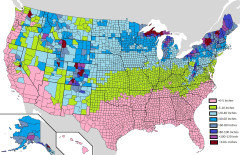
    Even compared to the rest of the native range, that is a high snowfall area.


    via https://www.reddit.com/r/MapPorn/comments/1zdfq4/average_yearly_snowfall_in_the_usa_by_county_oc/

    bengz6westmd thanked UpperBayGardener (zone 7)
  • 2 years ago
    last modified: 2 years ago

    Bill -

    From what I gather, the area these trees reside was largely ignored by loggers and after the big blow down no one gave it another thought.

    yes that was what I was mainly alluding to, not that the climate was directly related to the size of the tree. Although I wouldn't rule out there being some subtle correlation not involving human activity.

    bengz6westmd thanked UpperBayGardener (zone 7)
  • 2 years ago

    My great grandfather owned a sawmill in western Pennsylvania, along with various stands of timber. The land the timber was on, was claimed by the state for back taxes in the 1930's, and is now part of Cook Forest (no, it wasn't the Forest Cathedral). It wouldn't surprise me if something similar happened to this tract, though a brief search didn't reveal when the state took possession.

    bengz6westmd thanked mad_gallica (z5 Eastern NY)
  • 2 years ago
    last modified: 2 years ago

    ' yes that was what I was mainly alluding to, not that the climate was directly related to the size of the tree. Although I wouldn't rule out there being some subtle correlation not involving human activity '

    ha! exactly. I in no way was implying that the snow cover has anything to do with the size of the tree. Only that it might have kept the tree healthier over the years by protecting the roots from centuries worth of subzero freezing.

    To begin with. It has to have been an old growth tree to reach this level of status and most of the native range of white pine has been logged off more than once in the last 400 years.

    In Northern MN, we have an area called the 'Lost Forty' which has acreage that was inadvertently marked 'Lake' during surveying done back when logging was beginning its heyday. There are old growth white pines residing there that nobody cut because nobody bids on 'Lake' when planning to harvest timber.

    Those trees will never make a national/world record like the NY tree even though some are estimated to be 350-400 years old. Poor soil, long snowless winters, short summers and 50d below zero are just some of the variables preventing this. Some of the largest ones there have already declined and since broken off by storms and eventually died.

    bengz6westmd thanked BillMN-z4a
  • 2 years ago
    last modified: 2 years ago

    I've been told the lot that I'm on was the site of a sawmill that dealt w/quite alot of white pine in the early 1910s. The neighbor's BIG barn that was near me (blew down from the Sandy storm) was about 100 yrs old & made of absolutely enormous & long white pine beams. Someone came by afterward and bought/hauled away the fallen beams that were still in surprisingly good shape.

  • 2 years ago
    last modified: 2 years ago

    Some history of tall white pines. Some good comments about how shelter is important for these trees to get very tall.

    http://nativetreesociety.org/historic/nwhite_pine_heights.htm

  • 2 years ago

    I have never seen a map that breaks out snowfall by county. That might be useful for eastern states, but out west it's next to useless. In my county in WY it ranges from 300"+ to very little (~40")

    bengz6westmd thanked L Clark (zone 4 WY)
  • 2 years ago

    At one time the tallest Pinus strobus in Minnesota was around 130'.

    Last year we were at one of the previous state champs in Itasca Park.

    Not sure if this was the same tree but iirc: was ~125' when it took the state crown.

    We walked/climbed a couple of hundred feet up to reach this one as it was perched on a rocky hilltop overlooking a large area of the park.

    That's most likely the reason it lost about 30' of its top during a storm several years ago, dethroning it. So call it what you want, 'Micro climates' or 'protected areas' with all the variables are instrumental in growing old, large trees.

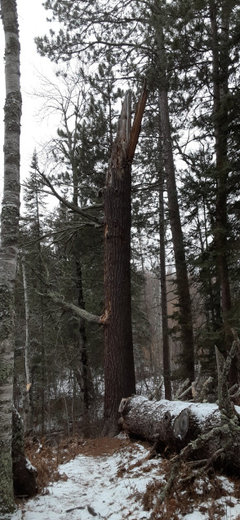
    Former state champ white pine, Itasca park MN:


    Below:

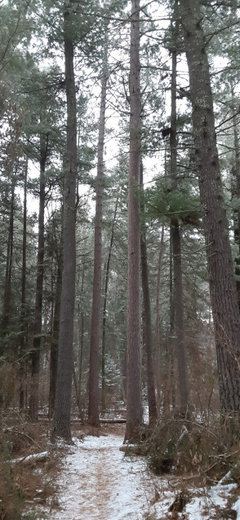
    A view of the trail at 'Lost Forty' SNA by Blackduck MN when I was there Dec. 2020:

    The P. strobus on the right was one of the more impressive trees there.


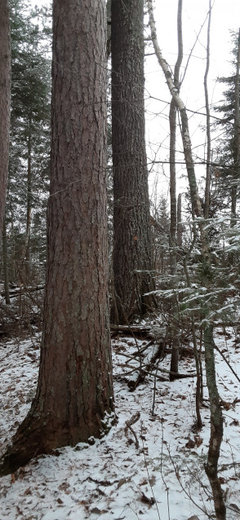
    Here's a large red pine and white pine growing alongside each other.

    Where does diameter at breast height begin on the left (red pine) tree? ;-)


    All the biggest trees were located on an elevated, exposed area.

    Below was one of the oldest trees in the SNA. ~4ft. DBH.

    It succumbed a several years ago now, to a wind storm.

    /////////

    bengz6westmd thanked BillMN-z4a