Software
Houzz Logo Print
jillius18

Where to put the dryer vent hookup behind stackables in a tight nook?

2 years ago
last modified: 2 years ago

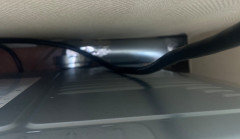
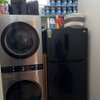
Hi everyone. We are at the tail end of shifting the hookups for our washer dryer to this nook (pictured below) where we're going to have a stackable washer/dryer.


Since this is a small nook, and I have PTSD from installing stackables into an unwisely tight closet in our last place, I am REALLY keen to make sure all the hookups are actually accessible this time around.

  • I'm happy with how we've solved the issue for the water hookups. This nook is wide enough that, if we place the machines as far right as they'll go in the nook, we should have enough space on the left to reach a hand in to hook/unhook the water.
  • I'm also happy with how we've solved this issue for the electrical. We've placed the outlets high enough on the wall that a person standing on a chair shouldn't have too much trouble reaching the plugs, even when reaching over the machines.

But I'm stumped with how we should position the dryer vent. The back wall of this nook (the wall with the outlets) is an exterior wall, so we are planning to vent the dryer out that wall. Our new stackable machines will arrive in a little over a week, and our contractor is coming out the week after that to cut the required hole through this exterior wall and then to install the dryer duct and the machines.


Since we will have had our new washer and dryer delivered by the time he arrives, our contractor has proposed measuring the exact spot where the dryer vent is on this specific model, cutting the hole in the wall exactly there, installing whatever vent outlet thing goes through the wall, and then positioning the dryer so its vent and the wall vent outlet thing are perfectly aligned and then just shoving the washer/dryer straight into the wall vent outlet thing.


I understand his point that there will be no shorter, straighter run possible with duct, but:

  1. I've never met a duct that slid right in. In my experience, they are all lightly mashed/oblong in their own unique ways and require some manhandling to get one to slide into the other.
  2. This would put the duct connections more or less dead center behind the stack of machines, which I think would be impossible to access.
  3. Doesn't his plan marry us to having only this specific machine forever?

Before he proposed that plan, I had been assuming we'd cut the hole through the wall somewhere high on the wall -- maybe roughly level with where the electrical outlets are -- because up high is the only area we'll be able to reach once the machines are in place.


I figured we'd use rigid ducts, attach a 90 to the machine, then attach a vertical straight to that 90, then shove the machines in place, and then attach a 90 at the top where it would exit through the wall.


But of course that adds a couple feet and two 90-degree turns compared to my contractor's plan, and for the life of me, I can't find examples when I google of how people usually run ducts in this situation.


What would you recommend?


Comments (11)

  • 2 years ago

    We used Magvent behind our Washtower as there was no way to get behind to connect. It worked perfectly.

  • 2 years ago
    last modified: 2 years ago

    Seconding magvent. Read about it here and used it recently. I didn’t ”need” it but it sure made for a simple install and clean run.


  • 2 years ago
    last modified: 2 years ago

    Your plan sounds fine. Two 90s and a few extra feet of duct shouldn't make much difference and is the only way you can see what you are doing without guessing and, very likely, getting it wrong.

    I've seen ads for the MagVent and it looks interesting, but I'd let someone else be the guinea pig!

  • 2 years ago

    The generic term for what you want is "periscope vent." A Google/etc. search will turn up dozens of models along with installer and and user experiences.

  • 2 years ago

    @luna123456 Yep, GE Ultrafast combo washer/dryer! I was thinking the same thing but people will start thinking I'm selling them if I suggest it again. :P

  • 2 years ago

    I wasnt thinkong GE (do not care for the brand). More of a Miele household.

  • 2 years ago
    last modified: 2 years ago

    Too late for me as I just bought new W/D set but do any of these come American-sized? I just bumped back up after about four years of a smaller set, and the feeling of relief is overwhelming.

  • 2 years ago
    last modified: 2 years ago

    >>> "do any of these [heat pump dryers] come American-sized?"<<<

    A search for a friend earlier today turned up two models.

    One is the GE Ultrafast Combo Washer/Dryer. It has a 4.8 cu. ft. drum capacity which might qualify as "American sized." Paul F has one, has written about using it, and is looking to buy more for his rental property. There are a couple of discussions of it on the AutomaticWasher site and I think Yale Appliance has a couple of blog videos about it.

    The other, strictly a dryer, is the LG model DLHC5502 "dual inverter heat pump dryer." It claims a 7.8 cu. ft. drum capacity. LG announced it month or so ago. Several vendor sites, such as Appliances Connection, have listings for it but, as of this morning, only the Plesser's site was claiming to have one in stock.

    For the OP, the owner's guide says there is a stacking kit for mounting this model on other LG full-size front-load washers.

    ETA: Forgot about this non-recommended Whirlpool "Hybrid heat pump model," WHD560. Claimed drum capacity is 7.4 cu. ct. This model and a predecessor have been on the market for a few years. Apparently, it is called a "hybrid" because it has a resistive heating coil (same as on a regular vented electric dryer) alongside the a heat pump and can use either by itself or both together.. The knock on the Whirlpool design is that it requires at least annual disassembly in order to be able to clean internal lint that gets past the filters and builds-up on the coils inside the machine.

  • 2 years ago

    I think that qualifies, thanks! I guess I was lazy, coulda googled myself. My perhaps outdated impression was that they tend to be small.

  • 2 years ago
    last modified: 2 years ago

    The Miele dryer is 4.1 cuft so its not that much smaller.

    Normally dryers are double the volune of a washer or very close to that.