

Painting sample dilemma advice needed
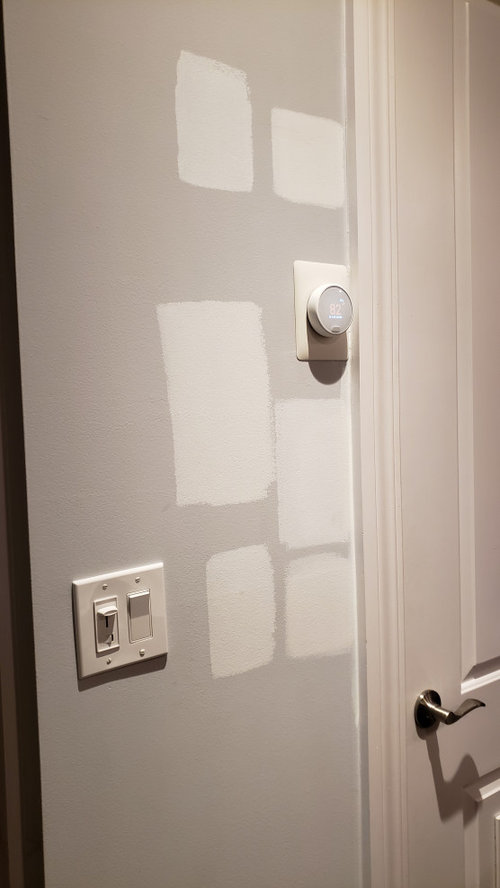
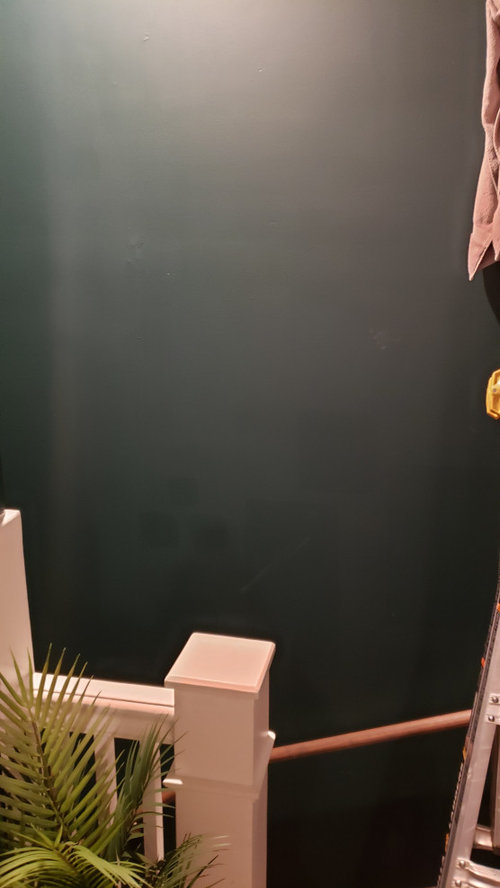
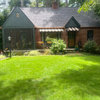
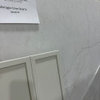
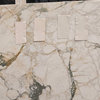
Im painting my wall white. People advised to try it on the wall which apparently is terrible advice (see picture 2 with dark green wall)
What do you all recommend I do for the wall with the white samples? Should I sand them?(these samples aren't as thick as the omes on the green wall btw) Should I get a separate primer? Currently using bm regal select paint.
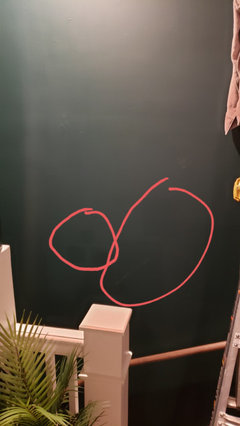
What do you all recommend for the dark green wall? I'm guess I should sand ive been wanting to buy an orbital sander.
Painter told me that the samples would disappear with the second coat but they didn't. I hand sanded before the painter arrived.
I also happen to prefer the dark spots coloring its a darker green. I imagine I'll have to have the painter come back and paint another layer but I just want to make sure the problem gets fixed
All advice welcomed thank you
Comments (34)

jo mu
Original Author2 years agoIn case it's not obvious
I can take pictures in the light the samples are even more visible in another part of the hallway during the day
- 2 years ago
For the wall that will become white, I would be inclined to prime the whole thing first (sand if there are any edges on the sample squares to smooth out). The need for sanding should come into play only if there are edges on the sample paint spots that need to be smoothed out. You don't say what sheen the paints are but may have an effect with the coverage. The green wall obviously needs another coat to cover the paint sample squares.
Related Professionals
Sheboygan Bathroom Remodelers · McComb Kitchen & Bathroom Designers · Providence Kitchen & Bathroom Designers · Burlington Kitchen & Bathroom Designers · Binghamton Interior Designers & Decorators · Yuba City Interior Designers & Decorators · Meridian Architects & Building Designers · Charlottesville Kitchen & Bathroom Designers · Spartanburg Furniture & Accessories · Vancouver Furniture & Accessories · Wausau Carpenters · Leamington Carpenters · Albany Custom Closet Designers · Tacoma Custom Closet Designers · Evanston Custom Closet Designers PRO2 years agolast modified: 2 years ago
A room has four walls. Rare is the need to make them different, rare is the need for an "accent wall. That is what art is for!
There is no possible way to test a white as you are sampling, and no way for us to tell you which white.
Two coats of paint are minimum in ANY color, cost little more and the difference in coverage is major. A white, depending which? Could take three coats, as some have better coverage than others.
If a wall has "issues" with condition? Good prep, a primer and two coats of finish paint.
- 2 years ago
I'm not clear what you're actually asking. Are you asking the best way to sample, or whether white paint will cover the dark green?
The best way to sample is to paint large foam boards or posterboards; you can (and should) move these around the room to see how the sample looks on all the walls -- paint can look very different in a different part of the room, and "the one" will look good everywhere. Once you've narrowed it down to a choice or two, then paint very large swatches on primed walls. I know many people disagree with this, but it is what I do.
If you're asking about covering the green when he paints, you don't need to prime if you're using a high-quality paint. It may take up to three coats to hide completely, depending, but painting is always a two-coat minimum and if you add a primer underneath that's three coats anyway. jo mu
Original Author2 years agoJack is there a primer you would suggest? So no paint and primer? I have a quart of behr flat paint and prime without colorant and would have used that until i had the entrance stairwell painted and ( the green) and realized these samples can come through
jo mu
Original Author2 years agoSorry to all who responded a bit confused and providing sampling advice
I dont need sampling advice im done sampling I need help fixing the problem sampling directly on the wall created (green walls) and advice on how to prevent it (white samples wall)
And yes I will from now on do the poster board or dry wall method and never again sample on a wall
jo mu
Original Author2 years agoI went a little paint swatch crazy lol at the time the stairwell had water damage and I was refinishing the banister luckily I didn't do this in the white rooms
I painted the apt white the stairwell I hired out as I cant reach up high.
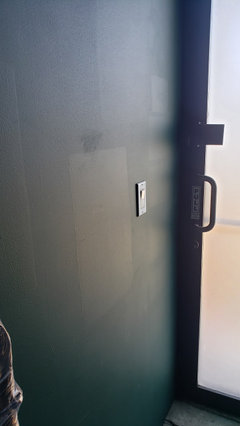
I used matte finish bm regal select. I want to keep it matte but for the paint experts do you have any suggestions as any time I touch the walls those white dust spots occur
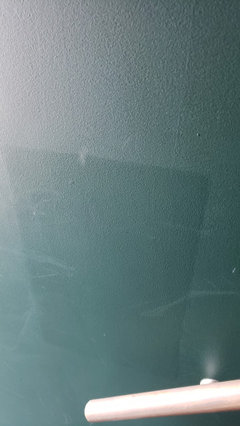
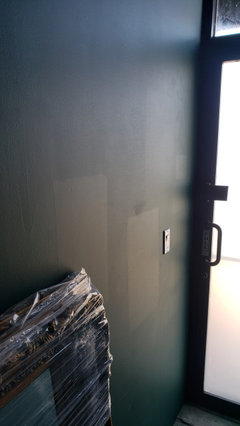
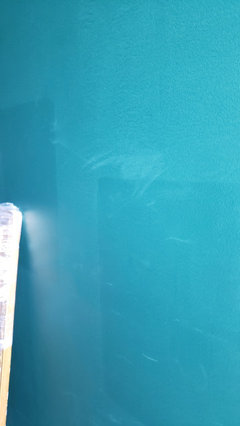
- 2 years agolast modified: 2 years ago
If it makes you feel better to hear of the misery of others, I tried paint color sampling in my living room. Problem is that I still can't make a decision and have moved on to other projects in the house and have these weird sampling spots in my living room--for several years now. I really don't notice them, and given that my kitchen (my priority project) is falling apart, the spots on the living room walls are not something that I focus my energy on for now.
Having done a lot of painting myself and having hired painters at my own home andat my husband's office for painting too over a lot of years, I would question the quality of the paint that your painter is using. And yes, they like to tell you that they did 2 coats but that its always the case and paint can get watered down. jo mu
Original Author2 years agoHU that is me too! Sorta those patches are in my kitchen I went crazy getting the perfect white in my open concept space I ended up mixing 2 benjamin moore whites for the final color ...the spots in the kitchen are what I have left to finish painting its been almost 2 years 🤭
I actually paid for the paint its pretty fancy at least in price benjamin moore. I think he did do 2 coats the problem is going from light to dark takes imo 3-4 coats...that what I did with the samples in retrospect so no wonder they're peeking through
- 2 years ago
First of all, Behr paint is pretty much low end. "Paint and primer" is a sales gimick". There's really NO such thing!
It appears you're going over dark colors, so a high quality primer is a must! Followed by a high quality paint!
I am partial to Benjamin Moore higher end paints (Regal, Aura), but I also really like the Scuff X line. Scuff X Matte is a very nice look, and still has the "clean-ablity"of an eggshell finish.
In the end, higher quality paint saves time and labor over low end paints. Plus a good painter will have discounts at the BM dealer he/she uses on a regular basis.
- 2 years agolast modified: 2 years ago
To clarify to all - I believe what the OP is asking is:
'The sample swatches I painted on my wall when I was in the color deciding phase have shown through my final paint job. The final paint job is done but I still have "ghost" images of square swatches showing through. How can I get rid of these? Sanding, repainting, prime, what?'
I believe it is the quality of your paint. Behr is bottom of the barrel. What line of Ben Moore did you buy? The lowest, least expensive Ben Moore really isn't that great. The more expensive ones give you the best coverage and save money in the long run.
I recently moved into this wildly painted apartment. Below is the before and after. My painter used one coat of Benjamin Moore Eco-spec primer and two coats of Farrow and Ball dead flat. Primer + one coat = no color was showing through, not even the red paint, which is the hardest to cover. Still, they did a second coat.
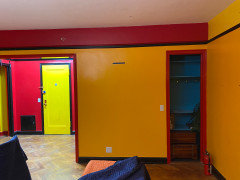
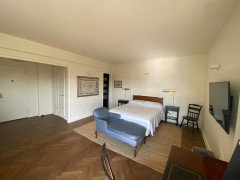
 PRO2 years ago
Doesn’t matter what brand or number of coats; because those areas will always have more paint film and the higher build will telegraph thru no matter what.
They have to be sanded off.
But you have to do the whole wall, spot sanding alone is not going to solve the problem.
Hit the spots and finish the whole wall, corner to corner, ceiling to base with a pole sander.
If you can find a pro who will do it, that would be ideal.
 2 years ago
Another tip for sampling (although that is not the OP's question), put your test boards on next to true white unpainted poster board. The white directly on a different colored wall (not white) will affect what you see.
jo mu
Original Author2 years ago@Lori
If its sanded can I have it painted with the same color corner to corner or do I need to involve primer (asking for green wall)
Is there a reason not to just sand samples? But sanding the whole wall? Will it create another issue if just sample spots are sanded?
jo mu
Original Author2 years agoKendra thanks for explaining it
And no I used a good quality benjamin moore paint (regal select)
My painter was use to using sherwin williams
He said the spots wouldn't show and that he could use primer but he didn't prime
He was rather inexpensive so I think he just want to do the 2 coats quickly and be done
Wish he had told me to sand off those spots before coming
Theyre a different sheen thats part of the problem
 2 years agolast modified: 2 years ago
Op wrote this:
I actually paid for the paint its pretty fancy at least in price benjamin moore. I think he did do 2 coats the problem is going from light to dark takes imo 3-4 coats...
I used matte finish bm regal select. I want to keep it matte..."
Looks like she used BMBehr paint isn't 'low-end'. I actually prefer it to BM for my walls. I've been using ALL paints for the better part of 30 years and prefer Behr, believe it or not.
jo mu. Can you please clarifly again what EXACTLY is the question?
do you want to paint over the green wall?
Is something 'coming' thru the green paint?
are you saying when you tested your samples like this, you then painted over them w/the green paint?
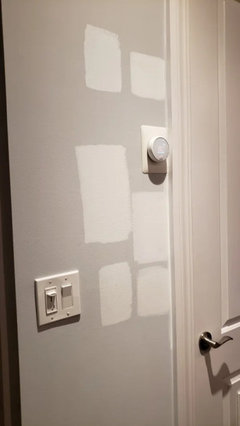
and now you can see those samples showing through? "White Dust spots?? can you clarify that?"If this is the issue, the painter needs to prime the entire wall and paint it again. I suspect he failed to do that in the first place.
What green paint did you use? BM? what color?
(what were the samples you tried? BM? what finish? matte, eggshell, satin, glossy???)
If this is NOT the question, please go into detail what we're missing.
Do you want the white paint on the other wall?
If you want to paint over the green:
Get an actual primer and prime the entire wall. Dark colors must have a primer if you're going to use a light color over them. *You can tint your primer a dark color so you won't have to use 4 coats of paint* c-below for more on that.
Sanding?
I can see you have a smoother texture finish on this wall, with some goober paint build-up here and there. You can try to lightly sand (a fine sandpaper) wipe very well, and then prime the entire wall
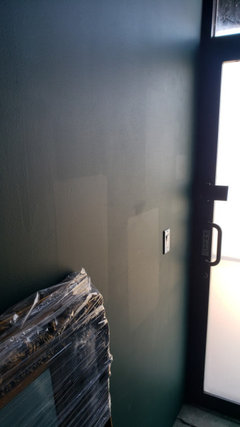
if you sand the entire wall, and the wall is textured to start with, you're going to have to 're-texture' it to match the other walls.A good primer (try Kilz
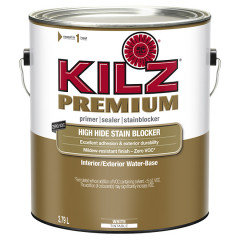
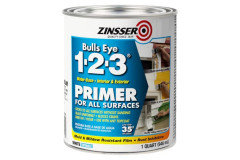
should cover whatever you think that issue is.If you use a first class primer that is meant to cover darker colors, glossy/satin, or film spots, it should be fine
One more thing,,,anytime you prime a wall first, and plan to paint a dark color, have the primer tinted to one shade lighter than your dark paint color. takes less paint to cover. You can have your primer tinted any color. doesn't have to stay white. so in your case, I'd get this primer for your green wall. Have the paint guy add a green tint to the primer (show him the green paint color you're using) and have at it. You want it one shade lighter so you'll be able to see what's primer and what/where the paint is going on the wall.
I can't believe a professional painter doesn't know this.
jo mu
Original Author2 years agoBeth thanks for the primer suggestions
And you pretty much got the issue except the white patch wall is staying white and ill be the one painting... the green walls are staying green and I can't paint that high up so ill be hiring
I wish my sample walls weren't so long corner to corner😪
He does paint for a living but he is very affordable. Thats why I didnt even call to complain if I did I would still pay him to fix it
I have a feeling he did know better but lives very far away lol and figured it wouldn't be a big deal ...no ones ever mentioned it but I sure notice and it bothers me
I have water damage again so at least its not a redo in vain
 PRO2 years ago
I have “preached and preached” to folks to 1) use samplize samples; 2) paint your samples on foam boards after priming them. Painting on your walls never works out and causes these problems. Plus, you can’t get good visual with out some border to help block eye from viewing both current wall color and new color desired. So sorry. But your painter didn’t meet his require either so on him. Most “sample” paint is satin finish and it will look different than flat. It will show through. Good luck on getting what you want without too much extra cost!
- PRO2 years ago
Btw, I always get the proper tint on my primers that provides the best base for your ultimate color, especially saturated final colors.
- 2 years ago
When my kids were in a child care center, they moved to a different building. We painted different walls primary colors and secondary colors. I thought red would be the worst for coverage, but purple and green were worse - if I remember correctly, they took 4 coats (we were painting over white walls, and did not use tinted primer).
Our neighbors painted stripes in their living room. The next owners tried just paining over the stripes, which didn't work. I think they ended up sanding the whole thing.
- PRO2 years agolast modified: 2 years ago
You cannot spot sand sample spots.
This is not a color issue.
This is not a primer issue.
The problem is uneven paint film build.
No product will fix painted samples on a wall.
Even one coat adds a layer of paint film thickness.
What you see now is an uneven wall.
You have to even out or buff out the whole wall if you want it to be right.
If you spot sand, you’re essentially just rearranging the unevenness.
A pole sander with attached vacuum would take care of this rather easily.
- PRO2 years agolast modified: 2 years ago
You never know what you don't know.
But you just learned this:
A really good painter with a lot of experience is not low cost and few will ever call that guy "affordable". They just suck it up: ) to get a result.
The best tools in the hands of an amateur will not guarantee success. ( Ben Moore , here ) The worst tools in the hands of an expert have a far better chance at success.
You either live with the "spots", or you get the pole sander, or.......change painters and pay for the result you want, on all the walls involved.
 2 years ago
Good Grief - We patch holes in walls all the time without having to sand the entire wall. You patch, sand and match the texture. On fairly smooth walls this may be achieved with just a paint roller, on heavier textured walls you may have to use a texture spray. On these walls I would sand off only those lines that are demarcating the outside edge.
I don't think the patches on the green wall are showing because the samples are thicker, it is simply because the base used to create dark colors is transparent when it dries, (Think Elmer Glue - white when it goes on, dries clear) so the lighter color is showing through. Run your hand over the edges, can you feel where the patch stops? If not it isn't the layer of paint, it is a coverage issue.
The painter should have primed the entire wall so you had a consistent base. He should have had the primer tinted a dark gray. Gray is the correct base to use. It scatters the light evenly, where using a tined base that is a color does not scatter the light evenly. This is why they make gray tinted primers.
Always prime. If you have large patches or lots of repairs, old wallpaper glue or other issues I prime with a coat of Gardz (dries clear, but seals beautifully) and then something like Zinsser 123 to get a consistent color base.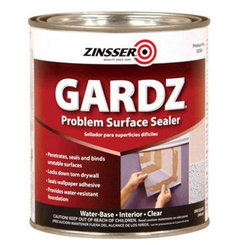
These are the SW primer tint colors. I would get a P6 for your dark paint color.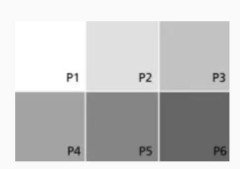
He should have also patched the divots and problem areas instead of just throwing paint over them.
If you try to sand this whole wall now, when it is not fully cured you may end up with a disaster. The paint will likely ball up and clog the sanding paper because it is still soft. PRO2 years ago
Two coats of most paints will cover up anything akin to the samples on your wall. I guess you could hand sand but would not suggest using an orbital sander on a gypsum board wall. You will quickly sand thru the paper covering and into the gypsum itself.
- 2 years ago
This is a great video showing why base 3 paint may need more coats to cover depending on the opacity of the tint being added. Some tints are more opaque than others.
https://www.youtube.com/watch?v=33OYhsdpkUA
I used to have a picture of Base 1, Base 2 and Base 3 similar to the test that this guy performs.
Base 3 is transparent.
It is the pigments being added that create the opacity.
Generally Titanium White is the most opaque pigment used in wall paint and what makes the base 1 dry white and cover the black lettering in the video. You can't add titanium white to dark saturated colors because it will make it a new, lighter color.
Obviously the green tint isn't opaque enough to cover the samples. - PRO2 years agolast modified: 2 years ago
I’ll say it one more time.
The only way to know - for sure - that the multiple, large test sample areas will not telegraph through new layers is to even out the wall.
Repainting hoping two coats will hide the problem and then they don't is not fun.
Good luck with your project, OP.
- 2 years ago
Thousands of people have painted samples on a wall and covered those samples without having to sand the entire wall.
You fix what needs fixed. Feeling the edges of your sample will tell you if there is an edge that needs to be taken down.
Blowing up your photo I see that you may have left a demarcation on the left side of your samples, not uncommon that one side of the roller got a thicker line. Looks like the painter has a few roller lines as well or maybe the wall had them before he painted, but they are visible.
First arrow shows roller marks that are not part of the sampleSecond arrow - edge of your sample that needs to be lightly sanded to blend with the rest of the wall
3rd arrow shows an imperfection that is part of the wall and wasn't fixed prior to painting.
Red Square - shows no roller demarcation lines but does show where the paint was too transparent to cover the lighter sample.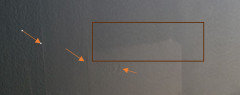
Most homes have some small imperfections and most people don't get that close to your walls to notice, but the color difference is really noticeable and if you have a heavy edge that makes a square on the wall it will be noticeable. As long as the edges are feathered into the wall a coat of primer and 2 coats of paint covers the samples.
The ability to cover does depend on how smooth the wall is to begin with. If you have Level 5 smooth drywall any imperfection will be noticeable.If you have orange peel - you can hide pretty much anything.
jo mu
Original Author2 years agoThank you to everyone commenting to figure out the issues and resolution
Here are some conclusions you have made me realize that maybe is hard to figure out from your screens
The problem is multifaceted
Uneven surface ( ridges on some squares even though I personally sanded them the night before painter arrived)
Sheen issue- even without build up ( some samples are flat to the touch no buildup) my final paint is matte but most paint stores only sell satin finish samples (a whole 2 levels higher =/)
Base color/coverage issue sort of like painting 1 white color onto black walls vs white walls and the final color depth will be different ( that green wall use to be a light grey like the picture with the white patches)
If he had used primer i think problem #3 would have been solved but not #1 and not sure about problem #2 especially if tinted primer was used to my understanding the more tint the less effective it is in hiding.
Not mentioned in post or comments is that he had to work in less than ideal weather and ventilation conditions because I wanted it done before it got even colder and only one hvac vent there at the top of the stairs so some goopyness ( also imo regal select is harder to work with than less quality that is thinner)
- PRO2 years ago
It is multifaceted - in several, rather large areas.
By the time someone farts around fixing all the spots, it’d be faster and easier to do the whole wall. And no question it will look better.
Painters who get paid by the hour would go spot by spot, painters who get paid by the job would not.
Work smarter, not harder.
jo mu
Original Author2 years agoLori do you thinking sanding the whole wall then adding a couple more coats of the paint will work?
Or will I need to prime after sanding?
I only ask because well the 5 gallons used weren't cheap and they still didn't give the coverage I want. I want the deeper colors the sample that probably have now 5 coats have. I dont want to have to buy 10 gallons plus primer to fix it all and get it to where I want if I don't have to



Patricia Colwell Consulting