Software
Houzz Logo Print
webuser_939966930

Potentially Dangerous Retaining Wall - Strategies to Resolve?

last year
last modified: last year

Hi everyone - Hoping to get some guidance/advice on a problem that we're having with our builder. Thank you in advance for your review and any perspective you can offer!


Bottom Line Up Front

Are there any provisions in the building code or other applicable laws that relate to retaining walls and physical safety of occupants?


Context

  • I own a new construction home in the U.S. state of South Carolina. We worked with a small local builder from the beginning to design the house in a small neighborhood of similar homes. This is our first home.
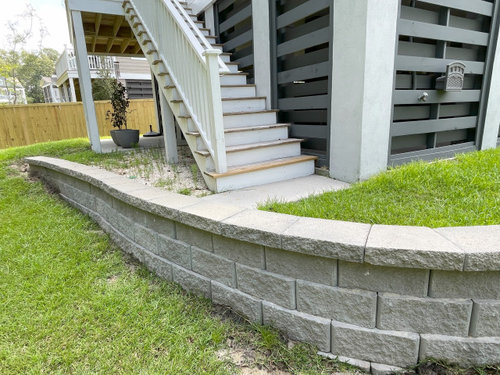
  • Very late in the construction process, the builder added a retaining wall at the bottom of the stairs leading down from our deck to the backyard. According to the builder, the retaining wall was needed because a large oak tree in the backyard prevented him from establishing a more gentle grade. Because of the retaining wall, we cannot access our backyard without jumping down from the wall or skirting along the side of the house and descending a small hill to go around the wall.
  • The retaining wall measures 30" in height from the bottom of the footing to the top of the cement blocks where the stairs from the deck terminate.
  • Given the placement of the wall, I am concerned about physical safety: people/children descending the steps from our deck and falling off the wall and getting hurt, especially in the dark. I am also concerned about the long-term performance of the wall in holding back the dirt (sandy loam) along our foundation which is built up significantly from grade.
  • I have raised my concerns with the builder multiple times since we closed on the house, but he has brushed it off and refused to mitigate the risk either by installing some additional steps down to the backyard or placing a handrail along the top of the wall to guard against falls. He does not see a problem with the wall or its placement. He is generally very unhelpful even with documented warranty items which seems to be common right now.
  • I met with our town inspectors including the project engineer that was assigned to our house. They stated that the retaining wall meets code based on Section R404.4 of the International Residential Code (IRC) which the town follows. Only if the wall is greater than 4' in height would it need a permit and an engineering study to determine construction. The house was given a Certificate of Occupancy (CO) by the town.

Reference Materials

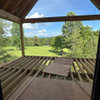
Here is a photo of the area. Please forgive the weeds under the stairs!


Here is a video of the area that I took descending the steps from the deck.


Here is the applicable section from the IRC:

"Retaining walls that are not laterally supported at the top and that retain in excess of 48 inches (1219 mm) of unbalanced fill, or retaining walls exceeding 24 inches (610 mm) in height that resist lateral loads in addition to soil, shall be designed in accordance with accepted engineering practice to ensure stability against overturning, sliding, excessive foundation pressure and water uplift. Retaining walls shall be designed for a safety factor of 1.5 against lateral sliding and overturning. This section shall not apply to foundation walls supporting buildings."


Conclusion What would you do in my situation? I am considering several options:

  1. Engaging an attorney with expertise in new construction to further consult on the details.
  2. Reaching out to the South Carolina Department of Labor, Licensing and Regulation (LLR) which is where the town told me to appeal any issues related to the code.
  3. Simply hiring a contractor to install some steps down to the backyard and calling it a day. If that ends up being the solution, what would you do here to mitigate the risk and provide better access to the backyard?

Thank you very much in advance for any thoughts you might be able to offer!

Comments (23)

  • last year
    last modified: last year

    Add stairs to the backyard. Add a deck to the bottom of the stairs, then stairs down to the backyard. Maybe a deck or pavers at the bottom of those stairs.

    Think of this as an opportunity, not a reason to try to punish the contractor. Half full, not almost empty.

    HU-939966930 thanked A Mat
  • PRO
    last year

    Oh my goodness that's a hazard. You need steps. I don't have advice on the legals or anything there... but yeah, someone is going to break themselves falling off that if that isn't fixed.

    HU-939966930 thanked beesneeds
  • last year
    last modified: last year

    What type of building contract did you have? Did you close on the lot and have the builder build on it, or did the builder own the lot and you closed after the home was finished?

    HU-939966930 thanked bry911
  • last year

    @bry911 - The latter case. The builder owned the lot and we closed after the home was finished. The retaining wall showed up at the very end of the build process, but the home passed inspection by the town and received a CO.

  • last year
    last modified: last year

    The odds of prevailing with any action you take are drastically reduced in that situation.

    Essentially, you bought a finished home from someone, much like buying any existing home. Since the builder has a duty to construct the home with due care, you have some recourse for hidden defects, but very few against any defect that was clearly evident at the time of closing.

    So I strongly suspect that option three is the most reasonable action and anything else is likely to cost more in the long run than you could hope to achieve.

    Good luck

    HU-939966930 thanked bry911
  • last year

    Hiring a lawyer and suing will cost more than building some steps. I would look for a good landscape designer to come up with a plan, which you can implement as time and funds permit.

    HU-939966930 thanked latifolia
  • PRO
    HU-939966930 thanked Mark Bischak, Architect
  • PRO
    last year

    "Simply hiring a contractor to install some steps down to the backyard and calling it a day."


    This please.


    See if he's got a carpenter that owes him a favor; maybe he'll split the cost with you.


    I'm glad he saved the tree.

    HU-939966930 thanked Joseph Corlett, LLC
  • last year

    3.

    HU-939966930 thanked just_janni
  • last year

    If it were me, I'd look to add stairs where someone will naturally walk down. Then I would use landscaping to denote the edge of the wall everywhere else. For example, you could do a planting bed along the low side of the wall to have shrubs / trees / etc grow up in front of the wall creating a visual indication that that is not steps.

    HU-939966930 thanked pricklypearcactus
  • PRO
    last year

    Agree with Ross. Just build a set of steps down to the lower yard, using the same stone as existing for the side walls. And using a different contractor...

    HU-939966930 thanked RappArchitecture
  • PRO
    last year

    " Apply the time and money you would otherwise spend on an attorney to the cost to implement the modifications."

    He could move the tree and regrade the site, eliminating the retaining wall, for that much money.

    HU-939966930 thanked Mark Bischak, Architect
  • last year

    You have an opportunity to do something interesting. How much space in the side yard? I’m picturing raising the height of the retaining wall to be high enough for a seat, and wrapping it around to create a council ring kind of patio.

    HU-939966930 thanked bpath
  • last year

    When I read this, I was imagining something awful. After seeing the picture, my reaction is that it's a nice looking retaining wall and you have an opportunity to embrace it. Yes, add steps where it makes sense. Add a taller border layer of you are afraid people won't notice the drop and will accidentally step over. From what I see, I don't see a major concern that can't be addressed at relatively low cost.

    HU-939966930 thanked T T
  • last year

    You need to stop and not give yourself a bad memory about your new home.

    HU-939966930 thanked Paul F.
  • last year

    No brainier, number 3.

    Everything about the wall is right according to the code. I do not see why steps couldn't continue down to the yard, and didn't see any oak tree in the video when you panned around. How he could of built the wall but not the steps is beyond me but give you a slim chance in court or with the SC department of favor.

    HU-939966930 thanked kevin9408
  • last year

    #3 As many have pointed out above, this could become an opportunity for something graceful and lovely on which to descend to the yard.

    Re: this: I am also concerned about the long-term performance of the wall in holding back the dirt (sandy loam) along our foundation which is built up significantly from grade. IMO, as long as that sprinkler head is there you will continue to experience wash out of the sandy loam. The sprinkler head is also a trip hazard that will be needed to be addressed when you build the stairs. I recommend removing it and extending the landing pad at the foot of the wooden stairs when you build the additional stairs. You'll likely need to let the entire area settle a bit and fill in areas that sink. As a geologist friend of mine says, "Shift happens." Especially true when sandy loam meets water.

    HU-939966930 thanked tozmo1
  • last year

    Consult a landscape designer or landscape architect to help you with this, they can surely make something that you will love, and might even inspire your neighbors. I just noticed the little patio under the deck. Was there a plan to connect the two better?

    HU-939966930 thanked bpath
  • PRO
    last year
    last modified: last year

    If you think about it, the existing stairs are more dangerous than the retaining wall.

    HU-939966930 thanked Mark Bischak, Architect
  • PRO
    last year

    Masonry steps down to grade and a railing may not be required by code but in you situation I think it would be advisable to have them added even if your original contractor is not doing the work.

    HU-939966930 thanked Norwood Architects
  • last year

    When you are building the stairs or any add-on features, ask about drainage and whether you need weep wholes/drainage pipe or other.

    HU-939966930 thanked HU-910663146
  • last year

    Hi everybody - I just wanted to say a huge "THANK YOU!" for all your advice! I really appreciate your input and expertise as well as the time you spent reviewing the situation and answering. The clear consensus here is that I should look to add steps down to the yard as a short-term solution and then determine what should be the longer-term plan for the backyard. This will likely cost less than any litigation, and I'll have more control over what vision gets realized. Although I regret the builder didn't do this himself, I agree with the approach and think it's the best way forward. Again, I'm very grateful for everything that's been shared!