Software
Houzz Logo Print
bengz6westmd

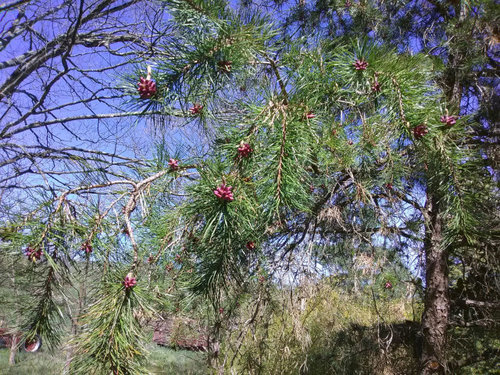
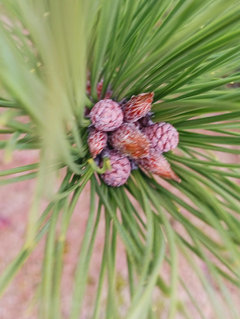
Table Mnt pine male cones

2 years ago

Table Mnt pine male cones look like clusters of reddish grapes.


Comments (15)

  • 2 years ago

    Very nice. I've spent many sunny days in the woods with beautiful pines surrounding me.


    From what I understand, the male cones are lower down on the branches to prevent the tree from pollinating itself? Is that true?

  • 2 years ago

    Beng, did you bite into one? :)

    I’m not familiar with Table Mtn Pine, but it looks like our Jack Pine, which is a short-lived, scruffy looking pine that I’ve grown fond of. Does the TMP turn a gold hue when temps get cold?

    bengz6westmd thanked maackia
  • 2 years ago

    It seems to be a short-lived seasonal color

    cones of table mountain pine - Search Images (bing.com)

    bengz6westmd thanked Ontario_Canada5a_USDA4b
  • 2 years ago
    last modified: 2 years ago

    Bill, I'd say that is correct for some trees. If they produce very fine, tiny pollen grains, they are so light that as they blow downwind, they spread outward and upward very quickly, but away from the parent tree.

    maackia, TM pines typically maintain a dark green color all winter. Mine's close to my Wates Golden Virginia pine, so they make a nice contrast in winter.

  • 2 years ago

    Bill, there's some discussion on your pollen-cone question on this very old post that popped up on the side related discussions.

    https://www.gardenweb.com/discussions/1840874/this-bud-s-for-you

  • 2 years ago

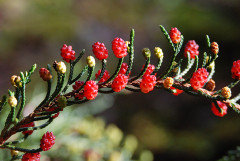
    I found the Microcachrys tetragona pic below, and here is what Copilot has to say about it. Not sure if all of it is accurate, but the pic appears to show the female seed cones that look like mini strawberries :-)

    Microcachrys tetragona, commonly known as the Creeping Pine, is an attractive dwarf conifer native to Tasmania. Here are some details about its growth:

    • Growth Habit: Microcachrys tetragona has a low, creeping growth habit with straggling branches that can be 40-100 cm (15.7-39.4 inches) long.
    • Foliage: Its foliage is remarkably similar to Diselma archeri, with tiny, thick, overlapping, scale-like leaves arranged in four rows along the branches, giving a square cross-section to the stem.
    • Dioecious: Like Diselma archeri, Microcachrys tetragona is dioecious, meaning it has separate male and female plants.
    • Male Cones: The male cones are small and inconspicuous, measuring 2-3 mm in length and borne on the ends of the branches.
    • Female Seed Cones: The ripe female seed cones are only 6-8 mm long but become most conspicuous as the bract scales surrounding the seeds turn fleshy and scarlet in color.
    • Growing Conditions: Microcachrys tetragona thrives in well-drained soil rich in organic matter (such as peat) and requires plenty of water. While it grows in full sun in its native Tasmania, light shade is more suitable at lower altitudes.
    • Propagation: Propagation is possible from cuttings taken in either spring or autumn. These cuttings root well and can be used for propagation.
    • Pest and Disease Tolerance: This species appears to be relatively free from most garden pests and diseases12.In summary, the Creeping Pine is a delightful dwarf conifer that adds charm to rockeries, pots, or trailing over garden edges. Its compact size makes it perfect for small spaces! 🌿🌲


    bengz6westmd thanked Ontario_Canada5a_USDA4b
  • 2 years ago
    last modified: 2 years ago

    4-17-2024:

    Hi beng!

    Just in from the back yard Pinetum. ;-)

    Good article! Thanks!

    I see no pine or spruce pollen cones yet but notice the White pines (P. strobus) pushing their year-old seed cones. They come below the branch buds on their own personal branchlets. Not a great picture but you can see what I mean. These started last season's spring and will mature this Fall.


    Branch buds swelling but it's early and male cones will appear later:


    Now the Red pine (P. resinosa) showing new cones among the branch buds, and these will take 2 years to mature.


    A year old Red pinecone that looked like the above cones last year and will be mature this coming Fall.


    My P. ponderosa var. scopulorum tried to make a cone 2 years ago but in the absence of any male cones as expected, didn't produce seeds. Last year was dry. We may see some new cones yet this year.


    The Larix is loaded with cone buds. I think these will all be male because of the lower branch proximity (females will be surrounded by needles) and there will be hundreds of them this season. ;-)


    bengz6westmd thanked BillMN-z4a
  • 2 years ago

    Thanks, Bill, the red pine "conelets" are endearing.

  • 2 years ago

    On the computer, something out the bay window distracted me. Looked, and a big yellowish "dust" cloud went by the window. I mean big. Something from the nearby road? Construction nearby? Then another wind gust -- it was a pollen-cloud blown from one of my Table Mnt pines!

  • 2 years ago

    beng, Is this the first year that TMP coned?


    Reminds me back in day living in the Jack Pine woods. Clouds of pollen sweeping through the canopy on a windy day.

    The tree at a neighbor's place was the worst. A 30ft tall male Juniperus virginiana. Whoa!


    bengz6westmd thanked BillMN-z4a
  • 2 years ago

    Bill, no, that particular one has been loaded w/cones, male and female. Biggest female cones are baseball-size and bigger (I wish I could fetch one, but they're too high). The other, a bit older one upwind has much fewer cones (it's shaded by my sugar maple).

  • 2 years ago
    last modified: 2 years ago

    I'll bet my 15ft. pole saw could reach those cones. ;o)

    bengz6westmd thanked BillMN-z4a
  • 2 years ago
    last modified: 2 years ago

    I've read the description by Donald Peattie in 'A Natural History of Trees' that it's impossible to pull/twist a TM pine cone off its stem, you can only cut it off somehow or cut off the branch to get it. I don't want it bad enough to cut off a branch :)

  • 2 years ago

    Those are interesting !

    bengz6westmd thanked L Clark (zone 4 WY)