Software
Houzz Logo Print
doris_benowitz

HELP: Would you use Quartz and mix with Porcelain in a kitchen?

2 years ago

My dilemma: love these two stone options and want to use both, I also hate cookie-cutter kitchens. I want to have a kitchen with character and a stunning focal point: the backsplash.


So I've been getting a lot of mixed reviews on mixing countertop material and using a different backsplash and need a outside source to confirm if this combination of quartz and porcelain would work for my kitchen.


The one thing I am certain of: I have to have the blue roma porcelain, just look at that slab!

Still feel like their may be a better option for the quartz to match the bronze/rustic veins in the porcelain.


My cabinet colors: White Oak (Island) Surrounding: BM Natural Cream

Possible quartz choice: https://www.veronaquartz.com/product-page/calacatta-bellezza-gold

Porcelain choice: Porcelain


Please help!! Thanks :)

Comments (27)

  • 2 years ago

    Not a expert in design but I would do the quartz on the countertops and backsplash, I feel like it would just look better put together. If you feel like your really have to use that porcelain than just do that everywhere. I don't think mixing them would do your kitchen any good. Hope this helps!

    Doris Benowitz thanked leahboo827
  • PRO
    2 years ago
    last modified: 2 years ago

    NO NO NO.

    One or the other. One star in the show, please.

    If you must have the blue? It is all the counters- Same material on the splash or keep it simple.

    You want the quartz? Same thing, it is one of the two for tops.

    You're warned : ) lose the "vein matching" concept of the two paired. Re think the Ben Moore color which isn't good with the blue.

    Doris Benowitz thanked JAN MOYER
  • 2 years ago

    I too, hate cookie cutter kitchens but I totally deeply detest mismatched kitchens.


    My vote is NO.


    My question is why? Why theses two materials? You say you love them both. I get it.. I love my slinky evening top that I wore NYE but I also love my Tommy Bahama golf outfit. I would not wear them together. It is okay to love each item separately and not put them together. How about finding one of the stones to put in a powder room or over by a bar not connected to your kitchen.


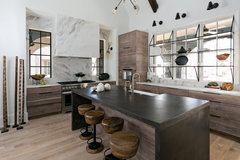
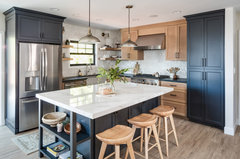
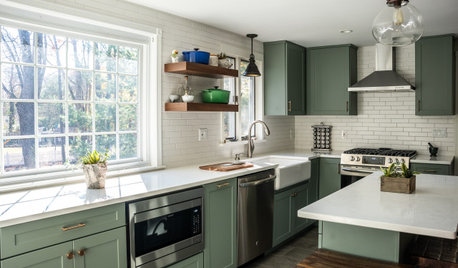
    Here are some great kitchens with mixing materials..


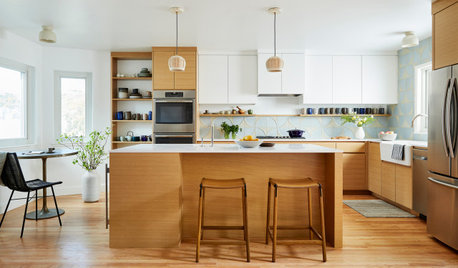
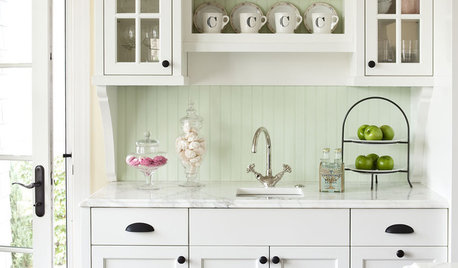
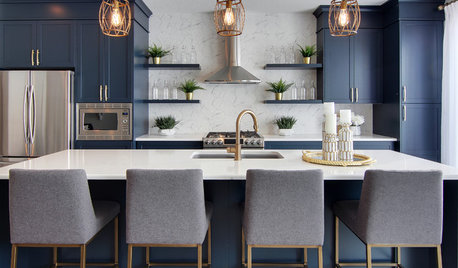
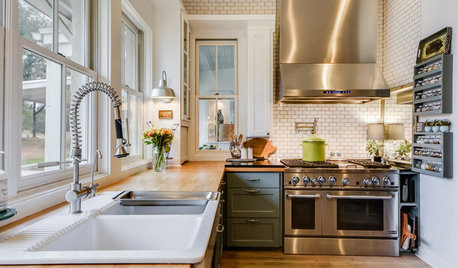
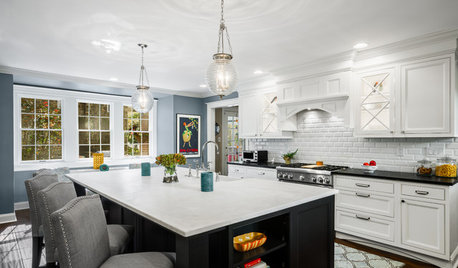
    Organic Life House · More Info


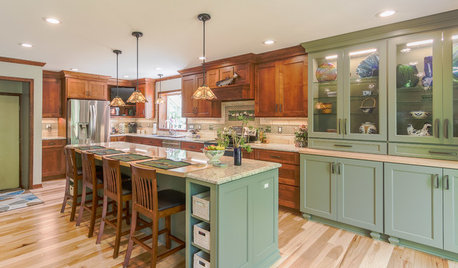
    Kitchen · More Info


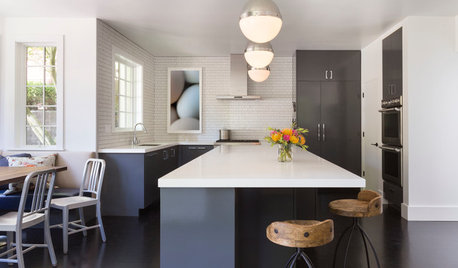
    Adobe Falls Kitchen Remodel · More Info


    Doris Benowitz thanked Boxerpal
  • 2 years ago
    last modified: 2 years ago

    Except for matching slab counter and bsplash all combos are different materials. One is dominant. Using porcelain as a counter material has shown edge chipping as a common downside. I'd rule that out. You can still choose the porcelain as the splash with a less dramatic counter choice. Remember, quartz is 33% plastic by volume. The weight percentage is irrelevant.

  • PRO
    2 years ago

    If you trully do not want cookie cutter why choose a quartz that everyone seems to have and go look at some really awesome real stone for both.Or do that fabulous blue everywhere but I have no clue as to your actual kitchen and neither of those would be great if you have 90 degree angles anywhere . Show us your space then you will get real help. Post the pics here in a comment DO NOT start another post

  • 2 years ago

    I can't think of anything more cookie cutter than marble look quartz. OTOH, I would steer clear of porcelain because of the chipping factor.

  • 2 years ago

    Leah & Jan thank you so much for your insight. Question for the both of you: if this was your kitchen would you do the porcelain everywhere? I feel like I might drop something and chip it ;/

  • 2 years ago

    Also what would you recommend instead of natural cream on the surrounding??

  • 2 years ago

    @Boxerpal When you say it like that I feel that I made the right choice asking people on Houzz. My family would just tell me to do what I loved and get it over with lol.

  • 2 years ago

    @dan1888 thank you In regard to chipping I'm starting to realize I probably can't have that Porcelain everywhere. And plastic? I was told otherwise. This isn't quartz?

  • 2 years ago

    Quartz countertops are a man-made product using ground up particles of quartz in polymer resin, so some people call them plastic, and some of them do look and feel plastic-y though others can look quite nice. There are pros and cons to how well it holds up to kitchen use (don't use it as a backsplash too close to cooktop or range burners for instance.) Quartzite is a very hard natural stone.

  • 2 years ago

    i think the blue roma is quartzite, not porcalein .. just own it and use it everypllace! its beau

  • 2 years ago
    last modified: 2 years ago

    The quartz industry has sold the public a bill of goods.

    Quartz counters are a manufactured product, containing 33 1/3% plastic resins by volume. The resins, being plastic, are senstive to heat. Search for threads on this site for scorched quartz counters, and backsplashes. There‘ve been tons of them over the past several years.

    Adding: There isn’t a quartz counter out there trying to imitate marble, that looks real. They all look absolutely fake…lacking the depth, and chrystallized beauty of earth’s creation.

  • 2 years ago
    last modified: 2 years ago

    @Jane, Blue Roma IS porcelain. See here: Blue Roma

    Editing to add: I stand corrected. In addition to porcelain Blu Roma, further googling shows there is a quartzite with the same name, and also a marble called Blue Roma. All are gorgeous, and all have different properties.

  • 2 years ago
    last modified: 2 years ago

    Just for the record, engineered quartz is not one third plastic. The standard ratio is 7% resin. (Other solid surface counters, such as Corian, are about 1/3rd resin.)

    Of course, you can't put hot material on it directly or use it as a backsplash behind a standard stove. And we found it chips easier than you'd expect.

    We're planning on mixing leathered quartzite and stainless steel counters.

    In the past, we've installed granite, high-end laminate and quartz.

    Frankly not a fan of the proposed mixing.

    Doris Benowitz thanked worthy
  • 2 years ago

    For the record, engineered quartz is 7% plastic resins by weight, which is meaningless. It is 33 1/3% by volume, which is quite significant.

  • 2 years ago
    last modified: 2 years ago

    When the sales pros feed out misinformation, the product has to be examined closely, ime. Quartzite is the hardest stone material used for counters. Fabricators use up more of their diamond cutting tools working it. A far more durable and naturally beautiful product than quartz. When you talk to a quartz salesperson, ask for the volume amounts and see their reaction.

  • PRO
    2 years ago

    "A far more durable and naturally beautiful product than quartz."


    However, there aren't 26 engineered stone horror story threads here on Houzz as there are for naturally beautiful quartzite.

    Doris Benowitz thanked Joseph Corlett, LLC
  • PRO
    2 years ago

    "Just for the record, engineered quartz is not one third plastic. The standard ratio is 7% resin. (Other solid surface counters, such as Corian, are about 1/3rd resin.)"


    Worthy:


    Your record is wrong. Engineered stone is 33% resin and 66% quartz by volume, the only meaningful measurement. The 7% weight nonsense is industry pap.


    This is not up for debate.

  • 2 years ago

    Hello All, just wanted to chip in here and say that the color/design of your quartz can vary the amount of quartz mineral content vs resin and other materials. For example: Calacatta colors have less quartz mineral in them because of the color pigments and filled veins. While materials like pure colors (white, grey, black) have more quartz content.

  • PRO
    2 years ago

    No to mixing. Both are too contrasting of each other. As everyone suggested, please choose one or the other for your kitchen. You can place the other elsewhere.

  • 2 years ago

    Hey all, thank you so much for all of the pointers in regard to what I should use and whether or not to mix these two stone options. However, all of this talk about the composition of the material has me worries and lost now, more than ever. Is there clear proof that quartz isn't just 7-10% resin as the manufacturer claims?

  • 2 years ago
    last modified: 2 years ago

    I think the guys going off into arguing about how to calculate the percentage of resin in quartz countertops derailed your question and decision. All quartz countertops are made of resin mixed with ground quartz; does it really matter that much exactly what percentage various products have or how to calculate weight/percentage? People either love their quartz countertops or dislike the look; the pros and cons are well known (pros low maintenance, easy to clean, not staining, cons are cautions about heat damage from hot pots or right up against high BTU gas burners.) It seems to me that your dilemma is that you fell in love with something really striking and flashy but everyone recommends against mixing your two choices (I agree they don't go together.) So now...can you find a quartz dramatic enough to make you happy on both countertop and backsplash? Can you find a quartz plain enough to blend and let the Blue Roma porcelain backsplash be the star? Can you find Blue Roma quartzite anywhere (the porcelain is made to mimic Blue Roma quartzite or marble)?

  • 2 years ago

    The percentage of plastic resins by volume, does matter. It’s the high volume percentage, which makes the manufactured quartz product so suseptible to heat damage. Do a search. There were even posts about quartz counters being scorched by a lid placed on the counter, that had come off of a hot pot on the stove.

    This has nothing to do with whether a person likes quartz, or not. Facts, are facts.

    And, yes, Doris. There is clear proof that quartz is 1/3 (33%) resin, and not the 7% that manufacturers claim. From the web: “Percent by weight or volume? Big difference!

    When researching quartz counter tops, I discovered that this man made material is made from ground up quartz with a polyester resin binder material. Wanting to know how much stone and how much resin, I read further to find out that the material is approximately 93% stone and 7% resin. I was having a hard time visualizing how such a small amount of binder could work.

    Reading further I discovered that the 93% and 7% is based on the weight of the components, but since the stone is much heavier per volume than the polyester resin binder, the percentages by volume should be different, and indeed they are.

    By volume, it turns out that the same material calculates to 66% quartz and 34% resin binder. Big difference.”

    Now I’m not a pro, however I’ve done much research, and also listened to Joseph Corlett, the countertop pro here, and who installs tons of quartz counters. He posted above, in this thread. You can believe what he says, or you can choose to believe what the quartz industry wants you to believe, by providing statistics by weight, instead of the more relevent statistics, by volume.

  • 2 years ago

    That being said, Blue Roma porcelain is stunning, and definitely not ”cookie cutter.” On the other hand, any quartz trying to mimic marble is most definitely ubiquitous, cookie cutter, and looks absolutely fake.

    As debrak6 suggested, try to find Blue Roma in natural stone, quartzite. That would certainly be a show stopper in any kitchen. It’s that gorgeous. Just test any slab of quartzite for porosity.

    Or, find a manmade quartz that isn’t trying to mimic marble. Cambria has many offerings of that kind, that are quite pretty. Just be aware, should you intend to have quartz as the backsplash, the wall behind a range, cooktop or rangetop should have fireproof steel studs, and cementboard behind it. By doing that, the resins in the quartz shouldn’t melt/scorch.

  • 2 years ago

    I do see what darbuka means, and that I phrased that part of my thoughts poorly (it's actually more like me to do a deep dive into research and composition of quartz!) Mostly I meant that I see the OP's first dilemma being whether there is *any* quartz that compares to her vision and love for the Blue Roma porcelain she found. And darbuka is right about the need for fireproofing behind a cooktop or range with quartz. If the OP can find a gorgeous natural stone that fits the vision and wish, use it for both surfaces. Or if she decides to go for the gorgeous Blue Roma porcelain backsplash and find a very plain (not fake marble looking) man-made countertop to go with it, then yes I'd dig into which manufacturer and the actual composition!