Software
Houzz Logo Print
nycgal

stove hood placement

last year

Regarding a stove hood, is there supposed to be some space, like 3" or something like that, between the wall cabinets and the stove hood, on both sides of the hood? I think the area is easier to keep clean having the space, especially if the cabinets are white, although it is also more aesthetically pleasing to me as well (something about symmetry?).


The stove hood would be this, venting to outside: XO XOJ30SC Wall Mount Chimney Range Hood with 4-Speed 395/600 CFM Blower, Code Compliance Control, LED Lights, Dishwasher-Safe Mesh Filter, and UL Listed: 30 Inch Width (ajmadison.com)


Thanks.

Comments (12)

  • PRO
    last year

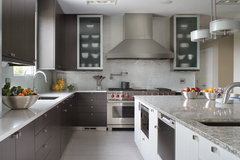
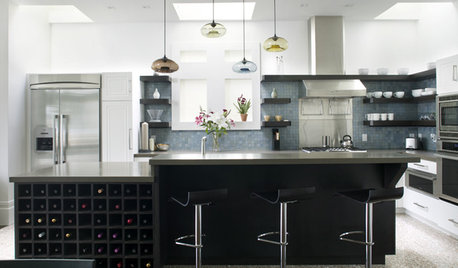
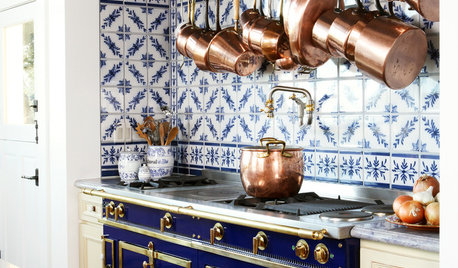
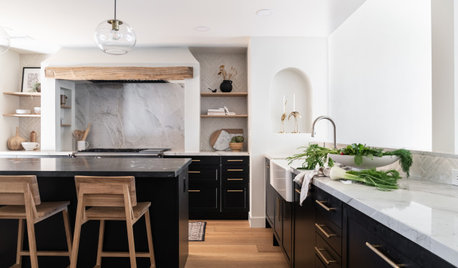
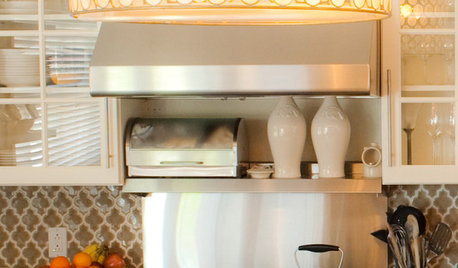
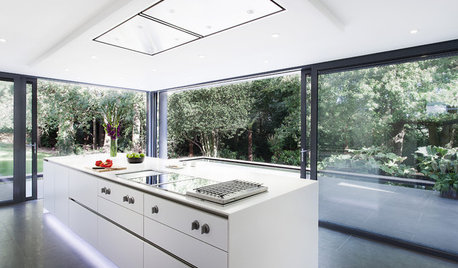
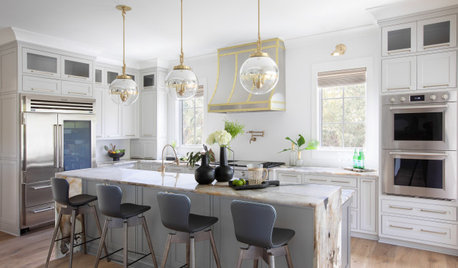
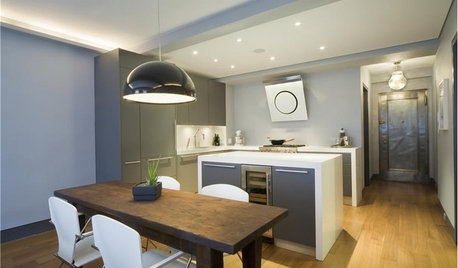
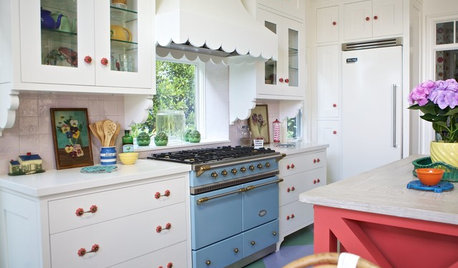
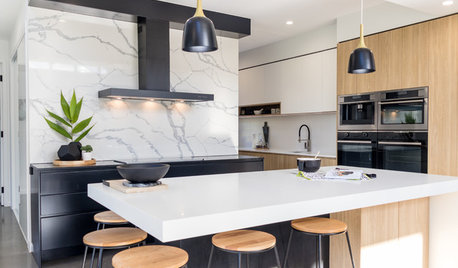
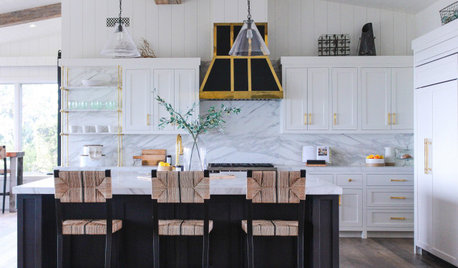
    I just looked at the installation instructions per your link and it only shows the clearance between the range top and the mounting height of the hood. I didn't see side clearances listed. But here are a few photos of wall mounted chimney hoods. Some are pretty tightly mounted between the hood and the upper cabinets:


    Teri Turan · More Info


    Contemporary Kitchen · More Info


    Marinwood Kitchen · More Info


    nycgal thanked Sabrina Alfin Interiors
  • last year
    last modified: last year

    It depends on:

    • The size of the hood in relation to the cooktop/range
    • The shape of the bottom of the hood
    • Whether you're installing it per the specs


    Size: Since FOGSS (fumes, odors, grease, smoke, steam) spread out as they rise, the general recommendation is that the hood be at least 6" wider than the cooking surface and 24"D. This allows approx 3" on each side to capture the rising and spreading FOGSS. If it's too shallow front-to-back, then the front burners will not be covered or not covered enough to capture the rising & spreading FOGSS (19" or 21" is too shallow). So, if you have a 30" wide cooktop or range, that would mean a 36"W x 24"D hood.

    Shape of hood bottom: Ideally, your hood underside will have a concave or cup shape so when the FOGSS are captured there's a space for them to be "held" until they are expelled to the outside. Flat undersides are not very useful and the FOGSS will just spread to the edges and then up your cabs and walls and then spread to the rest of the home.

    Installation: The hood should be install no higher off the cooking surface than the specs state. In the case of the linked hood, it says 27" to 32" (for flat top, the top of the cooktop/range; for gas or coil electric, that's off the top of the grates or coils).


    If you are following the recommendations and specs, then a few inches b/w the cabs and the hood provide room for fitting your hand or fingers in the space for cleaning both the wall and the hood.

    However, if you are not following any one of the above, then I recommend butting the hood up against the cabinets to help with FOGSS capture and holding. Yes, that will mean holding FOGSS against your cabinet walls, but if you want the hood to be effective, that's the best way to do it.

    nycgal thanked Buehl
  • last year

    Wow, @Buehl! That’s very interesting. Searching range hoods on houzz, almost none of the posted pics include concave or cup shaped undersides. Who knew??

    nycgal thanked flopsycat1
  • last year

    I've noticed in my hood that the steam from a large pot of boiling water temporarily "sits" in the concave area below the exhaust fan until it's exhausted to the outside. It's not there long, but if I had a flat surface, that steam would likely have gone up the sides instead of "waiting" to be exhausted.


    @flopsycat1...On Kitchens on Houzz many have talked about flat vs concave. I'm surprised you haven't seen any of them. You probably don't see it in Design Dilemma or any of the Houzz-original forums. You're more likely to see them in the forums that originated from GardenWeb when Houzz bought out GW.

    nycgal thanked Buehl
  • last year

    You’re correct, Buehl! May need to broaden my online horizons.

    nycgal thanked flopsycat1
  • PRO
    last year

    I use Vent-a-hood often they have great capture are realively easy to clean I take mine all apart once a year . I often install hoods right up the the cabinets on either side no issues but I agree a good hood has a capture area inside I do however choose the CFM by figuing out how direct the venting is I have 1200CFM for my hood it works really well above my 36" 6 burner all gas range vented right up striaght through my 8' ceiling to the roof . Every bend means more CFM . I guess my first question would be what kind of range does the OP have .

    nycgal thanked Patricia Colwell Consulting
  • last year

    There is a need in residential hoods that have insufficient blower flow rate to be able to exceed the input plume flow rate to have "fencing" around the base to block plume drift out of the hood. These edges inherently provide some reservoir volume. In this case the reservoir is only incidentally providing some plume averaging across the baffles.

    However, better if practicable, is to have higher flow rate for these conditions. Impracticable conditions include one's budget, MUA code requirements with which one cannot easily comply, and having a small existing exhaust duct diameter that one is not allowed to modify.

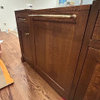
    One can see in my hood's image above that the fencing is small, about an inch, but there isn't drift out of my hood so long as I set the blower power sufficiently high.

    Note: drift should not be confused with plume bias due to cross drafts, or plume broadening due to turbulence from moving persons, or mistakes in how MUA is inserted into the kitchen.

    nycgal thanked kaseki
  • last year

    It also depends on if it is recirculating or not. If recirculating, then the gap between hood and cabinet can be a place that blows air down, so closing the gap works better. Based on my real life experience. Size of hood vs size of cooktop also matters.

    nycgal thanked ker9
  • last year

    Patricia wrote: "Every bend means more CFM." Please allow me to refine that statement to be: "Every bend means more rated CFM is required due to needing a stronger blower for the same actual CFM." The significance of pressure loss from bends depends somewhat on what portion (often large) of the overall pressure loss is due to baffles and also how much is due to restricted MUA.

    When considering MUA insertion into the kitchen, even that from recirculation, avoiding turbulence at the cooktop is important. Usually MUA introduced above the hood is directed across the room to return somewhat less turbulent. Flow down the sides of the cabinets may be fine; I haven't read here of anyone complaining. We have learned of cases where toe-kick supplied MUA reflected from the opposing cabinets and reached the cooktop in a quite turbulent manner, causing plume disruption that mixed the plume into the room air.

  • last year

    Patricia, it is a 30" gas range and a 30" hood. Now, I see the size of the hood is not ideal - it should be wider than 30" - but we have to stay with the 30" hood at this point. This wont be a kitchen that will be used daily, it is a country house for weekends or very short stays, so I guess maximum efficiency is not a concern (?). I thought a 3" gap between the sides of the hood and the cabinets would make it easier to keep everything clean in that area especially since the cabinets will be white. The hood will vent to the outside.

  • last year

    30” + 3” on each side means you have room for a 36” hood, which that company also makes.


    36” would be better because the hood has zero capture volume, the lower surface is flat and the intake is a good deal smaller than the 30” hood dimension - in a sense, you have a hood that is actually smaller than your rangetop.


    If the 36” hood contacts or is very close to the upper cabinets, then the cabinets would create a sort-of capture volume.

    nycgal thanked John Liu
Sponsored
Kuhns Contracting, Inc.
Average rating: 5 out of 5 stars26 Reviews
Central Ohio's Trusted Home Remodeler Specializing in Kitchens & Baths