

Another stump removal post: questions
This is probably the 10,000th post on the topic, but I can't find answers in the ones I read.
I started by getting out my old plastic can of Stump Out granules. They appear to be in good condition, but moisture and humidity have made the label unreadable. And the instructions are on the label. I searched the web but couldn't find them. After all, why should anyone put them on the web when they're right on the label...?
I found some YouTube videos that told me what to do, but I also found references to something that's apparently in the instructions, that I never saw it before: that I'm supposed to "season" the stump for 18 months before I try to remove it. How is that supposed to work? This was an acacia tree. If I leave the stump for 18 months, I won't have a seasoned stump; I'll have a new tree.
But onward. I found a 1" augur bit which I don't remember buying, but I must have gotten it just for this purpose, because it did a great job of drilling into the tree. The augur just pulled the bit in... until the drill stalled, and I found that the bit was too firmly jammed to move when I reversed the drill. I had to take the the drill off and use a pipe wrench to remove the bit. Is there something I don't know here... a way to use an augur bit without having that happen?
Finally, a question that has plagued me since the first time I drilled a stump. I'm supposed to drill 1" vertical holes 10" deep, but trees rarely grow straight down even if they grow straight up (which this one didn't). When I drill a hole that deep, I usually drill right through the base of the tree into soil. Then any water I pour into the hole just drains away. How can I tell where, and in what roughly vertical direction, it's safe to drill?
Comments (31)
 last year
Here are the instructions for the Stump Out - https://files.plytix.com/api/v1.1/file/public_files/pim/private/assets/43/37/8d/5e/5e8d3743202d9eba64d3af60/texts/43/95/42/60/6042954305e975d441fdfef1/l272.pdf
Sorry, can't help with the other questions.
 last year
I've always just covered the stump with heavy black plastic. Takes a few years, but if the sprouts can't photosynthesize, it all eventually dies.
Related Professionals
Asheville Landscape Architects & Landscape Designers · Harrisonburg Landscape Architects & Landscape Designers · Petersburg Landscape Architects & Landscape Designers · La Crosse Landscape Architects & Landscape Designers · Rapid City Landscape Architects & Landscape Designers · Madison Landscape Contractors · Cincinnati Landscape Contractors · Orangeburg Landscape Contractors · Canton Landscape Contractors · Anchorage Landscape Contractors · Little Rock Home Additions · Columbia Home Additions · Corpus Christi Home Additions · Grand Rapids Home Additions · Beatrice Home Additions last year
For drilling into the stump, get a 1" x 16" spade bit.
It doesn't pull the bit into the wood for better control as you drill (never mind the picture) and you can sharpen it with a file or bench grinder.
https://www.strobelssupply.com/1-x16-spade-bit/
Best/fastest way is, if you or your neighbor has a backhoe. 15-minute job with stump out and soil smoothed over again.
I've also pulled them out with a chain and 60 hp farm tractor.After I've dug around them some and cut through some of the anchor roots with an ax.
If you don't mind the time involved, I've drilled multiple holes with a spade bit, poured some high N fertilizer or salt petre, then just let the rain and sun do their thing. Takes 2-3 years depending on the condition of the stump at treating time.central_valley
Original Authorlast year@gardengal48, thanks for the link.
@BillMN-z4a, no neighbor here with a backhoe or a 60 hp tractor. No way to get either one to the location, either, unless they can travel up a four foot wide path between a retaining wall and a fence. I think I'm limited to human muscle and chemicals, and I'm inclined to rely on the latter. I guess I'll get a spade bit and keep doing what I've always done.
Although it occurs to me now (too late) that positioning the holes would be easier if I left a foot or so of stump above ground.- last year
I had 9 mature arborvitae trees that needed to be removed after they outgrew the locations in which they were planted. I was able to cut them down, bit by bit. That left 9 stumps (6 along sidewalk, 3 at corner of house) that I thought I could take care of with stump granules and/or charcoal briquet treatment per YouTube advice. The solution was hiring a company to grind the stumps. They were tidy, thorough, careful around irrigation system and other plants, and …expensive. Worth every penny, though. My back thanks them.
- last yearlast modified: last year
Yeah. Nine stumps, close to an occupied building with sidewalk would be a different story.
You'd have to be careful about buried cables, pipes and burning the place down. You didn't mention the cost, but I would go to that idea with so many stumps where you would want it to go quick and clean. On a back yard outbuilding, out of the way, different story.
One thing about stump grinders, they tend grind very shallow, ~4" so you need to consider what that ground is intended for. Just to level it out and grow grass, you're fine, other plans where you need to dig deeper, not acceptable. Most will dig deeper and add that to the cost, something about machine wear and tear and labor.
eta: there will be issues with leaving a large body of wood in the ground. There will be mushroom displays annually for years and raw wood can rob the soil of nitrogen until it fully rots, moisture issues in that spot too and sinkage as the wood disappears.
- last yearlast modified: last year
I had some 22-0-0 with iron I had left over here from the lawn.
Pile it on.
eta: if you start to get a lot of rain after you apply the Fert, cover things up with a pail or wash tub. You want it wet/moist but not washed away.
- last yearlast modified: last year
And just to add:
Check the stumps with the holes drilled and add fertilizer regularly.
I checked one of mine lately that still appeared to have holes full of fertilizer but when I poked into the holes with a stick, there was only a thin crust on the top part of the holes, and they were hollow underneath (but still wet).
I then added more fertilizer, (30-0-4) this time bc that's what I have.
And TBH, this time I wetted the fertilizer inside the holes by pouring clear ammonia on top, to finish filling the holes completely and covered with a plastic pail.
I'll keep checking and we'll see what the stump looks like in a couple of months.
;-)
- last year
Just an update:
I looked at my stump that's been covered with a pail all summer.
I removed the pail and wet things down a couple of times and added fertilizer.
It's the first 'Green' stump I've tried to rot out so maybe why it's so slow, but it does take a while even for a dried-out stump to fully rot.
It shows good decline, but I'm sure it will take another season before it gets really rotten from the way it looks now. Started this one 3-28-2025:
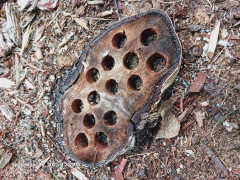
central_valley
Original Authorlast yearAfter seven months, the Acacia stump is still sending up loads of new shoots. Every couple of weeks I break them off.
I've covered the stump to keep it dry when the rains start, probably in about another month. Once the ground is thoroughly wet I'm going to douse the stump with whatever flammable liquid is on hand (probably tiki torch fuel) and see if I can burn it out.
Understand, that is illegal in the county where I live, but I figure the fire will be small so no one will see the flames, and if I start around dusk no one is likely to notice the smoke. It's about eight feet away from the house with nothing growing above it, and I can keep an eye on it with a garden hose on standby.
If the first one works well I'm going to torch a couple of others. One is nearer the house but smaller, also sending up shoots. The other is much larger but farther from the house, completely dead and years old but showing no signs of rotting.- last year
Oh, I had no idea that your stump was still alive.
Killing a stump and getting one to rot are two separate steps.
When a stump, after cutting the tree, can produce basal sprouts from the stump, it never dies and you can't expect a stump that's alive to rot, it's just impossible.The fertilizer probably helped it with nutrients for the roots.
When you have a freshly cut stump that's capable of root sprouts, you first have to paint the cambium ring with either undiluted glyphosate (~31% and up) or other product that's labeled a 'Stump Killer' and this has to be done very soon after the tree is cut, or the results may be in question.
Once the stump is dead, then drilling many, deep hole into the surface of the stump and adding fertilizer will speed up the rotting process and yes it may take a season or three before it's completely rotted, depending on the size. - last year
I am fortunate. The soil in my lot is very active. About 4 years ago, a storm brought a maple tree down. I cut it up and left it in our wooded area. Recently, I checked the and the logs about 9" in diameter were completely rotted away.
In another incidence I cut down a cypress. I cut the stump as low to the ground as was permitted with out damage to the chain saw. I first used the chainsaw to cut several deep cuts in the stump and then drilled several 1/2" holes in the stump. That was about three years ago. During that time I would occasionally grab the axe and take a couple of wack at it, more it I was getting anywhere. Two weeks ago I cut the rotten stump down until it was such I could easily and safely mow over it.
The easiest way to handle a stump is patience.. central_valley
Original Authorlast year@BillMN-z4a I hate those chemicals... but I use 'em when I absolutely have to. I did paint the stump with a concentrated solution of Round-Up, a/k/a glyphosate, and it's growing back anyway. If I can't kill it by burning it... maybe I can slow it down a little?
If nothing else works, I guess I can dig the thing out. I've dug out tree stumps before, although I was thirty years younger then.
As for the dead one, I think it was an acacia. "Highly resistant to rotting due to its natural oils and dense grain structure," my LLM says. And yes, I applied stump remover to that one when I cut the tree down, maybe 12 years ago. I can point to multiple holes to prove it.- last year
C_V
Thanks for that information.
I've used 43% glyphosate on all kinds of trees, native and non-native that grow in our upper Midwest, even several Siberian Elm (Ulmus pumila) that also sprout from the roots, with no problems whatsoever. Killed them deader than a door nail as the saying goes.
Sorry to hear it didn't work on your Acacia. I guess I won't suggest using RU for that type of tree anymore. ;-) They must be one tough customer imo.
Using mechanical equipment for removal would most likely then be something to consider.I've hired a Backhoe service to dig out some stumps on my old property.
The cost back then was ~$75/hr. and I'm sure costs have risen since, but it didn't take all that long per stump so really wasn't all that bad cost wise.
You'll probably need soil to back fill after a larger sized stump is removed.And remember to have your wires and pipes located before digging.
Otherwise stump grinding also would be an option.
- last year
If you have a hammer drill, trowel and reciprocating saw, removing the stump isn't that hard. You don't have to do it all at once but can work on it piecemeal. I‘m not young or a man but have removed several stumps that way.
- last yearlast modified: last year
'I did paint the stump with a concentrated solution of Round-Up, a/k/a glyphosate,'
One last thing, when you say solution, do you mean a RU and water mix?
Just for clarity, I'm saying 100% pure, unadulterated Glyphosate concentrate.
Straight from the bottle with no additional water added.
And not the already diluted stuff you can buy that's pre-mixed and ready to spray for grass and weeds.
central_valley
Original Authorlast yearBillMn: A mechanical aid is not in the cards, unless it's something that will fit through a doorway (garage to back yard). There are several other modes of access, but they're worse, like up three steps and around a tight corner.
A concentrated solution means 1:3. I've had bad luck applying undiluted Round-Up in the past; it didn't penetrate.
mojavemaria: I have a hammer drill, but I'm not clear on how I'd use it it. I think a hammer drill would be 'way underpowered for digging out a stump in compacted soil, and would likely to burn out if I kept at it. A rotohammer, now, would be up to the task, and used ones are cheap and not to hard to find. In my experience they're slower than the ol' pick and shovel, but easier on the body. Maybe I should go that route if fire doesn't help.- last year
'A concentrated solution means 1:3. I've had bad luck applying undiluted Round-Up in the past; it didn't penetrate.'
c_v,RU doesn't have to penetrate a live stump.
A freshly cut tree stump will suck glyphosate into itself because it's still moving fluids through the cambium layers and that happens only for a short period of time after it's cut.
That's why it's important to apply it soon after the tree is cut or that function will cease.And it has to be full strength ~43% glyphosate if you want positive results.
I don't like messing with chemicals either but if you want a dead stump, it's the only way I know of, and I've done many (stump killers are designed to do the same thing but I've only used glyphosate personally).
And be sure to use protective equipment like rubber gloves, face shield etc. You don't want to get it on your skin or eyes. Wash thoroughly afterwards. central_valley
Original Authorlast yearlast modified: last yearI don't mean "penetrate" as opposed to "sit on the surface." I mean "penetrate" as opposed to "run off as if the tree were made of wax paper, leaving the surface essentially dry."
My experience has been variable. Today I cut some wisteria vines and put straight Round-Up on them. The wood was soft, and the cuts were messy; the stumps soaked it up like a sponge. But I've dealt with trees that did not act that way at all.
Stirring up my rusty memory, though, I realized that when I had this problem I diluted the chemical with horticultural oil, not water.
- last year
If you're putting enough liquid concentrate on so it 'runs off' that's too much RU.
And can end up killing desired plants nearby (don't ask me how I know).
I use a 1" wide paint brush or a dauber to 'paint' a thin layer of concentrate, only on the outer phloem area (living bark area on the stumps top perimeter).
As far as I know, all trees have a phloem system that moves water and nutrients from the roots to the crown and vice versa. Making this method standard procedure for all trees. - last yearlast modified: last year
10-1-2025:
Checked my stump today and noticed I had left it a little high on one side so got the chain and carefully, slowly took off another 1/2" down to 0" by the time I got to the center (in case I forget about it and hit it with the lawnmower).
The wood appeared fairly solid and the bark appeared quite porous like it is on its way out
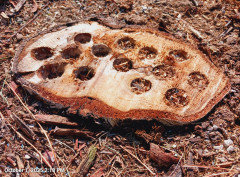
Took my drill driver to add another hole to the front center of the stump because I think I missed putting one there or my battery gave out before I could do that last time.As long as I had the drill going, decided to clean out existing holes and found they were really clogged, about halfway to the top with an unknown substance. Like a brown, fibrous matter, maybe wood fibers? It's visible, mixed in with the saw dust around the stump.
One of the holes was really rotted at the bottom and my drill went down easy and felt like it broke through out the bottom of the stump. So possibly there's more rotting going on under the ground, than there is on top?
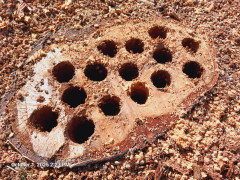
With the holes all cleaned out, I filled them with 30-0-4.I could've piled more fertilizer on top but I'm less than 3 ft. from a small red pine and didn't want high N to spread out so it might affect that little tree. But it doesn't hurt to have a little around the perimeter to help it rot from the outside in.
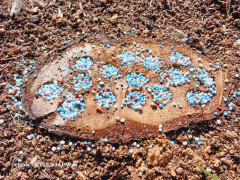
Wet all the holes with water using a watering bottle for better control so not to wash the fertilizer off (I didn't use ammonia this time because I read you can overwhelm the fungi and bacteria that rot wood, if nitrogen levels get too high). idk; I still have to test that one, but this fertilizer is plenty 'hot' so don't think I need it. ;-)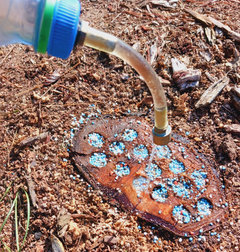
When the air stopped bubbling out from the holes of fertilizer, I stopped with the water but wetted the surrounding ground some just to activate the little bit of fertilizer spilt around the perimeter of the stump.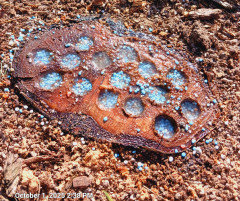
If the landscape looks like the Mojave Desert, it's real close with no rain here for 2 months.Another possibility, if we had regular rains, moisture in the soil may have speeded up the process and showed greater progress than what we see today.
If it starts raining this Fall, I'll remove the pail and let the soil take in the rain. to a point.
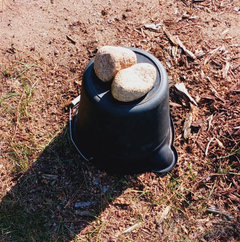
 last yearlast modified: last year
BillMN's method of painting concentrated glyphosate around the cambium of FRESHLY CUT tree stumps is excellent for killing the unwanted tree. I had great success using this method on around 2000 Ailanthus trees I inherited here, over a period of 3 years. But I can't see it as a useful method of rotting an already dead stump. The only successes I've had to remove stumps is by burning them out by piling firewood on top and letting it burn for a few days, or ideally, getting a stump grinder onto it.
- last yearlast modified: last year
Yes, shaxhome, glyphosate will not rot a stump no matter what as mentioned earlier.
Using an old steel tractor wheel rim, tossed around the stump and filling it with wood or charcoal is the best and fastest way to get rid of a large stump, like you say it might take a few days.
But I suppose there are people that are restricted from burning if living in town.
So, in a residential area and if you have only one or two stumps and they are not in your way for anything, you can rot them out over a couple/few seasons.
And yes, stump grinders are fast but most only go down several inches, so you're still left with a stump but if you're planting only grass, it's no matter.
Out in the country, I'd just dig around the stumps with a shovel and chop a few of the lateral roots with an axe and yank the stump out using a larger farm tractor. Cleared a few acres for plowing the soil that way.
These days, I'm not as apt to doing things that way, must be getting old. ;-)
eta: I am getting old. Corrected the above where I said glyphosate will not kill the stump to will not rot the stump. It will kill any live stump applied to the cambium layers of the stump if the stump has been freshly cut. Sorry for any confusion.
- 3 months ago
8-5-26:
After more research, it appears that too much nitrogen can deter bacteria from rotting a stump. So last Fall, I throttled back the N to hopefully speed up the decaying process.
The problem this season has been hot dry weather and I noticed my birch stump would dry out and stay dry, except when I watered trees, I would try to remember to wet the stump too. But it still dried super-fast with 90's temperatures, sunny and no rain.
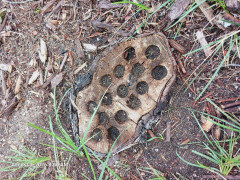
Next idea was to fill the holes with soil, to help it stay wet longer. So the last few weeks, its had soil inside the holes. Results? So far the bark has essentially separated from the wood and the wood has declined somewhat. It has cracks in it is getting softer. I could push the tip of my little pair of scissors into the wood far enough it would stand upright in the wood by itself and some of the holes have broken through, out the bottom, so there must be more happening down deep than what's visible from the top.
So, one year in process and it's not done yet.I have neglected putting N on it lately, probably do that tomorrow.
I think if I wanted to, I could take it out pretty easy now with an axe, the wood is that compromised but that's too much work. I'll see what it looks like next season. ;-)
- 3 months agolast modified: 3 months ago
It takes time for a stump to rot, and that time is not a couple of months. I had a tree fall, and 12 years later, it is only now that I can no long find the stump. If wood rotted in a couple of month we would not have houses that are 300 years old. Archeologist would not be able to compare the tree ring and determine that a building was built in 1066. Yes some trees rot quicker that others, but none rot to nothing with in a year..
Now that your stump has set for a year, You should take ab axe and give it a couple of whacks. Work on the edges and remove what will come off easily. Wait a several month and do it again. Using an axe is good exercise.
One other thing, for an organism that cause the rot to grow they need the right conditions that are stable for a long period. Your efforts to speed the rot may have retarded the rot, as each time you changed the condition the organisms had to adjust or possibly may have been killed
- 3 months ago
I agree but microbes do need a certain amount of N to thrive and moisture to go with it.
The one in my picture was merely an experiment because I had this opportunity easily at hand.
My stump is in an out of the way location and cut so low, it won't present a hazard and I can mow right over the top without issue so nbd.
And my axe swinging days are over. 😉 - 3 months ago
Our axe swinging days are not over, the question is how many swings and how hard they are. ;-)
- last monthlast modified: last month
Well, just to finish this one off;
Things I've learned:
1) Too much nitrogen can inhibit microbes from working at their peak but they do need a certain amount of it to accelerate the decaying process.
2) Keep the stump moist. Cover the stump with something to preserve moisture.
3) Be sure the stump is dead (dead only has one meaning), before starting the rotting process.
If it's a type of stump that will resprout from the base, make sure it's treated with a stump killer immediately after the cut, and then don't try to rot it until at least the following year. Green wood doesn't rot so wait until the wood has a chance to dry out some.
This one that I started back in March 30 2025, was a freshly cut stump, the Fall before and most kinds of wood won't begin to rot for at least a year, some 3-4 years after they die (some exotic woods much longer and I know redwoods will last forever).
So I shouldn't have expected much happening to mine (paper birch) all last year (2025) which it didn't.
But, with regular rains and an occasional application of nitrogen Fertilizer (I filled the holes with my sandy soil to retain moisture), this one is beginning to show signs of degradation, with a softening of the surface wood, surface cracks from shrinkage and a general discoloring.
It's progress for sure but I can definitely see now, that it will be at least the end of next season, or possibly sometime during the season after that, before it will be completely rotten, without using mechanical help (I see now there is a white fungus working on this stump as I post here)
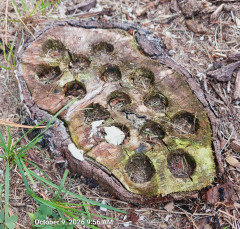
It's cut so low to the ground that I can effectively run over it with the lawn mower so it isn't in the way and I can leave it until nature reclaims this tree back into the earth. ;-)












BillMN-z4a